Imagine finding the perfect apartment in Seoul.
The subway station is only a few minutes away.
The neighborhood feels lively.
The photos look exactly like the kind of place you hoped to find.
Then the real estate agent mentions the deposit.
Instead of one or two months’ rent, the amount could equal tens of thousands of dollars.
For many people moving to Korea, that is the moment they realize renting a home here follows very different rules.
So, can foreigners rent an apartment in Korea?
Absolutely.
Foreign residents can legally rent apartments, officetels, studios, villas, and many other types of housing throughout the country.
The challenge isn’t whether you’re allowed to rent.
It’s learning how Korea’s housing market works before you sign your first contract.
Once you understand the system, the process becomes far less intimidating than it first appears.
Foreigners Use the Same Housing Market as Everyone Else
One of the biggest misconceptions is that Korea has a special rental market designed specifically for foreigners.
In reality, most international residents search for homes in exactly the same neighborhoods as Korean tenants.
You might rent an apartment inside a large residential complex, choose a compact officetel beside a subway station, or find a one-room studio close to your university or workplace.
The right choice depends far more on your lifestyle than on your nationality.
A graduate student may value being within walking distance of campus.
A family with children might prioritize parks and nearby schools.
Someone relocating for work could prefer living above a busy commercial district where cafés, supermarkets, and public transportation are all just downstairs.
This is one reason Korean cities feel so convenient to live in.
Housing is rarely separated from everyday life.
Instead, residential buildings are designed to sit alongside the places people visit every day.
As we explored in Why Korean Neighborhoods Are Designed for Everyday Convenience, many daily errands can be completed within just a few minutes of home.
For newcomers, that convenience often becomes one of the biggest surprises after moving to Korea.
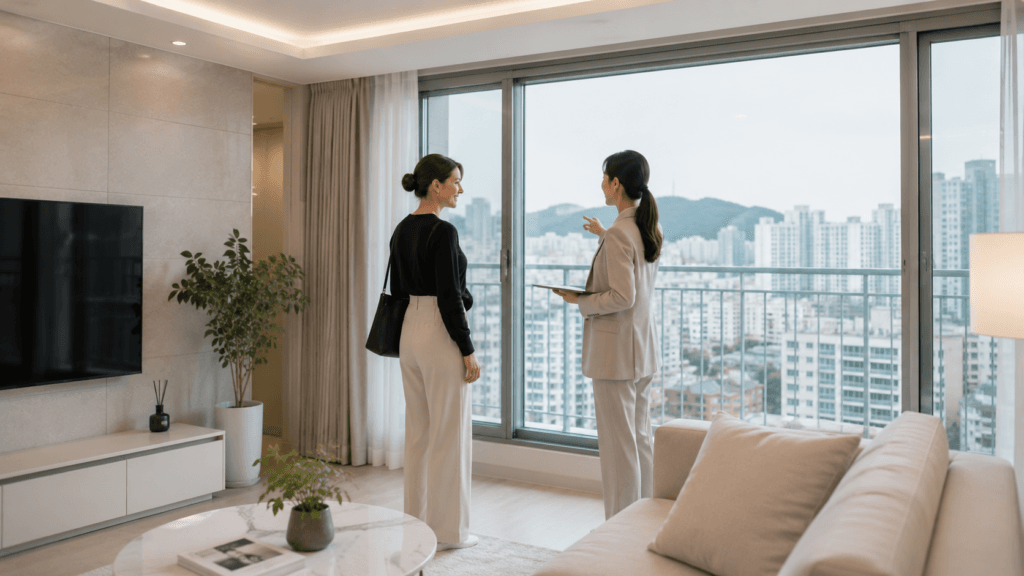
Renting in Korea Often Starts With the Deposit
The first major difference most foreigners notice isn’t the apartment itself.
It’s the payment structure.
In many countries, renters expect to pay a modest security deposit followed by monthly rent.
Korea certainly has monthly rental contracts, but even those often require a much larger deposit than international renters expect.
The reason is that deposits play a much bigger role in Korea’s housing market.
Rather than being a simple security payment against potential damage, the deposit becomes one of the central financial terms of the entire agreement.
Some renters choose to place more money into the deposit in exchange for lower monthly rent.
Others prefer keeping more of their savings and paying a higher monthly amount instead.
Neither approach is unusual.
Instead, the balance between deposit and monthly rent is often adjusted until both the landlord and tenant find an arrangement that works.
For people moving to Korea for the first time, this flexibility can feel unfamiliar.
Understanding how deposits work before beginning your apartment search makes conversations with real estate agents much easier.
If you’re unfamiliar with Korea’s unique rental structure, Jeonse vs. Monthly Rent: Why Korea Created a Different Housing System explains why deposits became such an important part of renting a home.
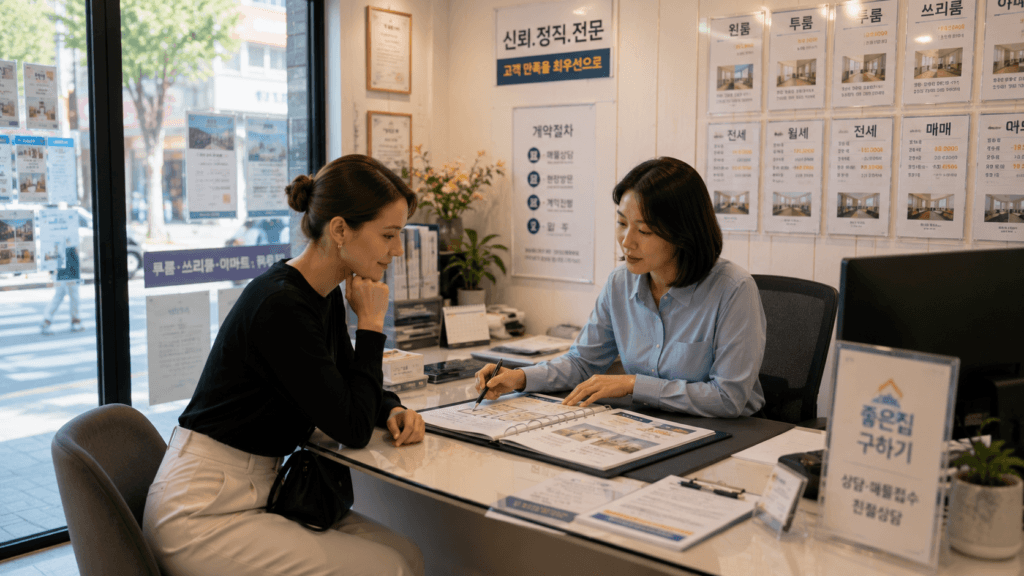
Finding an Apartment Usually Means Visiting a Local Real Estate Office
Unlike some countries where renters complete nearly everything online, apartment hunting in Korea still revolves around neighborhood real estate offices.
Walk through almost any residential district and you’ll notice small storefronts displaying apartment photos in their windows.
These local agencies usually know their neighborhoods extremely well.
Many available homes never remain online for long.
Instead, agents often hear about vacancies directly from landlords and can arrange viewings almost immediately.
Rather than scrolling through hundreds of listings yourself, the search usually begins with a simple conversation.
The agent wants to understand how you plan to live.
Are you looking for a quiet neighborhood or a lively one?
Do you need to commute every day?
Will you be living alone or with family?
How much can you comfortably spend each month?
Those answers gradually narrow the search until only a handful of suitable apartments remain.
For foreigners, working with someone who can communicate clearly in English can make the process much smoother.
Even so, understanding the contract yourself remains just as important as understanding the apartment.
The Monthly Rent Isn’t Always the Whole Story
One reason newcomers occasionally underestimate their housing budget is that the advertised rent rarely represents the total monthly cost.
Many apartment buildings also charge a separate management fee.
Depending on the building, that fee may help cover shared facilities such as security, elevators, hallway cleaning, or common utilities.
Exactly what is included differs from one property to another.
Because of that, two apartments with identical monthly rent can have noticeably different overall living costs.
Utilities such as electricity, gas, water, internet, and parking may also be billed separately.
Experienced renters therefore compare the expected monthly cost of living rather than focusing only on the number shown in the advertisement.
Understanding those additional expenses early makes it much easier to compare different neighborhoods realistically.
Choosing the Right Home Is About More Than the Room
The apartment itself is only one part of the decision.
The surrounding neighborhood often shapes everyday life even more.
During a viewing, it’s worth opening the windows, listening to the street outside, checking the natural light, and walking to the nearest subway station.
A home that looks perfect in photographs can feel very different during the morning commute or after dark.
Fortunately, Korean neighborhoods are usually designed so that daily necessities are never far away.
Convenience stores, cafés, pharmacies, supermarkets, and public transportation often become part of the same routine, making everyday life remarkably efficient.
For many foreigners, adapting to that neighborhood-centered lifestyle becomes one of the most enjoyable parts of living in Korea.
Before Signing, Make Sure You Understand the Contract
Finding the right apartment is exciting.
Signing the contract deserves a slower pace.
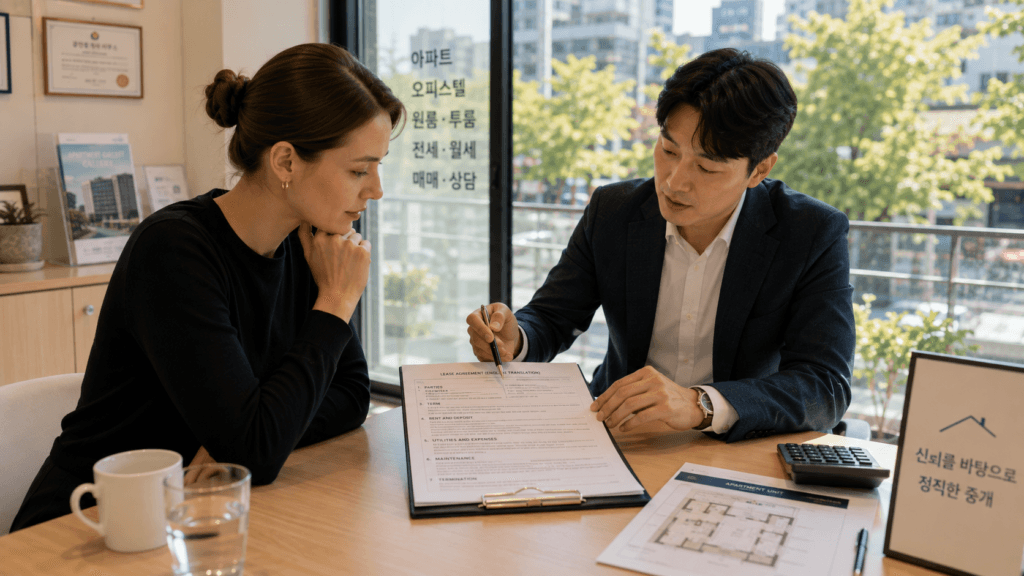
Most residential lease agreements in Korea are written in Korean, even when the landlord or agent speaks some English.
That doesn’t mean the process is unsafe, but it does mean you should fully understand what you’re agreeing to before transferring any money.
A good real estate agent will explain the major terms, but foreign renters should never rely only on a verbal summary.
Take the time to read a translated version or ask someone fluent in Korean to review the document with you.
The contract should clearly explain how much you will pay as a deposit, when the monthly rent is due, how long the lease lasts, and what happens when you eventually move out.
The section that often deserves the closest attention is the additional agreement at the end of the contract.
This is where landlords and tenants record special promises that don’t appear in the standard form.
Perhaps the landlord agrees to replace an aging washing machine before you move in.
Maybe the tenant receives permission to keep a pet or move out early under certain conditions.
Those details matter because they become part of the written agreement rather than remaining a verbal promise that could later be forgotten.
Understanding the contract is less about expecting problems and more about making sure both sides begin the relationship with the same expectations.
Registering Your Address Is an Important Step
Moving into your apartment doesn’t always mean the administrative process is finished.
For many foreign residents, officially registering their new address is an important part of settling into life in Korea.
Besides meeting immigration requirements where applicable, proper residence reporting can also strengthen a tenant’s legal position under Korea’s housing lease system.
This becomes especially important when renting with a large security deposit.
Before signing the lease, it’s worth confirming that the property can be used for official residence registration.
Most ordinary residential apartments present no difficulty, but asking the question in advance avoids unnecessary surprises later.
Experienced real estate agents are accustomed to this request and can usually explain the procedure or direct you to the appropriate local office after you move in.
Renting Becomes Much Easier After the First Time
Many foreigners worry that finding housing in Korea will be overwhelming.
In reality, the first apartment search is usually the hardest simply because every part of the process feels unfamiliar.
Terms like Jeonse, Wolse, and management fees quickly become part of your everyday vocabulary.
After signing one contract, you’ll begin to understand how deposits influence rent, why neighborhoods matter so much, and how local real estate offices operate.
What initially feels like a completely different housing system gradually becomes surprisingly logical.
In fact, many long-term foreign residents discover that apartment hunting becomes easier with each move because they already understand how Korean landlords, agents, and contracts typically work.
That growing familiarity is part of adapting to everyday life in Korea itself.
Which Type of Housing Is Best for Foreigners?
There isn’t one correct answer.
The best home depends on the reason you’re living in Korea.
Someone staying for a single university semester may have very different priorities from a family relocating for several years.
Likewise, a professional working in Seoul’s business districts may value convenience over additional living space, while someone working remotely might prefer a quieter residential neighborhood.
Rather than asking which type of housing is objectively best, it’s often more useful to ask which one fits your daily routine.
A compact officetel close to the subway can make commuting effortless.
A larger apartment inside a residential complex may provide more space and a stronger sense of neighborhood life.
Each option reflects a different way of experiencing Korea.
Conclusion
So, can foreigners rent an apartment in Korea?
Absolutely.
Every year, international students, teachers, engineers, researchers, business professionals, and families successfully rent homes throughout the country.
The biggest adjustment is not gaining permission to rent.
It’s becoming familiar with a housing system that approaches deposits, contracts, and neighborhoods differently from many other countries.
Once you understand those differences, the process becomes much less intimidating.
Working with a trustworthy real estate agent, carefully reviewing the contract, understanding your financial responsibilities, and completing the appropriate registration steps will help you start your new home with confidence.
For many newcomers, renting an apartment becomes one of the first moments they truly begin experiencing everyday Korean life—not as a visitor, but as a resident.
Frequently Asked Questions
Can foreigners legally rent apartments in Korea?
Yes. Foreign citizens can legally rent apartments, officetels, studios, and other residential properties throughout Korea.
Do foreigners need a Korean bank account?
Many landlords prefer receiving deposits and monthly rent through a Korean bank account, so opening one soon after arrival is often helpful.
Is it difficult to rent without speaking Korean?
Not necessarily, but the process becomes much easier with an English-speaking real estate agent or someone who can help explain the contract.
Can foreigners rent using Jeonse?
Yes. Foreign residents may sign Jeonse contracts, although many newcomers choose monthly rent first because it requires a smaller upfront deposit and is generally easier to manage.
How long are rental contracts in Korea?
Many residential leases are signed for around two years, although shorter and longer agreements are also available depending on the landlord and property.
Continue Exploring
If you enjoyed this article, you may also like: