Imagine arriving in Korea for the first time.
Before you’ve had breakfast, your Korean friend sends you a message asking where you’d like to meet.
A few minutes later, another notification appears.
Your lunch plans have changed.
By the time you step onto the subway, almost everyone around you glances at their phone for just a few seconds before putting it away again.
Later that afternoon, someone at work smiles and says,
“I’ll add you to the KakaoTalk group.”
By evening, you’ve received directions to dinner, a reminder about tomorrow’s appointment, and a message from your family—all through the same app.
At some point, you stop noticing KakaoTalk itself.
You simply begin using it like everyone else.
This is why visitors often misunderstand KakaoTalk at first.
It looks like an ordinary messaging app.
In reality, it quietly supports hundreds of small interactions that keep everyday life in Korea moving smoothly.
Understanding KakaoTalk isn’t really about understanding technology.
It’s about understanding how millions of people stay connected without even thinking about it.

Your Day Usually Begins with KakaoTalk
For many Koreans, the first messages of the day arrive before they even leave home.
Parents ask whether everyone slept well.
Friends check if plans are still on.
Coworkers mention a meeting that has moved to a different room.
Students remind one another about an assignment due later that morning.
None of these messages feels particularly important on its own.
Together, however, they quietly organize the day before it has fully begun.
That is one reason KakaoTalk feels different from many messaging apps.
People do not open it only when they have something important to say.
Instead, it remains part of the background, helping everyday life unfold one small conversation at a time.
Because almost everyone already uses it, there is rarely any discussion about which app to use.
The conversation simply begins.
For someone new to Korea, this can be surprisingly noticeable.
Rather than asking for your phone number, people often ask,
“Do you have KakaoTalk?”
It is a small question that reveals a much larger habit.
Exchanging KakaoTalk contacts is often the first step toward becoming part of someone’s daily life.
One Conversation Naturally Leads to Another
As the day continues, KakaoTalk quietly follows people from one part of life to the next.
The chat with your family becomes a conversation with classmates.
That conversation is followed by messages from coworkers.
Later, friends begin discussing where to meet after work.
Nothing feels formal.
Nobody announces that they are switching from their personal life to work or from work to their social life.
The conversations simply continue.
This seamless flow is one reason KakaoTalk has become so deeply rooted in Korean society.
Instead of separating communication into different places, one familiar app allows people to move naturally between the different roles they play throughout the day.
A university student may begin the morning talking with family, spend the afternoon discussing a group project, and finish the evening arranging dinner with friends—all without leaving the same application.
The technology almost disappears.
What remains is the feeling that everyone stays connected, even while living busy and independent lives.

KakaoTalk Quietly Keeps Daily Life Moving
By the afternoon, something interesting begins to happen.
You realize that KakaoTalk is no longer just a way to talk to people.
It has quietly become the place where much of your day stays organized.
A restaurant confirms your reservation.
A clinic reminds you about tomorrow’s appointment.
A delivery notification lets you know a package has arrived.
A local shop shares news about a seasonal promotion.
None of these moments feels particularly remarkable.
In fact, many people barely notice them.
That is precisely why KakaoTalk has become so essential.
It doesn’t demand attention.
Instead, it quietly removes dozens of small inconveniences that would otherwise interrupt the day.
For many Koreans, checking KakaoTalk isn’t a separate activity.
It happens naturally between everything else.
While waiting for the elevator.
Standing in line at a café.
Walking from one meeting to another.
Riding the subway home.
The app fits into the rhythm of daily life rather than asking people to stop what they’re doing.
Staying Close Without Saying Much
Perhaps the most remarkable part of KakaoTalk is not how much people communicate.
It’s how effortlessly they stay connected.
Many conversations aren’t important enough to become phone calls.
A parent asks whether their child has eaten lunch.
A friend shares a photo from a nearby café.
Someone recommends a new restaurant that just opened.
A coworker asks if anyone wants coffee before returning to the office.
Each message takes only a few seconds to read.
Individually, they seem insignificant.
Together, they create a quiet feeling that people remain part of one another’s lives throughout the day.
Foreign visitors sometimes expect conversations to have a clear beginning and end.
Korean KakaoTalk conversations often work differently.
Someone replies twenty minutes later.
Another person joins an hour afterward.
The discussion continues during the evening.
No one finds this unusual.
The conversation simply pauses whenever life becomes busy before naturally continuing again.
This relaxed style reflects the pace of modern Korean life, where staying connected matters more than replying immediately.
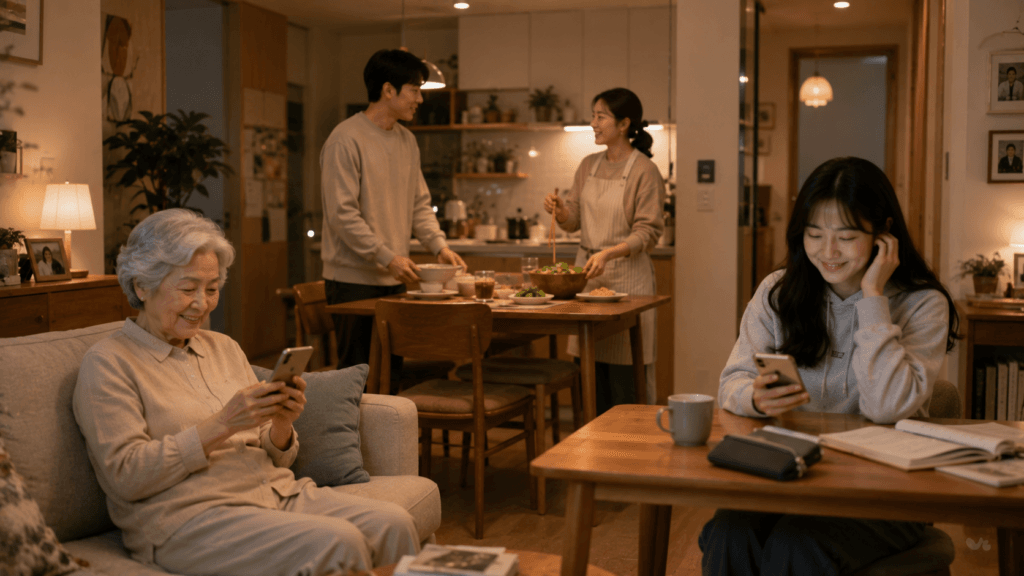
It Stops Feeling Like an App
The biggest surprise for many foreigners doesn’t happen on the first day.
It happens a few weeks later.
Without realizing it, they also begin saying,
“Send it to me on KakaoTalk.”
By then, the app has quietly become part of everyday life.
It is no longer something they consciously open.
It is simply where daily life happens.
This is why KakaoTalk has remained so important in Korea.
Its success isn’t based only on technology or features.
It comes from fitting naturally into the way people already live.
Like neighborhood cafés that become places to study and meet friends, or convenience stores that support countless small daily errands, KakaoTalk succeeds because it quietly makes ordinary life easier.
The app itself is almost invisible.
What people remember instead is how effortlessly they stayed connected to the people around them.
Conclusion
At first glance, KakaoTalk looks like one more messaging app among many.
Spend time in Korea, however, and a different picture begins to emerge.
It helps people coordinate plans, strengthen relationships, receive everyday information, and move smoothly from one part of the day to the next.
That is why Koreans rarely think of KakaoTalk as just technology.
It has become part of the everyday rhythm of modern life.
For visitors, downloading KakaoTalk may seem like a practical decision.
For people living in Korea, it quickly becomes something much more familiar.
It simply becomes part of the day.
FAQ
Why is KakaoTalk so popular in Korea?
Because almost everyone uses it, making it the easiest way to communicate with family, friends, coworkers, schools, businesses, and local services.
Can foreigners use KakaoTalk in Korea?
Yes. Anyone can create an account, and many travelers, international students, and expatriates use KakaoTalk while living or visiting Korea.
Is KakaoTalk only used for messaging?
No. It is commonly used for appointment reminders, business notifications, delivery updates, reservations, and many other everyday services.
Why do people ask for KakaoTalk instead of a phone number?
Since KakaoTalk is already integrated into everyday communication, exchanging KakaoTalk contacts is often the quickest and most convenient way to stay in touch.
Continue Exploring
If you enjoyed this article, you may also like: