If you’ve searched for apartments in Korea, you’ve probably come across a word that doesn’t seem to exist anywhere else.
Officetel.
At first glance, it looks like a typo.
Is it an office?
A hotel?
An apartment?
The answer is surprisingly simple.
An officetel combines ideas from all three.
Originally designed as buildings where people could both work and live, officetels have evolved into one of Korea’s most recognizable housing options.
Today, many no longer function as office spaces at all.
Instead, they serve as compact homes for people who value convenience, walkability, and easy access to public transportation.
For foreigners moving to Korea, students studying abroad, or young professionals starting their careers, an officetel is often one of the first housing options they encounter.
But while it may look like a typical apartment building from the outside, life inside an officetel can feel quite different.
Understanding what an officetel is also helps explain how Korean cities have adapted to changing lifestyles, smaller households, and increasingly flexible ways of living.
The Name Explains the Original Idea
The word officetel comes from combining office and hotel.
When this type of building first appeared, the concept was straightforward.
People could operate a small business during the day while also living in the same unit.
Instead of commuting between separate office and home locations, both functions existed within a single space.
This appealed particularly to professionals, consultants, designers, small business owners, and entrepreneurs working independently.
Over time, however, Korea’s housing needs changed.
As more people began living alone, demand for compact homes in central business districts increased dramatically.
Many officetels gradually shifted toward residential use.
Although some units are still used as offices today, many function almost entirely as apartments.
The original idea of combining work and home remains part of the building’s identity, but modern officetels are often chosen simply because they provide practical urban housing.
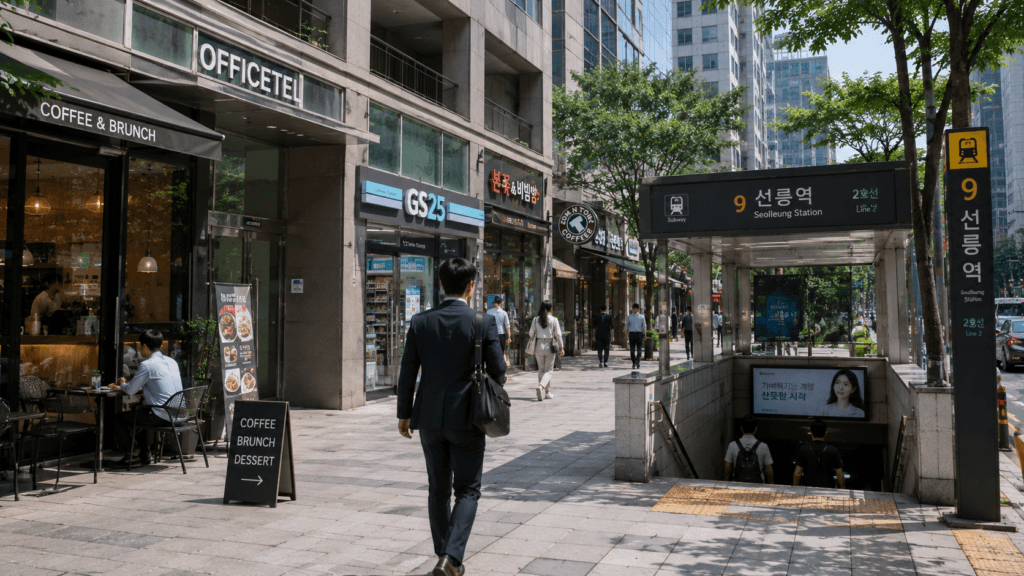
Designed for One- and Two-Person Households
Unlike large family apartments, officetels are generally built for smaller households.
Many residents live alone.
Others are young couples before starting families.
International students and foreign professionals also frequently choose officetels because they are located close to universities, business districts, or transportation hubs.
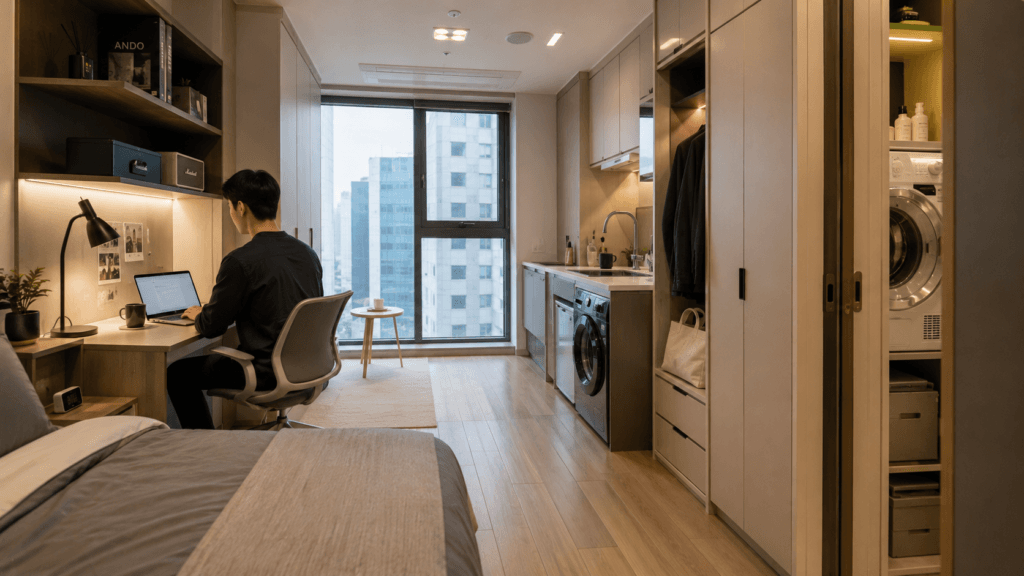
Inside, the layout often feels more compact than a traditional Korean apartment.
Many units feature a single open living area that combines the bedroom, dining space, and kitchen.
Some larger officetels include a separate bedroom, but maximizing efficiency is usually more important than creating multiple rooms.
The result is a home that feels practical for someone who spends much of the day working, studying, or exploring the city.
Rather than providing large family spaces, officetels focus on making everyday urban living simple and convenient.
Location Is Often the Biggest Advantage
Perhaps the greatest appeal of an officetel is not the unit itself.
It is where the building is located.
Many officetels are constructed directly above or beside subway stations.
Others sit within busy commercial districts where restaurants, cafés, supermarkets, pharmacies, fitness centers, and convenience stores are only a short walk away.
For residents who rarely drive, this location becomes a major lifestyle advantage.
Daily errands can often be completed within a few minutes.
Public transportation connects easily with workplaces throughout the city.
Instead of commuting long distances from suburban neighborhoods, many officetel residents choose to live close to where they work.
This reflects a broader pattern of Korean urban planning.
As discussed in Why Korean Neighborhoods Are Designed for Everyday Convenience, housing, transportation, and local businesses are intentionally integrated to reduce unnecessary travel.
Officetels Feel Different From Family Apartments
Although officetels are residential spaces, they usually provide a different atmosphere from large apartment complexes.
Family apartments often include playgrounds, schools, landscaped parks, community centers, and long walking paths designed for residents of all ages.
Officetels are generally much more compact.
The building itself may contain retail shops on the lower floors with residential units above.
Shared amenities tend to focus on convenience rather than family life.
Many residents appreciate the simplicity.
The building requires relatively little maintenance from individual occupants.
Security systems, elevators, and professional management provide a comfortable environment for people living independently.
At the same time, officetels may offer less storage space and smaller kitchens than traditional apartments.
For someone expecting a spacious family home, the difference can be surprising.
For someone prioritizing location and convenience, however, the trade-off often makes perfect sense.
Built-In Features Make Small Units More Practical
Because an officetel usually has limited floor space, much of its usefulness comes from built-in design.
Storage cabinets may extend from floor to ceiling.
A wardrobe can be integrated beside the entrance or sleeping area.
The washing machine is often installed beneath the kitchen counter or inside a compact utility cabinet.
Some units include sliding doors that separate the sleeping area without permanently dividing the room.
Loft-style officetels may use vertical space by placing the bed above the main living area, although ceiling height and comfort vary significantly from one building to another.
These features help residents live with fewer large pieces of furniture.
A person moving into an officetel may need only a bed, a desk, and a few smaller items because much of the essential storage is already part of the unit.
The design is not necessarily luxurious.
Its strength lies in reducing wasted space.
This is similar to the broader design philosophy found inside a typical Korean apartment, where built-in storage and clearly defined functions make compact interiors feel more manageable.

Rent Can Be Lower, but Monthly Costs Need Attention
Officetels are often presented as an affordable alternative to larger apartments, but the full cost can be more complicated than the monthly rent alone suggests.
The unit may require a deposit in addition to monthly rent.
The size of that deposit varies depending on the contract, building, neighborhood, and local market.
Some tenants choose a lower deposit with higher monthly rent, while others pay a larger deposit to reduce the monthly payment.
Residents must also consider building management fees.
These fees may cover elevator maintenance, security, common-area cleaning, building staff, shared utilities, and other services.
In some buildings, heating, water, or electricity may be calculated differently from ordinary residential apartments.
A unit with attractive rent can therefore become less affordable once monthly management and utility costs are included.
Before signing a contract, tenants should ask exactly what the management fee covers and request recent examples of typical monthly charges.
The building’s official classification may also affect taxes, utilities, registration, lending, and rental procedures.
These details can vary, so renters and buyers should confirm the rules for the specific unit rather than assuming every officetel works in the same way.
For foreigners, it is especially important to verify whether the address can be used for residence registration and whether the landlord permits the required paperwork.
An officetel may appear simple from the outside, but the contract deserves the same careful attention as any other Korean housing arrangement.
Privacy and Convenience Come With Trade-Offs
Officetel living can be extremely convenient, but it is not ideal for everyone.
Compact layouts provide less separation between sleeping, cooking, working, and relaxing.
Cooking smells can spread quickly through a studio-style unit.
Storage may become difficult for residents with seasonal clothing, sports equipment, or large household items.
Some buildings have smaller windows or less natural ventilation than traditional apartments.
Noise can also vary.
Because residents may keep different schedules, hallway and elevator traffic can continue late into the evening.
Buildings that mix offices and residences may feel busier during the day than family-oriented apartment complexes.
Parking can be limited or expensive, particularly in central districts.
Families with children may find that an officetel lacks the playgrounds, school access, and larger shared spaces available in major apartment communities.
On the other hand, many residents see these limitations as reasonable compromises.
Someone living alone may not need several bedrooms.
A professional working long hours may value a short commute more than a large kitchen.
A student may prefer being close to a university, library, and subway station.
The value of an officetel depends on how closely its design matches the resident’s actual routine.
Why Officetels Appeal to People Living Alone
The growth of officetels is closely connected to the rise of one-person households in Korea.
More adults now live independently for education, work, personal preference, or life-stage reasons.
Traditional family apartments are often too large and expensive for one resident.
Older low-rise housing may offer cheaper rent but can lack elevators, security systems, modern appliances, or direct transportation access.
Officetels fill the space between those options.
They offer compact private housing inside professionally managed buildings, often in locations where daily life can be handled without a car.
A resident can leave home, buy breakfast downstairs, reach the subway within minutes, and return late without managing a separate yard, exterior repairs, or building maintenance.
This lifestyle reflects the changing structure of Korean households.
The dominant housing system was originally developed around families, but urban housing increasingly needs to support individuals as well.
The officetel is one of Korea’s clearest responses to that change.

Officetel vs. Apartment: What Is the Difference?
An officetel may resemble an apartment, but the two should not be treated as identical.
A conventional apartment is generally designed primarily as residential housing.
It often forms part of a larger complex with family-oriented facilities, landscaped grounds, playgrounds, and standardized multi-room layouts.
An officetel was originally developed as a mixed-use property and may still be legally or administratively classified differently depending on how the unit is registered and used.
The interior is usually smaller and more flexible.
The building is more likely to stand inside a commercial district rather than a large residential complex.
Residents often choose an officetel for transportation and urban convenience, while families may choose apartments for space, schools, community facilities, and long-term stability.
That difference can be summarized simply:
An apartment is usually designed around the needs of a household.
An officetel is often designed around the routine of an individual urban resident.
Neither is automatically better.
They solve different housing problems.
The earlier article Why Almost Everyone Lives in Apartments in Korea explains how family apartments became the foundation of modern Korean urban life.
Officetels developed alongside that system to serve people who needed something smaller, more central, and more flexible.
Who Should Consider Living in an Officetel?
An officetel may be a strong choice for someone who:
- Lives alone or with one other person
- Prioritizes subway access and a short commute
- Does not require multiple bedrooms
- Prefers a managed building with security
- Wants nearby shops, cafés, restaurants, and services
- Owns relatively few large household items
- Expects to stay for a limited period
It may be less suitable for someone who:
- Needs substantial storage
- Works from home and requires a separate office
- Cooks large meals frequently
- Has children or plans to expand the household
- Wants quiet outdoor community space
- Requires inexpensive or abundant parking
- Prefers a clear separation between living and sleeping areas
The most important question is not whether officetels are good or bad.
It is whether the building supports the way the resident actually lives.
Conclusion
So, what is an officetel?
It is Korea’s distinctive answer to compact urban living: a building type that began by combining office and residential functions and later evolved into a popular home for one- and two-person households.
Officetels are attractive because they place residents close to transportation, workplaces, universities, shops, and daily services.
Built-in storage and compact layouts make small units practical, while professional management and security reduce many of the responsibilities associated with maintaining a separate home.
However, convenience comes with trade-offs.
Residents may have less space, higher management fees than expected, limited storage, and fewer family-oriented facilities.
Rental and registration rules also require careful checking because an officetel may not be treated exactly like a standard apartment.
That is what makes the officetel more than just a small studio.
It represents a different model of Korean housing—one built around mobility, independence, and life at the center of the city.
Frequently Asked Questions
What does the word officetel mean?
Officetel combines the words “office” and “hotel.” It originally described a unit where a person could work and live in the same building.
Is an officetel the same as an apartment?
No. An officetel may function as a home, but its building classification, typical size, location, facilities, and contract conditions can differ from those of a standard residential apartment.
Are officetels only for one person?
No, but they are most commonly used by one-person households and couples because many units are compact studios or one-bedroom homes.
Are officetels popular with foreigners in Korea?
Yes. Their central locations, built-in appliances, security, and proximity to subway stations make them convenient for international students and foreign professionals.
Are officetels cheaper than apartments?
They can have lower deposits or rent than larger apartments in the same area, but management fees and utility costs may be relatively high. The total monthly cost should always be checked.
Continue Exploring
If you enjoyed this article, you may also like: