f you visit Korea for the first time, one thing quickly stands out.
Apartment buildings seem to be everywhere.
They line the skylines of major cities, fill suburban neighborhoods, and stretch across entire districts in clusters that can house thousands of families.
For many visitors, this raises an obvious question.
Why does almost everyone in Korea live in apartments?
In many countries, apartments are often associated with young professionals, students, or temporary living before buying a house.
In Korea, however, apartments are not viewed as a stepping stone.
For millions of people, they are the preferred place to build a long-term home.
Families raise children there.
Retirees continue living there.
Entire generations spend most of their lives in apartment communities.
The answer is not simply that Korea is densely populated.
Population density explains part of the story, but not all of it.
The real reason lies in how Korea rebuilt its cities, planned its neighborhoods, and created a housing system designed around modern urban life.
Korea Needed Homes Faster Than Cities Could Grow
The story begins during Korea’s period of rapid economic growth.
As industries expanded, millions of people left rural communities to find work in growing cities.
Seoul, Busan, Incheon, and many other urban areas experienced dramatic population increases within just a few decades.
Traditional neighborhoods could not provide enough housing for everyone arriving.
Building individual houses required large amounts of land and infrastructure.
Growing cities simply did not have enough space to expand outward at the same speed as their populations.
Apartments offered a practical solution.
Instead of building one family home on a piece of land, developers could build homes for hundreds or even thousands of families within the same area.
This allowed cities to provide housing much more efficiently while also making it easier to build roads, schools, public transportation, and utilities around concentrated residential communities.
Apartment complexes quickly became more than collections of buildings.
They became the foundation of modern urban development.
Apartments Solved More Than a Housing Shortage
Over time, apartments became popular for reasons beyond simply providing enough homes.
Living in an apartment also meant gaining access to shared infrastructure.
Many complexes included landscaped walking paths, playgrounds, underground parking, fitness facilities, childcare centers, security systems, and professional management offices.
Instead of each household maintaining its own property independently, many daily responsibilities became shared across the community.
Maintenance could be organized more efficiently.
Security could be monitored around the clock.
Common spaces remained clean through professional management rather than individual homeowners.
For busy families living in growing cities, this created a practical lifestyle that balanced convenience with community living.
The apartment itself became only one part of a much larger residential system.
Cities Were Designed Around Apartment Communities
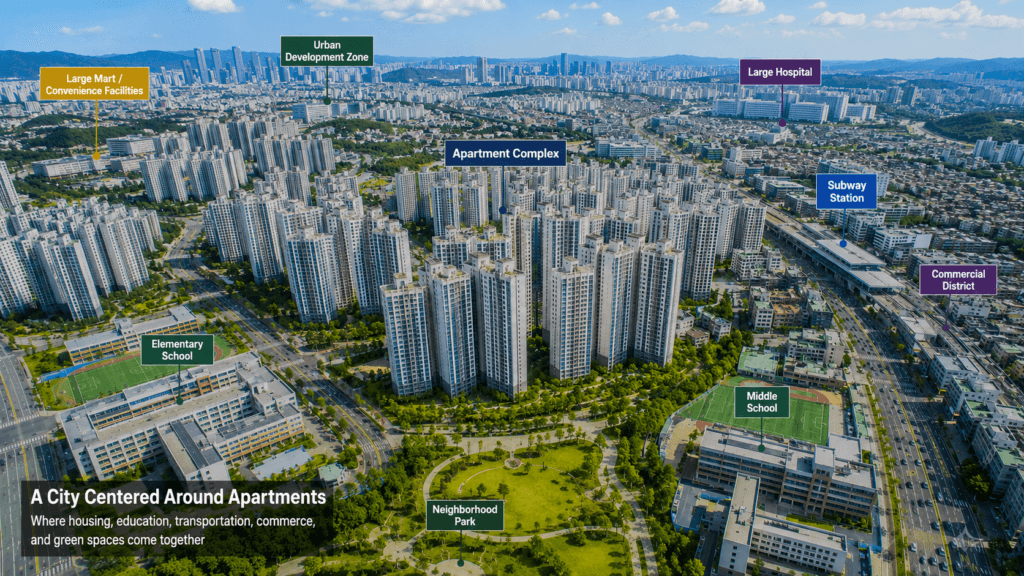
One reason apartments feel so natural in Korea today is that entire neighborhoods were planned around them.
Rather than placing isolated residential buildings throughout a city, many developments were designed as complete communities.
Schools were built nearby.
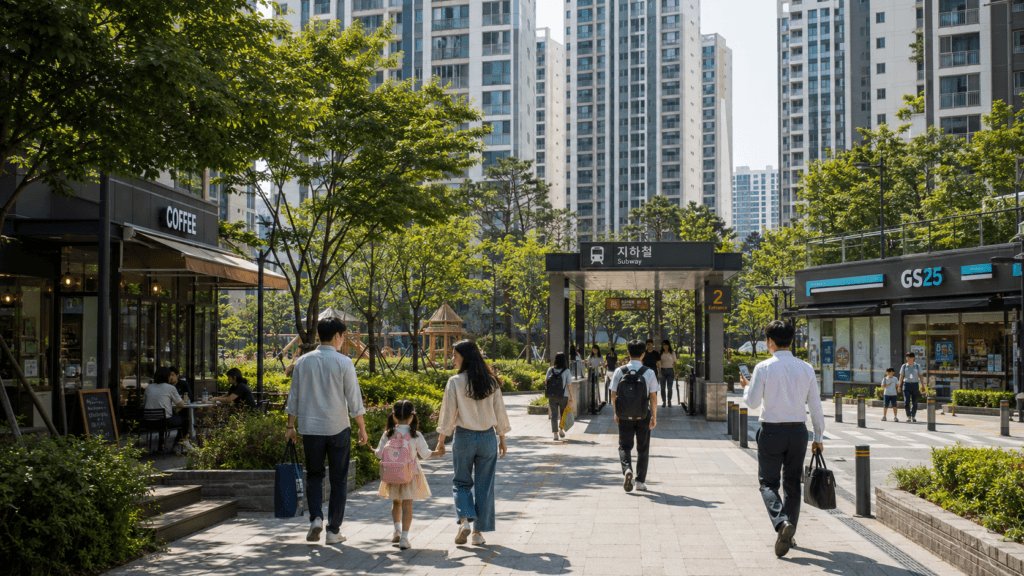
Bus stops and subway stations connected residents to workplaces.
Convenience stores, supermarkets, pharmacies, hospitals, cafés, and restaurants gradually developed around the growing population.
Daily life became highly walkable.
Instead of driving across town for everyday errands, residents could often reach most essential services within minutes.
This close integration between housing and neighborhood planning remains one of the defining characteristics of Korean cities today.
As explored in Why Korean Neighborhoods Are Designed for Everyday Convenience, residential planning focuses on making everyday life efficient rather than simply maximizing housing density.
Apartments Became a Symbol of Stability
Apartments eventually became more than a practical response to urban growth.
They also became closely connected with financial security.
For many Korean households, buying an apartment represents one of the most important long-term decisions they will make.
A home provides a place to live, but it is also often treated as a major family asset.
Apartment prices are relatively easy to compare because units in the same complex tend to have similar layouts, sizes, and building conditions.
Buyers can review recent sales in the same building or nearby complex.
Banks can assess the property more easily.
Future buyers already understand the neighborhood, transportation access, nearby schools, and management system.
An individual house may have unique advantages, but its value can depend heavily on the land, condition, location, road access, renovation history, and surrounding development.
Apartments feel more standardized.
That standardization creates a sense of predictability in a housing market where families may be committing a large share of their savings.
This does not mean apartment ownership is always safe or affordable.
Housing prices can rise or fall, and purchasing a home can place significant financial pressure on families.
Still, apartments remain central to the way many Koreans think about housing stability.
Parents may consider whether the home will remain practical as children grow.
Older adults may prefer buildings with elevators, security, and nearby medical services.
Young couples may evaluate whether a neighborhood offers reliable transportation and future resale demand.
The same features that make apartments convenient places to live also help explain why they became such important financial assets.
Standardized Layouts Made Daily Life Easier
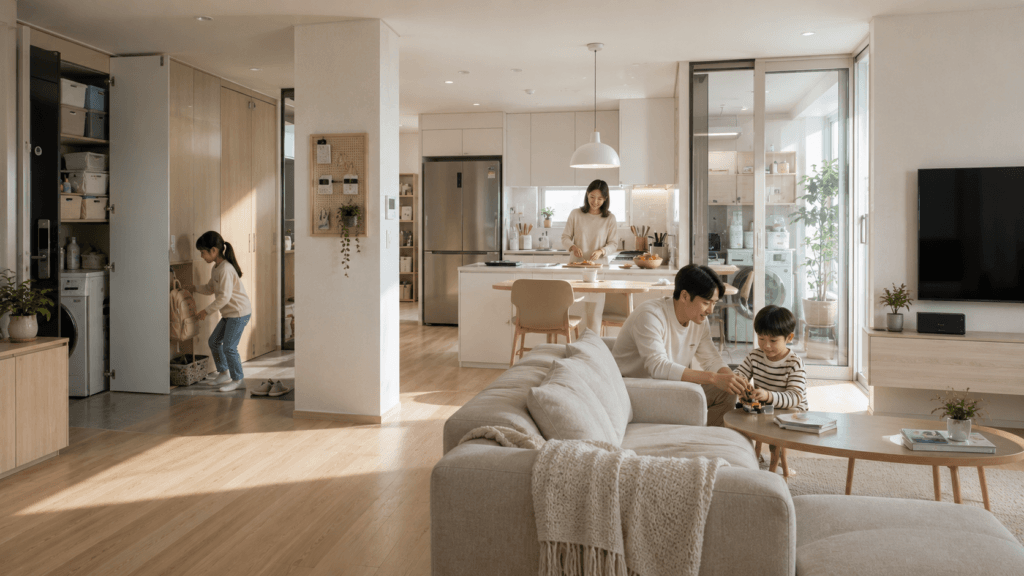
Korean apartments often share recognizable design features.
A central living room connects several bedrooms.
The kitchen sits close to the dining area.
Built-in storage reduces the need for large standalone furniture.
A utility space near the kitchen may hold a washing machine, recycling, household supplies, or an additional refrigerator.
The entrance usually includes a built-in shoe cabinet.
Bathrooms, balconies, storage walls, and heating systems are designed around familiar household routines.
Not every apartment looks the same, and newer homes continue to introduce different layouts.
However, this degree of standardization offers practical advantages.
Families generally understand how a typical apartment will function before they move in.
Furniture companies can design products for commonly used room sizes.
Moving crews know how to handle familiar building layouts.
Repair services are accustomed to apartment plumbing, heating, appliances, elevators, and shared systems.
Even daily household habits have developed around these spaces.
Shoes stay near the entrance.
Floor heating makes sitting on the floor comfortable.
Compact rooms rely on carefully planned storage.
Utility spaces keep laundry and household work separate from the main living area.
The earlier Home Design articles—including Why Koreans Always Take Off Their Shoes Indoors, How Ondol Heating Shaped Korean Home Culture, and Why Korean Apartments Have Hidden Utility Spaces Behind the Kitchen—show how individual apartment features gradually shaped the routines people now consider normal.
Apartment living did not merely adapt to Korean habits.
Over time, the design of apartments also helped create those habits.
Families Choose the Community as Much as the Home
When families compare apartments, they are rarely comparing only the interior.
They are also comparing complete living environments.
How far is the nearest school?
Can children walk there safely?
Is public transportation close enough for commuting?
Are there parks, supermarkets, clinics, and childcare facilities nearby?
Does the complex have secure entrances, convenient parking, and a reliable management office?
These questions can matter as much as the size of the living room.
A detached house may offer more privacy or outdoor space, but it can also require more individual maintenance.
The homeowner may be responsible for exterior repairs, security, waste management, snow removal, parking, and other practical concerns.
In an apartment complex, many of these responsibilities are organized collectively.
That arrangement suits households that value convenience and predictable management.
It is especially attractive in cities where long working hours and demanding commutes leave little time for maintaining a private property.
Children also shape housing decisions.
Apartment complexes often provide playgrounds and shared outdoor areas where families can meet naturally.
Schools, tutoring academies, sports facilities, and neighborhood services tend to develop around concentrated residential populations.
This can make family life easier to organize.
Over time, the apartment complex becomes part of a child’s daily world.
The route to school, the playground, the convenience store, and the elevator all become familiar pieces of childhood.
Housing choice therefore becomes closely connected with education, transportation, safety, and community life.
People are not simply choosing an apartment unit.
They are choosing the system that surrounds it.
Why Almost Everyone Lives in Apartments in Korea—But Not Literally Everyone
The phrase “almost everyone” describes the visibility and cultural dominance of apartments, not a literal rule.
Korea still has many other kinds of homes.
Some people live in detached houses.
Others live in villas, which are usually low-rise multi-family buildings.
Young adults may rent compact studios or officetels.
Older neighborhoods may include a mixture of small houses, shops, and low-rise residences.
Rural regions naturally have very different housing patterns from central Seoul or other major cities.
Even within the apartment market, lifestyles vary widely.
A family in a large suburban complex may have a very different experience from someone living in a small urban apartment tower.
Older apartment buildings may lack the facilities associated with newer developments.
Luxury complexes may offer services that ordinary households do not have.
Apartment living also comes with disadvantages.
Residents share walls, ceilings, entrances, elevators, parking areas, and common rules.
Noise between floors can create serious tension.
Management fees add to monthly expenses.
Renovations may be restricted.
Large complexes can feel repetitive or impersonal.
High demand in desirable neighborhoods can make apartments extremely expensive.
These limitations are real.
However, they have not removed apartments from the center of Korean housing culture.
The reason is that apartments continue to match the structure of modern Korean cities.
They use land efficiently.
They connect easily with public transportation.
They support large populations with organized services.
They provide familiar layouts and shared management.
They also sit inside neighborhoods where work, school, shopping, and everyday services are closely connected.
This combination is difficult for other housing types to reproduce at the same scale.
Apartment Living Became the Default Image of Home
When housing systems remain in place for several generations, they begin to shape expectations.
People who grew up in apartments often understand them instinctively.
They know how shared entrances work.
They are familiar with management offices, recycling areas, elevator etiquette, delivery access, and building security.
They recognize the general layout of the rooms.
They know what to expect from the surrounding neighborhood.
This familiarity reduces uncertainty.
A new apartment may be in a different city or built by a different company, but the overall living system still feels recognizable.
That is one reason apartments continue to attract residents even as housing preferences evolve.
They offer a familiar framework that can support very different stages of life.
A young worker may begin in a compact rental.
A couple may move into a larger apartment after marriage.
A family may relocate closer to schools.
Older adults may downsize while remaining near transportation and medical services.
The apartment changes, but the basic housing system remains familiar.
This continuity also helps explain why moving can happen so efficiently.
As discussed in Moving Day in Korea: More Than Just Changing Homes, professional movers, management offices, elevators, standardized layouts, and apartment access systems all work together.
People are not moving between completely unfamiliar housing structures.
They are often moving from one highly organized apartment system into another.
[Image Placement: At early evening, several generations of residents return to a large Korean apartment complex. Children play near a landscaped walkway, commuters head toward their buildings, and an older couple carries groceries home, showing how one housing system supports different stages of life.]
Conclusion
Apartments became dominant in Korea because they solved several problems at the same time.
They provided large numbers of homes during a period of rapid urban growth.
They allowed cities to organize schools, transportation, utilities, and commercial services around concentrated communities.
They offered shared security, maintenance, parking, and common facilities.
Standardized layouts made daily life easier to organize, while familiar apartment complexes became closely connected with long-term housing stability.
This does not mean apartments are perfect, nor does it mean every Korean lives in one.
Detached houses, villas, officetels, and other forms of housing remain important parts of the country.
But apartments became the default image of modern Korean home life because they fit the way Korean cities developed.
To understand why almost everyone seems to live in apartments in Korea, it is not enough to look at the buildings.
You have to look at the entire system around them.
The schools, subway stations, management offices, playgrounds, delivery networks, local stores, and familiar household routines all help turn a group of high-rise buildings into a complete place to live.
Frequently Asked Questions
Why are apartments so common in Korea?
Apartments allowed rapidly growing Korean cities to provide large amounts of housing while efficiently connecting residents with transportation, schools, utilities, and neighborhood services.
Do most Koreans prefer apartments to houses?
Many households prefer apartments because of security, convenient management, transportation access, shared facilities, and predictable layouts. However, preferences vary by age, region, budget, and lifestyle.
Are Korean apartments considered permanent family homes?
Yes. Unlike places where apartments are often viewed as temporary housing, Korean apartments commonly serve as long-term homes for families, couples, retirees, and multiple generations.
Does everyone in Korea live in a high-rise apartment?
No. Koreans also live in detached houses, villas, officetels, studios, and low-rise buildings. Apartments are dominant, especially in urban areas, but they are not the only form of housing.
What are the disadvantages of Korean apartment living?
Common concerns include housing costs, management fees, limited privacy, renovation restrictions, parking pressure, and noise between neighboring units.
Continue Exploring
If you enjoyed this article, you may also like: