When people first arrive in Korea, one thing often catches their attention before anything else.
The apartment buildings seem endless.
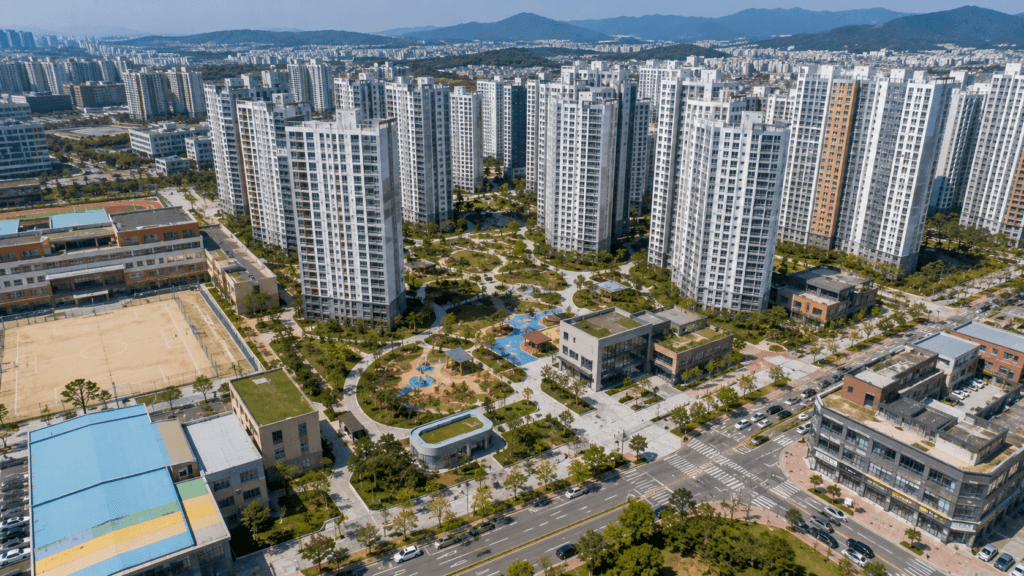
Tower after tower rises across the skyline, often arranged around wide streets, landscaped gardens, playgrounds, and walking paths.
From above, many apartment complexes almost resemble carefully planned towns rather than residential buildings.
At first, visitors may assume these developments exist simply because Korea has a large urban population.
More people require more housing.
Build upward instead of outward.
That explanation is only part of the story.
A Korean apartment complex is rarely just a collection of buildings where people sleep.
Instead, it functions as a neighborhood designed around everyday life.
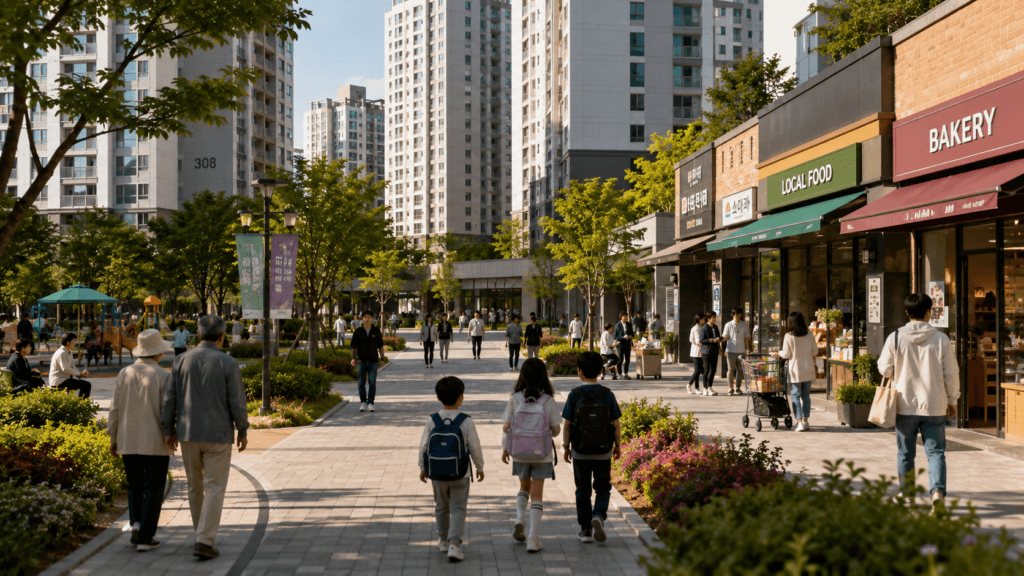
Children walk to nearby schools without crossing busy highways.
Parents buy groceries within walking distance.
Older residents exercise in community parks before meeting friends for coffee.
Packages arrive efficiently because hundreds of households share the same infrastructure.
Daily life unfolds inside a carefully connected environment where homes, transportation, shopping, recreation, and public services all support one another.
This is why many visitors describe Korean apartment complexes as feeling like small cities.
Not because they are enormous.
But because they quietly provide nearly everything people need for everyday life.
More Than a Collection of Apartment Buildings
In many countries, apartment buildings stand independently.
Residents leave the building before driving to school, shopping centers, parks, or other parts of the city.
The apartment itself is only one destination within a much larger urban landscape.
Korean apartment complexes are often planned differently.
Rather than treating each building as a separate project, developers frequently design an entire residential community at once.
Multiple apartment towers are arranged around shared outdoor spaces.
Wide pedestrian walkways connect homes with playgrounds, small parks, fitness areas, daycare centers, convenience stores, and neighborhood services.
The result is an environment where many daily activities happen only a few minutes from home.
This integrated approach also creates a stronger sense of continuity.
Residents rarely think about leaving the neighborhood for every small task.
Children meet friends within the complex.
Parents take evening walks along landscaped paths.
Older residents gather in outdoor exercise areas designed specifically for them.
Instead of simply providing housing, the apartment complex becomes the setting where much of everyday life naturally unfolds.
This planning philosophy has become increasingly important as Korea’s cities have grown denser.
Rather than allowing neighborhoods to develop randomly, large apartment communities help organize urban growth in a more coordinated way.
That is one reason Korean Apartment Culture: Why Apartments Shape Everyday Life in Korea extends far beyond individual homes.
The neighborhood itself becomes part of the living experience.
Designed Around Daily Convenience
One of the defining characteristics of Korean apartment complexes is how easily residents move through their daily routines.
Many errands that require driving in other countries can often be completed on foot.
A parent may walk a child to school before stopping at a bakery.
An office worker can pick up groceries on the way home from the subway.
Older residents often begin the morning with exercise inside the complex before visiting nearby cafés or neighborhood markets.
None of these activities feel unusual.
They simply reflect how the surrounding environment has been planned.
Transportation also plays an important role.
Many apartment developments are located near subway stations or major bus routes, allowing residents to reach workplaces across the city without relying heavily on private cars.
This close relationship between housing and transportation has helped shape modern Korean cities for decades.
The same philosophy supports everyday shopping.
Convenience stores, pharmacies, cafés, clinics, and supermarkets frequently appear within or immediately beside apartment communities.
Residents rarely need to travel far for ordinary necessities because essential services are intentionally placed close to where people live.
This focus on accessibility also explains why delivery services operate so efficiently.
As discussed in How Delivery Culture Changed Everyday Life in Korean Homes and Why Package Delivery Works So Well in Korean Apartment Buildings, concentrating hundreds of households within one organized community allows deliveries to happen faster, more consistently, and with greater security.
Shared Spaces Build Everyday Community
Unlike private houses separated by fences or long suburban streets, Korean apartment complexes encourage people to share certain parts of everyday life.
The goal is not to create constant social interaction.
Instead, it is to provide comfortable public spaces that naturally become part of residents’ routines.
Playgrounds allow children from different buildings to meet after school.
Walking paths remain active throughout the day as neighbors exercise, push strollers, or enjoy an evening stroll.
Community gardens, outdoor fitness equipment, small plazas, and seating areas give residents places to pause without leaving the neighborhood.
These encounters are usually casual.
People greet familiar faces.
Children recognize classmates.
Older residents develop regular walking schedules alongside friends.
Over time, these repeated interactions create a quiet sense of community that feels natural rather than organized.
Even residents who rarely know everyone by name still share the same public environment every day.
This balance between privacy and community is one of the defining strengths of Korean apartment complexes.
Why These Communities Continue to Shape Modern Korea
The influence of Korean apartment complexes extends well beyond housing.
Over the past several decades, they have helped shape the way cities expand, how families organize their daily lives, and even how different generations interact with one another.
As new neighborhoods were developed, apartment complexes often became the foundation around which schools, transportation, shopping districts, and public facilities were built.
Instead of adding housing to an existing neighborhood, many developments created entirely new communities from the ground up.
This long-term planning has helped Korean cities accommodate growing populations while maintaining relatively convenient access to everyday services.
For families, the benefits are equally practical.
Children often grow up surrounded by classmates who live in neighboring buildings.
Parents appreciate being able to walk to schools, parks, or local stores without long commutes.
Older residents enjoy public spaces designed specifically for daily exercise and social interaction.
Because many generations share the same neighborhood, apartment complexes naturally support a wide range of lifestyles at once.
They also encourage a different relationship with public space.
Instead of treating courtyards, walking paths, and gardens as places people pass through, residents use them as extensions of home.
A short evening walk after dinner.
Children riding bicycles after school.
Neighbors sitting on benches while watching grandchildren play.
These moments are rarely planned.
They simply become part of the neighborhood’s daily rhythm.
This explains why Why Korean Neighborhoods Are Designed for Everyday Convenience is closely connected to apartment living.
The neighborhood is not separate from the apartment.
It is part of the home experience itself.
Why Korean Apartment Complexes Feel Different to Visitors
Many visitors expect apartment complexes to feel anonymous.
Rows of tall buildings often suggest crowded living and limited personal connection.
In Korea, however, the experience is frequently quite different.
Although thousands of people may live within the same development, thoughtful planning helps the environment feel surprisingly organized.
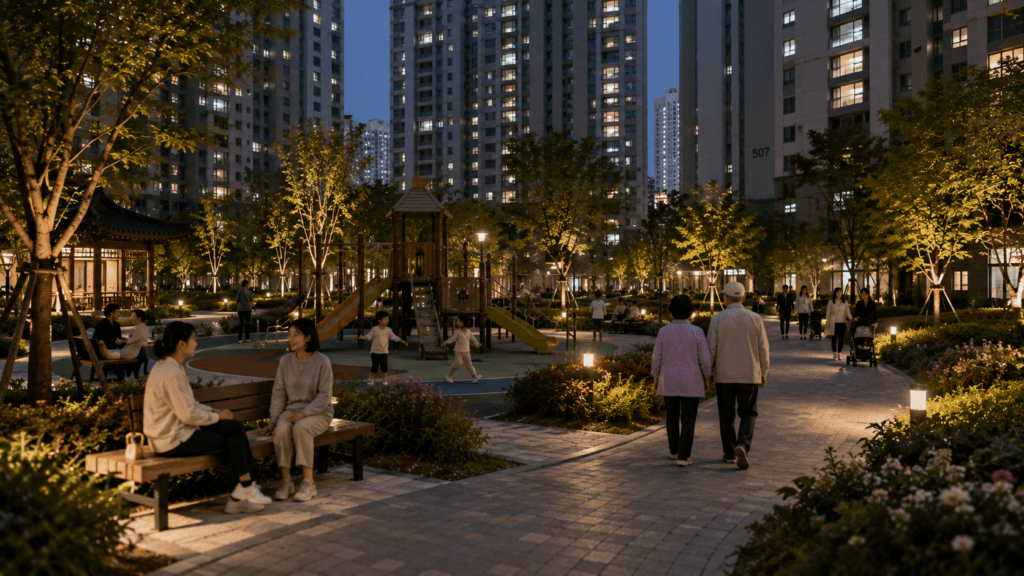
Wide pedestrian paths separate people from heavy traffic.
Trees and seasonal landscaping soften the dense urban surroundings.
Small parks provide quiet places to rest.
Community facilities reduce the need to travel long distances for everyday activities.
Even simple details—such as benches placed beneath trees or walking trails that loop through the complex—encourage residents to spend time outdoors.
As a result, apartment life often feels less isolated than many first-time visitors expect.
People are able to enjoy both privacy inside their homes and a comfortable shared environment just outside their doors.
This balance reflects one of the central ideas behind Korean apartment planning.
A home is not defined only by the walls of an apartment.
It also includes the spaces people use between those walls.
When children safely walk to school, grandparents exercise in neighborhood parks, and families gather in landscaped courtyards after dinner, the apartment complex becomes more than housing.
It becomes a living community.
Conclusion
At first glance, Korean apartment complexes may appear to be rows of similar high-rise buildings stretching across the city skyline.
Look more closely, however, and a very different picture emerges.
These developments are carefully planned communities where housing, schools, transportation, shopping, parks, and shared public spaces work together to support everyday life.
They allow children to grow up close to friends.
They make daily errands easier.
They create places where different generations naturally share the same neighborhood.
Rather than simply providing homes, Korean apartment complexes help shape how people experience their city every single day.
That is why they feel less like collections of buildings and more like small cities built around the rhythms of ordinary life.
Frequently Asked Questions
Why do Korean apartment complexes feel like small cities?
Because they are designed to combine housing with schools, parks, shops, community facilities, transportation, and public spaces, allowing many daily activities to happen within one connected neighborhood.
Do Korean apartment complexes include public facilities?
Yes. Many developments include playgrounds, walking trails, fitness areas, daycare centers, community buildings, landscaped gardens, and nearby retail services.
Why are Korean apartment neighborhoods so convenient?
Apartment complexes are often planned alongside public transportation, schools, shopping areas, and essential services, making everyday errands possible within walking distance.
Are Korean apartment complexes only found in Seoul?
No. While Seoul has many large apartment developments, similar communities can be found throughout Korea in cities of all sizes.
Can foreigners live in Korean apartment complexes?
Yes. Many foreign residents choose Korean apartments because they offer convenient transportation, modern facilities, strong security, and easy access to neighborhood services.
Continue Exploring
If you enjoyed this article, you may also like:
- Can Foreigners Rent an Apartment in Korea? What to Expect Before You Move
- Why Korean Neighborhoods Are Designed for Everyday Convenience
- Why Smart Homes Are Becoming Standard in Korean Apartments
- Inside a Typical Korean Apartment: What Every Room Reveals About Korean Life
- Why Almost Everyone Lives in Apartments in Korea
- What Is an Officetel? Korea’s Unique Apartment Alternative