For many first-time visitors to Korea, the biggest surprise inside an apartment isn’t the living room.
It isn’t the kitchen.
Sometimes, it’s the bathroom.
You step inside expecting a familiar layout.
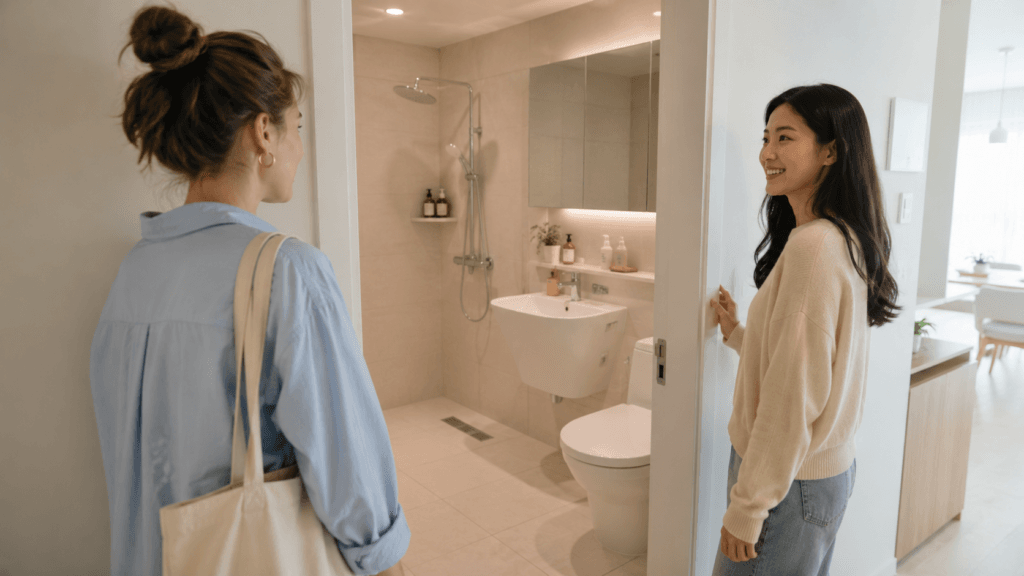
Instead, you notice there’s no shower curtain.
No raised shower tray.
Sometimes there’s barely any separation between the shower, sink, and toilet at all.
For a moment, it feels unfinished.
Then you realize—
it was designed that way.
If you’ve already explored Why Koreans Always Take Off Their Shoes Indoors, you’ve seen that Korean homes often follow a different philosophy from many Western homes.
Spaces aren’t designed simply to look good.
They’re designed to make everyday life easier.
The bathroom is one of the best examples of that philosophy.
A Bathroom Designed to Be Used, Not Protected
Bathrooms in many countries are divided into separate “wet” and “dry” areas.
The shower stays inside a stall.
Everything else stays dry.
Korean bathrooms approach the space differently.
The room itself is designed to handle water.
Floors gently slope toward a drain.
Walls are waterproof.
The entire room can get wet without causing damage.
Instead of protecting the bathroom from water, the bathroom is built to work with it.
That changes how people use the space every day.
Cleaning becomes simpler.
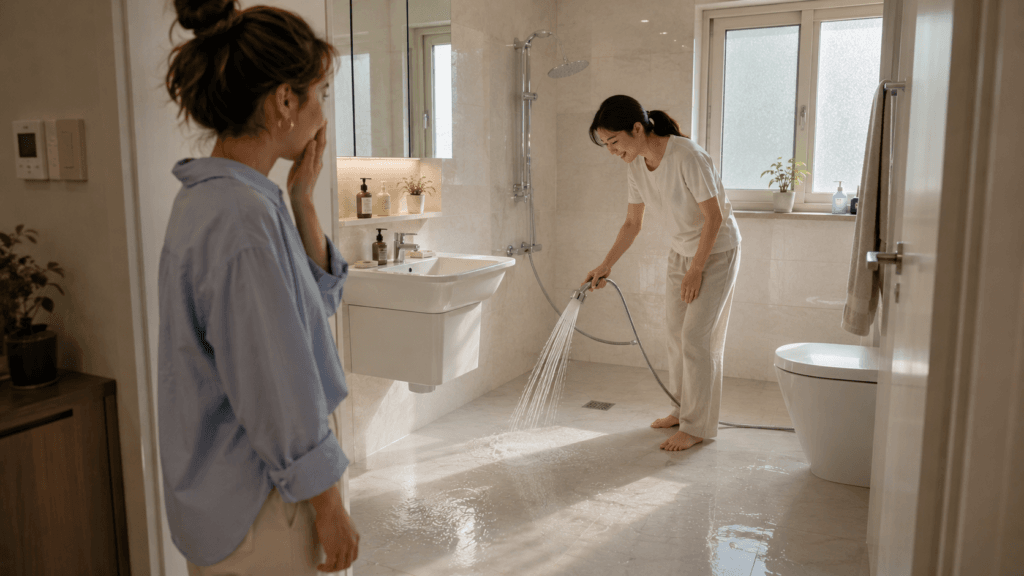
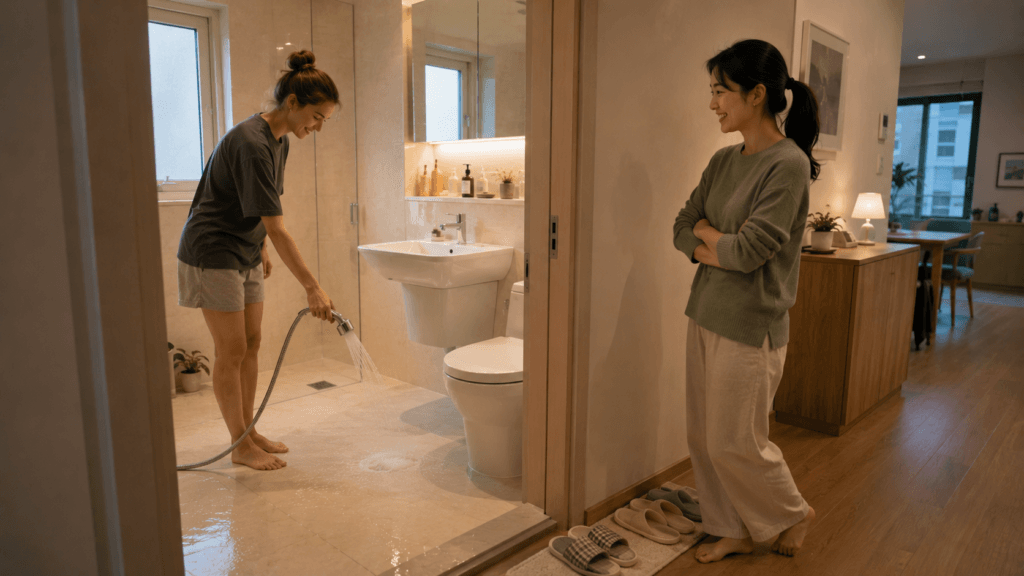
The entire floor can be rinsed in minutes.
Even after a shower, there’s no concern about water escaping onto wooden flooring outside the room.
It’s a practical solution that quietly fits into everyday life.
At first, visitors sometimes see this as unusual.
After living in Korea for a while, many begin to wonder why more bathrooms aren’t designed this way.
The bathroom doesn’t feel unfinished.
It feels surprisingly efficient.
And that raises another question.
Why did Korean homes evolve toward this practical design while many other countries chose a completely different approach?
Everyday Habits Shaped the Space
Every home reflects the routines of the people who live in it.
Korean bathrooms are no exception.
Rather than being designed around a single activity—taking a shower—they’re designed to support many small routines throughout the day.
Someone washes their hair before work.
A child comes home from school covered in dirt after playing outside.
Parents quickly rinse the bathroom floor while cleaning the house.
An elderly family member comfortably uses a handheld shower while seated on a small stool.
The same room quietly adapts to each situation.
That’s why flexibility matters more than separating every function.
This practical approach also reflects the limited space found in many Korean apartments.
Instead of making every room larger, Korean homes often ask a different question.
How can one space do more?
The bathroom becomes a perfect example.
A shower room.
A cleaning space.
A laundry support area.
Sometimes even a place to wash muddy shoes, pet supplies, or household items.
One room serves many purposes without feeling complicated.
Visitors sometimes describe Korean bathrooms as simple.
Koreans often describe them as convenient.
That difference in perspective says a great deal about Korean home culture.
The goal isn’t to separate every activity into its own space.
It’s to create a home that quietly supports everyday life with as little effort as possible.
And once you recognize that philosophy, you’ll begin noticing it far beyond the bathroom itself.
A Different Bathroom Reflects a Different Way of Living
The first time many visitors use a Korean bathroom, it feels unfamiliar.
A few days later, it begins to feel practical.
By the end of their stay, some even miss it.
That change doesn’t happen because the bathroom itself is extraordinary.
It happens because people gradually experience the thinking behind it.
Korean bathrooms aren’t designed to impress guests.
They’re designed to make everyday life easier.
The room dries quickly.
Cleaning takes only a few minutes.
The layout remains flexible enough to adapt to whatever the day requires.
Like many parts of a Korean home, the design quietly fades into the background while life takes center stage.
Perhaps that’s why Korean bathrooms often leave such a lasting impression.
They’re not luxurious.
They’re not filled with expensive materials.
Instead, they reflect a philosophy that appears throughout Korean home culture.
Design should quietly support people instead of demanding attention.
The same idea explains why Korean homes have open heated floors instead of thick carpets.
It’s why shoes are left at the entrance rather than carried through the house.
It’s why a built-in shoe cabinet feels like part of the architecture instead of another piece of furniture.
Every small decision points toward the same goal.
Make daily life a little easier.
Make shared spaces a little more comfortable.
And let the home adapt to the people—not the other way around.
Once you notice that pattern, the Korean bathroom no longer feels unusual.
It feels like another chapter in the same story.
Conclusion
At first glance, Korean bathrooms seem different because of their layout.
In reality, they’re different because of the values behind their design.
They’re practical without feeling cold.
Simple without feeling unfinished.
Flexible without becoming complicated.
Understanding a Korean bathroom isn’t really about learning how one room works.
It’s about discovering how everyday routines quietly shape the homes people live in.
Sometimes, the best way to understand a culture isn’t by looking at its biggest traditions.
It’s by paying attention to the room people use every single day without giving it a second thought.
Continue Exploring
Read next:
- Why Koreans Always Take Off Their Shoes Indoors
- How Ondol Heating Shaped Korean Home Culture
- Why Korean Homes Rarely Use Carpets
- Why Korean Apartments Have Shoe Cabinets at the Entrance
- Korean Home Culture: A Complete Guide to Everyday Life in Korean Homes
Coming Next
Bathrooms aren’t the only space that surprises first-time visitors.
Many people are equally curious about Korean kitchens—and why they’re often much smaller than expected.
In the next article, we’ll explore how changing lifestyles, apartment design, and food culture shaped one of the most distinctive kitchens in the world.
Coming Next: Why Korean Kitchens Are Smaller Than You Expect
FAQ
Why don’t Korean bathrooms usually have shower curtains?
Most Korean bathrooms are designed as waterproof spaces, allowing the entire room to get wet during a shower without causing damage.
Are Korean bathrooms designed this way because apartments are small?
Limited space plays a role, but the design also reflects a practical philosophy that values flexibility, easy cleaning, and efficient everyday living.
Is it normal for the bathroom floor to get wet?
Yes. Korean bathrooms are built with waterproof materials and floor drains, so getting the floor wet is completely normal.
Do all Korean homes have this type of bathroom?
While layouts vary, wet-room style bathrooms are common in both older homes and modern apartments throughout Korea.