When people think about Korean homes, one feature is mentioned again and again.
Ondol.
Most travel guides describe it as Korea’s traditional underfloor heating system.
That’s technically correct.
But it also misses the most interesting part of the story.
Ondol didn’t simply make Korean homes warmer.
It quietly changed the way people lived inside them.
Imagine two houses built hundreds of years ago.
One is heated by a fireplace that warms a single part of the room.
The other is heated from beneath the floor, allowing warmth to spread across the entire living space.
At first, the difference sounds like engineering.
In reality, it became culture.
The place where people naturally gathered changed.
The way families spent time together changed.
Even the meaning of home began to change.
Today, millions of Koreans live in modern apartments filled with smart technology, yet the influence of ondol is still everywhere.
You can see it in the way families sit together.
You can see it in the open living rooms.
You can even see it in one of Korea’s most familiar customs—taking off your shoes before stepping inside.
If you’ve read Why Koreans Always Take Off Their Shoes Indoors, you’ve already seen one piece of that story.
Now it’s time to discover what made that tradition possible in the first place.
More Than a Heating System
Most heating systems change the temperature of a house.
Ondol changed the relationship between people and their homes.
That may sound like an exaggeration.
Until you imagine what it feels like to spend winter with warmth rising gently beneath your feet instead of blowing through the air.
Suddenly, the floor isn’t just another surface.
It’s the warmest place in the house.
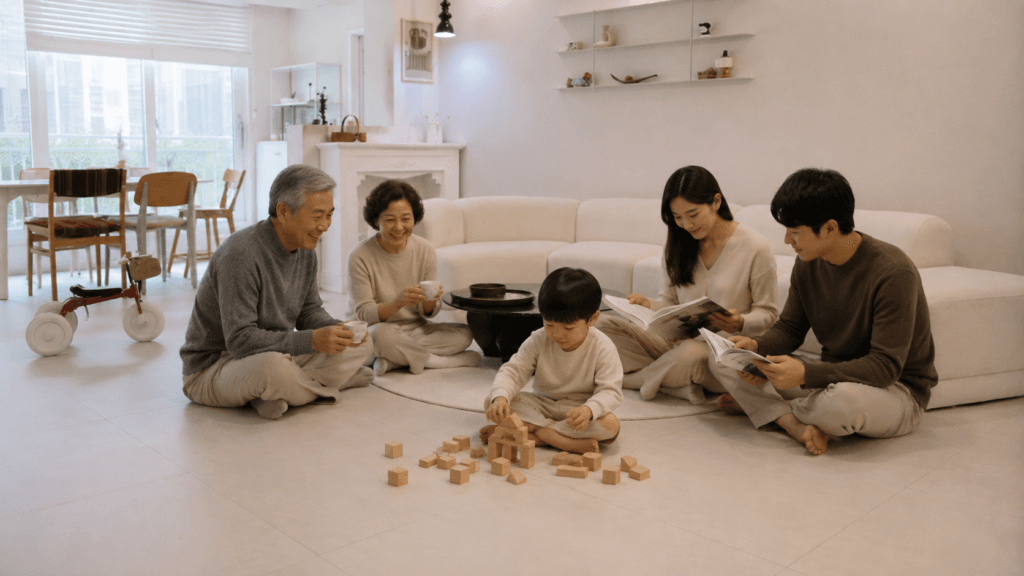
Families naturally move toward it.
Children play there for hours.
Parents stretch out after work.
Grandparents enjoy conversations over tea.
Without anyone planning it, the floor quietly becomes the center of everyday life.
This is the moment where many visitors begin to see Korean homes differently.
The floor was never important because of ondol.
Instead, ondol made the floor important.
It’s a subtle distinction, but it completely changes how you understand Korean home culture.
Once the warmest place in the house became the center of family life, architecture, furniture, and daily routines slowly evolved around it.
The story of ondol, then, isn’t really about heat.
It’s about how one simple innovation quietly reshaped everyday life for generations.
How Warm Floors Changed the Way Families Lived
It’s easy to think that ondol simply made Korean winters more comfortable.
In reality, it encouraged an entirely different way of living.
When the warmest place in the house is the floor, people naturally begin spending more time there.
Children don’t just play on the floor.
They grow up on it.
Families don’t simply walk across it.
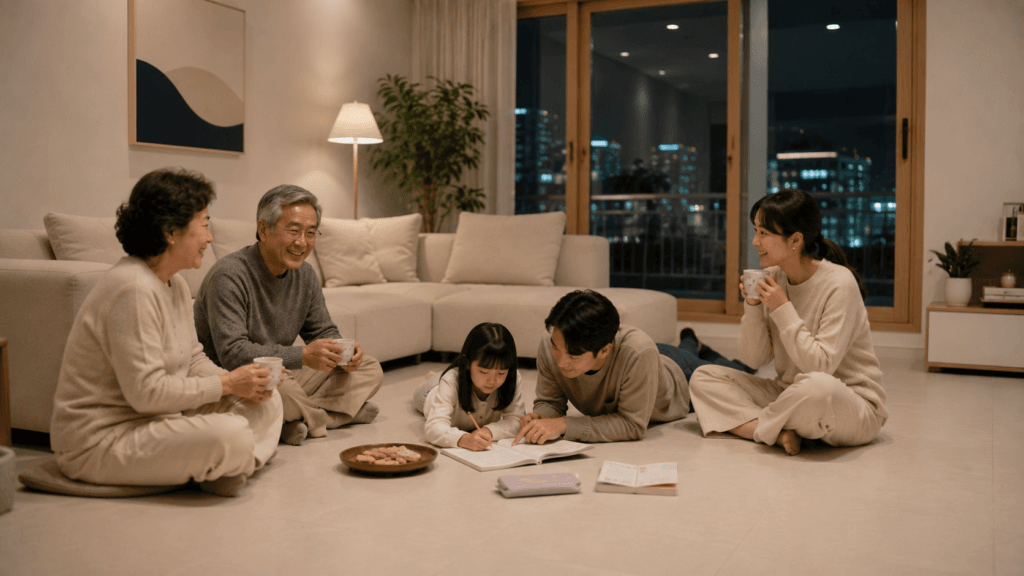
They gather there after dinner, share stories, celebrate holidays, and enjoy quiet evenings together.
Over time, the floor became something more than part of the house.
It became the place where family life unfolded.
That simple shift influenced countless parts of Korean culture.
Furniture remained lower than in many Western homes.
Large open living spaces became more practical than filling rooms with heavy furniture.
Even today, many Korean families instinctively choose the living room floor when everyone is together.
The space feels warm.
Comfortable.
Shared.
It’s a feeling that’s difficult to understand until you’ve experienced it yourself.
Here’s something many visitors never stop to consider.
In many countries, people gather around furniture.
In Korea, families have traditionally gathered on the floor.
That single difference quietly changed the rhythm of everyday life.
Perhaps that’s why many Korean homes still feel surprisingly open, even when they’re relatively small.
The center of the room isn’t reserved for a large dining table or oversized sofa.
Instead, it’s left flexible.
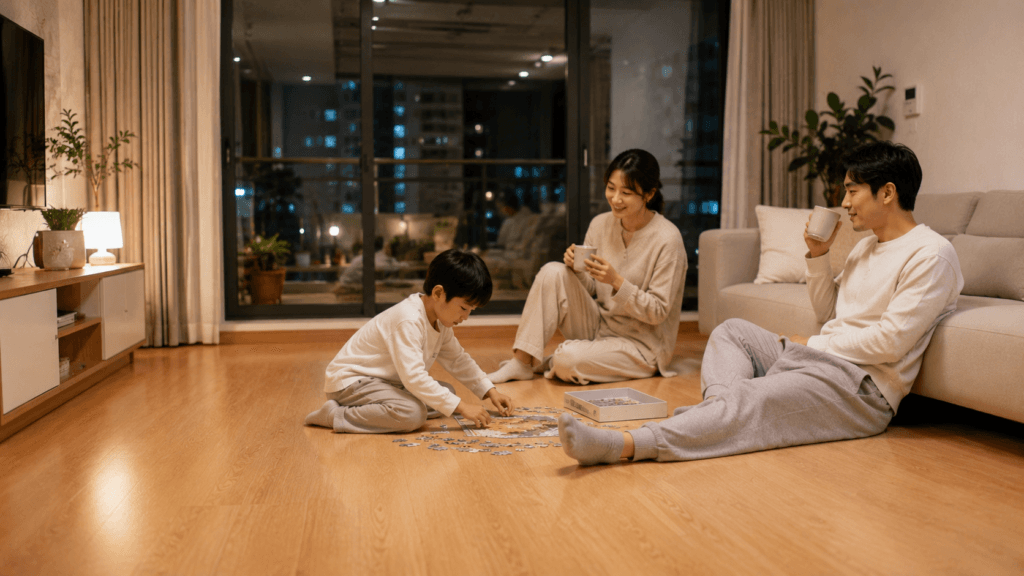
One moment it’s where children build puzzles.
An hour later it’s where grandparents relax.
By evening, it becomes the place where the whole family sits together.
The room changes with the people using it.
Rather than asking,
“How should we arrange the furniture?”
Korean homes have often asked a different question.
“How can this space best support the people living here?”
That’s a subtle but important distinction.
Because once a home is designed around people instead of furniture, many other parts of Korean home culture begin to make sense.
And nowhere is that more visible than in the way modern Korean apartments continue to embrace ondol—even centuries after it was first introduced.
Why Ondol Still Defines Modern Korean Homes
Many people assume that ondol belongs to Korea’s past.
In reality, it’s still part of everyday life.
Walk into almost any modern Korean apartment, and you’ll find a version of the same idea beneath your feet.
The technology has changed dramatically.
Traditional smoke channels have been replaced by modern radiant heating systems that circulate warm water beneath the floor.
The engineering is different.
The experience feels remarkably familiar.
Families still gather in the warmest part of the home.
Children still spread books and toys across the living room floor.
Parents still choose the floor when relaxing after a long day.
The tradition didn’t survive because people wanted to preserve history.
It survived because it continues to suit the way Korean families live today.
Perhaps that’s the most remarkable part of ondol.
Most inventions eventually become invisible.
People continue using them without thinking about where they came from.
Ondol is different.
Even if many Koreans rarely think about its history, they still experience its influence every single day.
It shapes how homes are designed.
It shapes where families spend time together.
It even helps explain everyday customs that might seem unrelated at first.
Why do most people remove their shoes before entering?
Why are wall-to-wall carpets uncommon?
Why do living rooms often feel more open and flexible than visitors expect?
These aren’t separate traditions.
They’re connected by the same philosophy.
Once the floor became the heart of the home, everything else gradually adapted around it.
That’s why understanding ondol isn’t simply learning about an old heating system.
It’s understanding one of the quiet ideas that continues to shape Korean life today.
Conclusion
The story of ondol is not really about warmth.
It’s about what warmth made possible.
A heated floor encouraged families to gather in one place.
That gathering shaped daily routines.
Those routines influenced architecture, furniture, and customs.
Over generations, a practical solution for cold winters became part of Korea’s cultural identity.
Sometimes the greatest innovations don’t change the world through dramatic inventions.
Sometimes they quietly change how people live together every single day.
Ondol is one of those rare ideas.
FAQ
What does ondol mean?
Ondol is Korea’s traditional underfloor heating system. Instead of heating the air first, it warms the floor, creating comfortable and even heat throughout the living space.
Do modern Korean apartments still use ondol?
Yes. Most modern apartments use radiant floor heating based on the same principle as traditional ondol, although the technology is much more advanced.
Why is ondol considered important in Korean culture?
Ondol influenced much more than home heating. It shaped family life, interior design, furniture, and everyday customs that are still common in Korea today.
Is ondol unique to Korea?
Many cultures developed different heating methods, but Korea’s ondol system is distinctive because it encouraged a floor-centered lifestyle that became deeply connected to Korean home culture.
Continue Exploring
If you enjoyed this article, you may also like:
- Why Koreans Always Take Off Their Shoes Indoors
- Why Korean Homes Rarely Use Carpets
- Why Korean Families Still Use Kimchi Refrigerators
- Why Korean Bathrooms Feel Different from the Rest of the World
- Inside a Typical Korean Apartment: What Every Room Reveals About Korean Life
- Why Almost Everyone Lives in Apartments in Korea
- Korean Home Culture: A Complete Guide to Everyday Life in Korean Homes