Many visitors notice something unusual after spending a few days in Korea.
Daily life rarely seems to require much planning.
Need groceries?
There’s probably a supermarket or convenience store just a few minutes away.
Want a coffee before work?
A café is likely on the same street.
Need to visit a pharmacy, clinic, bakery, or bank?
Most everyday errands can be completed during a single short walk.
At first, this convenience feels almost accidental.
In reality, it reflects decades of urban planning that placed everyday necessities close to where people live.
Rather than separating residential areas from commercial districts, many Korean neighborhoods combine housing, transportation, shopping, education, and public services into one connected environment.
This doesn’t mean every neighborhood looks the same.
Instead, many share a common philosophy.
The city should make ordinary life easier.
That idea influences where apartment complexes are built, how streets are organized, where local businesses operate, and how residents move through their day.
For millions of people, convenience isn’t considered a luxury.
It’s simply part of everyday life.
Everyday Essentials Are Never Far Away
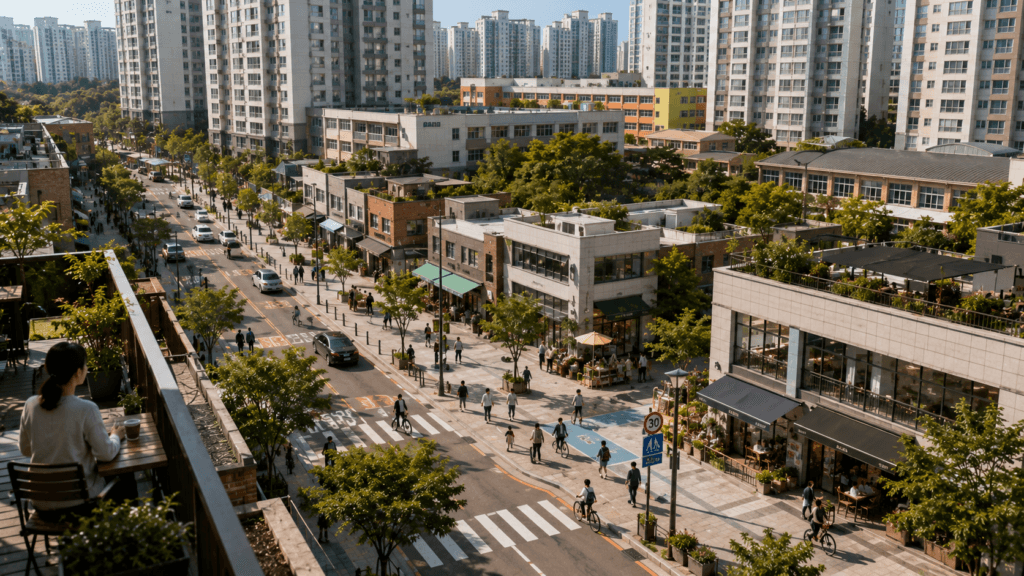
One of the biggest differences visitors notice is how little time many daily errands require.
Instead of driving across town for basic necessities, residents often find everything they need within walking distance.
A typical morning might begin with coffee from a neighborhood café before stopping at a convenience store on the way to the subway.
After work, groceries can be picked up without making a separate trip.
If someone needs a prescription, a pharmacy is often located just a short walk from nearby medical clinics.
These routines are possible because Korean neighborhoods are planned around everyday needs rather than occasional destinations.
Businesses that people use frequently naturally cluster near apartment communities and transportation hubs.
As a result, ordinary tasks become easier without requiring extra planning.
This close relationship between housing and local services also helps explain why Why Korean Apartment Complexes Feel Like Small Cities.
The apartment is rarely isolated from the surrounding neighborhood.
Instead, it functions as the center of a connected local community where daily life flows naturally between home, shops, schools, and public spaces.
For residents, this convenience quickly becomes something they stop noticing.
Only after traveling elsewhere do many realize how unusual it is to accomplish so much within a short walk from home.
Walkability Shapes Daily Life
Walking plays a much larger role in Korean cities than many visitors initially expect.
Even people who regularly use cars often spend part of each day walking between apartment buildings, subway stations, neighborhood shops, schools, parks, and restaurants.
Because destinations are located relatively close together, walking becomes the easiest option rather than an extra activity.
This influences more than transportation.
It changes how people experience their neighborhoods.
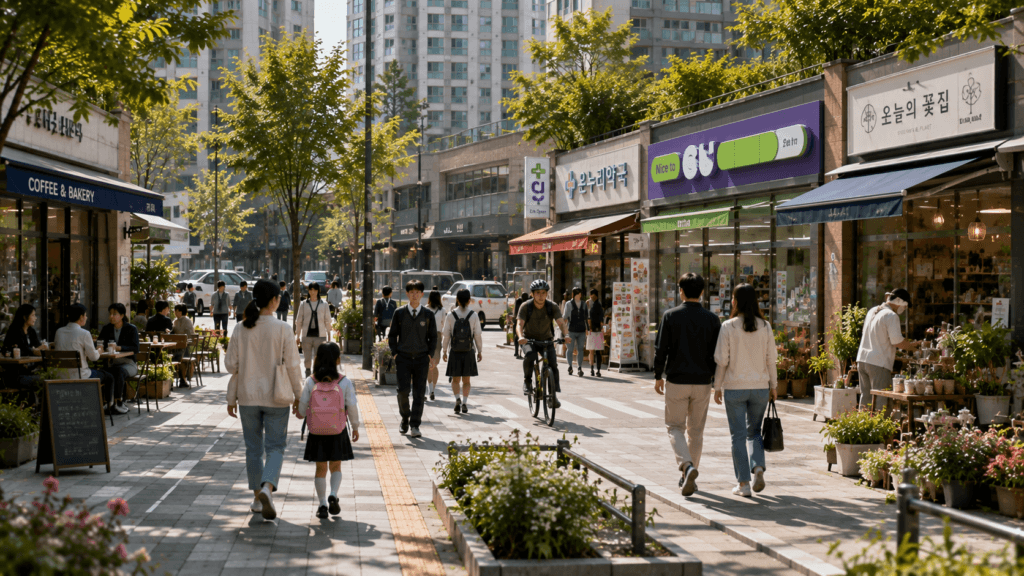
Instead of passing quickly through residential areas, residents regularly encounter familiar cafés, flower shops, bookstores, bakeries, and local restaurants during ordinary routines.
These repeated encounters create neighborhoods that feel active throughout the day.
Parents walk children to school.
Office workers stop for lunch at nearby restaurants.
Older residents enjoy morning walks through landscaped streets before meeting friends for coffee.
Evening brings another wave of activity as families shop for dinner or enjoy a short walk after returning home.
The streets remain connected to everyday life rather than serving only as routes between destinations.
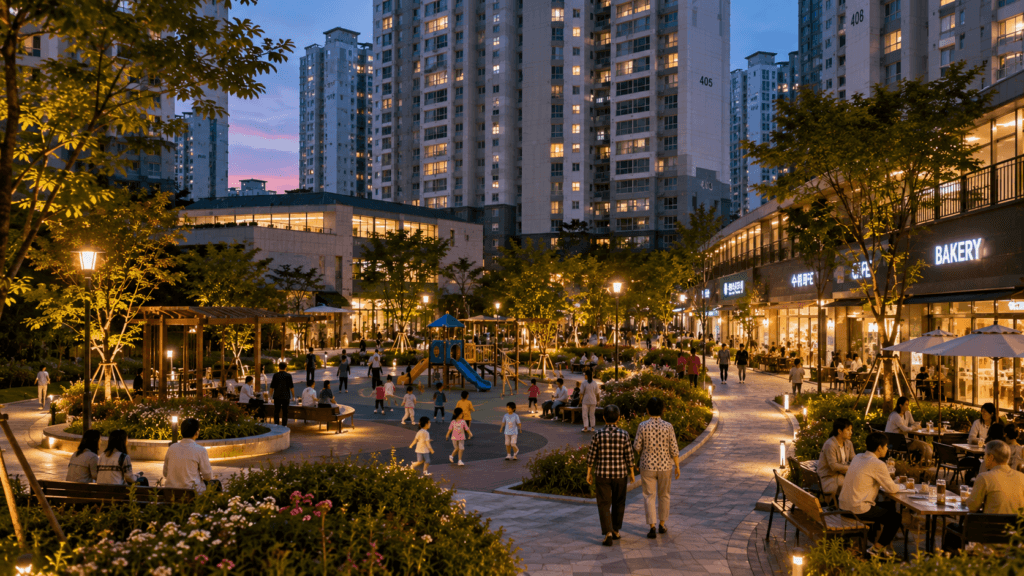
Parks also contribute to this rhythm.
Rather than being isolated recreational spaces visited occasionally, neighborhood parks often become part of residents’ daily routines.
Many people naturally pass through them while walking between home and nearby destinations.
As explored in Korean Park Culture: Why Parks Matter in Everyday Korean Life, these green spaces quietly support exercise, relaxation, and social interaction without requiring special planning.
Public Transportation Completes the Neighborhood
Convenience in Korean neighborhoods depends not only on nearby shops but also on excellent public transportation.
Many apartment communities are located within walking distance of subway stations or major bus routes.
This allows residents to travel across the city without relying entirely on private cars.
For many office workers, the daily commute follows a simple pattern.
Leave the apartment.
Walk a few minutes.
Take the subway.
Arrive near work.
Because transportation is closely integrated with residential development, the transition between neighborhood life and city life feels remarkably smooth.
This planning also influences where businesses choose to operate.
Cafés, restaurants, convenience stores, and service businesses naturally gather around transportation hubs because they serve both local residents and commuters.
The result is a neighborhood that remains active throughout the day instead of becoming quiet after the morning rush.
Transportation therefore does more than move people.
It helps connect every part of the neighborhood into one continuous living environment.
Why Convenience Supports Stronger Communities
It is easy to think of convenience as simply saving time.
In Korean neighborhoods, however, convenience also shapes how people interact with one another.
When schools, parks, cafés, grocery stores, and public transportation are all close together, residents naturally spend more time within their own community.
Children often walk to school with classmates who live in neighboring apartment buildings.
Parents recognize familiar faces while buying groceries or waiting at crosswalks.
Older residents develop daily routines around neighborhood parks, outdoor fitness areas, and local cafés.
These interactions are rarely planned.
They happen because the neighborhood encourages people to share the same public spaces throughout the day.
This creates a sense of familiarity without requiring close personal relationships.
People may not know every neighbor by name, but they often recognize one another through repeated encounters.
The neighborhood gradually becomes more than a collection of streets.
It becomes part of everyday life.
Apartment complexes contribute significantly to this atmosphere.
Rather than separating residents from the surrounding area, they often connect directly to pedestrian paths, parks, local businesses, and transit stations.
As discussed in Why Korean Apartment Complexes Feel Like Small Cities, housing and neighborhood planning are designed to complement each other rather than function as separate systems.
This balance between private living and shared public space is one reason Korean neighborhoods often feel both lively and comfortable.
Why Visitors Notice the Difference
Many visitors arrive expecting Korean cities to feel crowded and overwhelming.
Instead, they are often surprised by how manageable daily life becomes after only a few days.
Simple tasks rarely require long trips.
Walking feels practical.
Public transportation is easy to reach.
Local businesses remain close to residential areas.
The neighborhood quickly becomes familiar.
Someone staying in Korea for a week may find themselves visiting the same bakery every morning, stopping at the same convenience store after dinner, and recognizing the employees at nearby cafés.
Without consciously trying, they begin developing routines similar to those of local residents.
This experience explains why Korean neighborhoods leave such a lasting impression.
The convenience is not created by one remarkable feature.
It comes from dozens of thoughtful planning decisions working together.
Comfortable sidewalks.
Reliable public transportation.
Mixed-use streets.
Apartment-centered communities.
Accessible parks.
Local businesses that support everyday needs.
Each element contributes a little.
Together, they create neighborhoods where daily life feels unusually smooth.
Visitors often describe this feeling as efficiency.
Residents simply call it normal.
Conclusion
The success of Korean neighborhoods is not measured by famous landmarks or dramatic architecture.
Instead, it is reflected in the ease of ordinary life.
Buying groceries after work.
Walking children to school.
Meeting friends at a nearby café.
Taking a short evening stroll through a neighborhood park.
Catching the subway only a few minutes from home.
These small routines become possible because homes, transportation, businesses, and public spaces have been planned to support one another.
Rather than forcing residents to travel across the city for everyday necessities, Korean neighborhoods bring daily life closer to home.
That is why they feel so convenient.
And it is also why they remain one of the clearest examples of how thoughtful urban planning can quietly improve the quality of everyday life.
Frequently Asked Questions
Why are Korean neighborhoods so convenient?
Many Korean neighborhoods are designed with apartments, shops, schools, parks, and public transportation located close together, allowing residents to complete everyday errands within walking distance.
Do most Korean neighborhoods have convenience stores?
Yes. Convenience stores are extremely common and are usually located within a short walk of residential areas, making them part of everyday life for many residents.
Why is walking so common in Korea?
High residential density, mixed-use neighborhoods, and excellent public transportation make walking one of the easiest ways to travel between home and nearby destinations.
Are Korean neighborhoods designed around apartment complexes?
In many cities, yes. Apartment complexes often serve as the center of residential neighborhoods, with schools, parks, shops, and public transportation planned around them.
What makes Korean neighborhoods different from suburban neighborhoods?
Rather than separating residential, commercial, and public spaces, many Korean neighborhoods integrate them closely together, creating walkable communities that support everyday convenience.
Continue Exploring
If you enjoyed this article, you may also like:
- Why Korean Apartment Complexes Feel Like Small Cities
- Why Smart Homes Are Becoming Standard in Korean Apartments
- Inside a Typical Korean Apartment: What Every Room Reveals About Korean Life
- Why Almost Everyone Lives in Apartments in Korea
- Moving Day in Korea: More Than Just Changing Homes
- Can Foreigners Rent an Apartment in Korea? What to Expect Before You Move