Moving to a new home is usually stressful.
Boxes fill every room.
Furniture must be carried down narrow staircases.
Friends and family often spend the day lifting heavy appliances before collapsing from exhaustion.
Many visitors assume moving in Korea works the same way.
Then they witness their first Korean moving day.
Early in the morning, a large truck arrives.
A professional moving team quickly begins wrapping furniture, protecting appliances, and carefully packing kitchenware. Within a surprisingly short time, the apartment is almost empty.
Hours later, the same team is already arranging furniture, reconnecting appliances, and organizing belongings inside the new home.
The entire process often appears remarkably smooth.
For many Koreans, this efficiency isn’t unusual.
Moving is certainly a major life event, but it has also become a highly organized service supported by Korea’s apartment-centered cities.
Understanding moving day in Korea therefore means looking beyond the boxes and trucks.
It reveals how apartment design, professional moving companies, neighborhood planning, and modern urban living all work together to make one of life’s biggest transitions far less complicated.
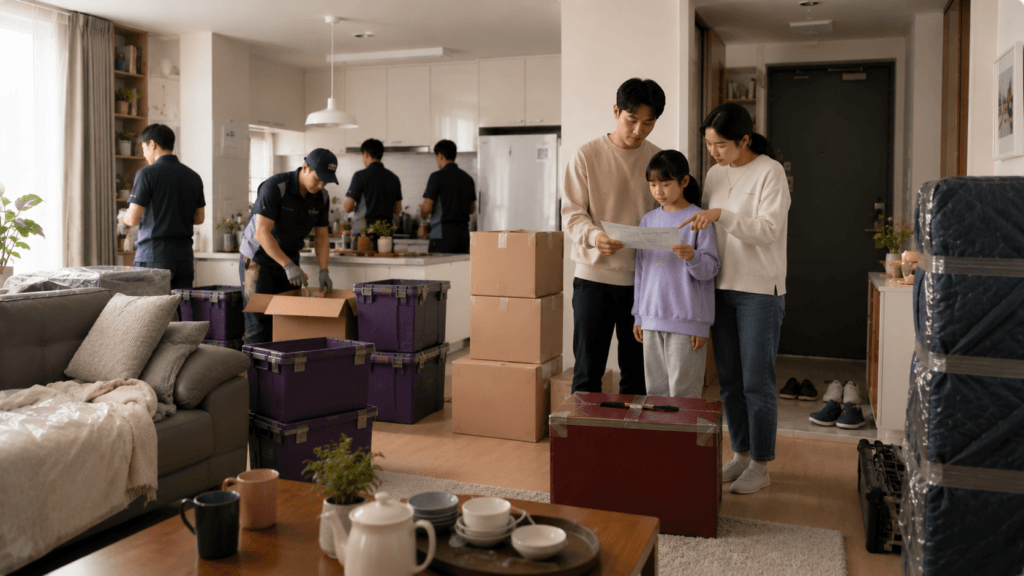
Moving Is a Carefully Organized Process
One of the biggest surprises for visitors is how professional the moving process has become.
Rather than relying on relatives or friends, many Korean families hire specialized moving companies that manage nearly every step.
Furniture is wrapped with protective covers.
Televisions and appliances are secured using custom materials.
Kitchen items are packed into reusable containers instead of ordinary cardboard boxes.
Even clothing often remains on hangers while being transported inside portable wardrobe boxes.
The goal is not simply to move belongings from one apartment to another.
It is to help families return to normal life as quickly as possible.
Professional movers frequently unpack furniture, reconnect appliances, and place household items in their new locations before leaving.
Instead of spending days surrounded by unopened boxes, many families are able to resume their daily routines almost immediately.
This level of organization reflects the practical approach found throughout Korean apartment living.
Just as apartments are designed to make everyday life more efficient, moving services have gradually evolved to reduce one of life’s most disruptive experiences.
Apartment Living Makes Moving Easier
Apartment buildings themselves play an important role in making the process more efficient.
Because many Korean families move between apartments with similar layouts, professional movers become highly familiar with building designs.
Loading areas, elevators, parking spaces, and apartment floor plans are often easier to navigate than detached homes with very different layouts.
Many apartment complexes also coordinate moving schedules.
Residents may reserve elevator access in advance so large furniture can be transported safely without causing unnecessary inconvenience for neighbors.
Management offices often help organize these arrangements, allowing several households to move on the same day while keeping the building running smoothly.
The standardized nature of many apartments also simplifies planning.
Furniture that fit comfortably in one apartment often fits similarly in another with a comparable layout.
Built-in storage reduces uncertainty.
Kitchen appliances are designed for similar spaces.
The transition therefore feels more predictable than moving between completely different types of homes.
As discussed in Inside a Typical Korean Apartment: What Every Room Reveals About Korean Life, many apartments share practical design principles that make everyday living—and moving—much more straightforward.
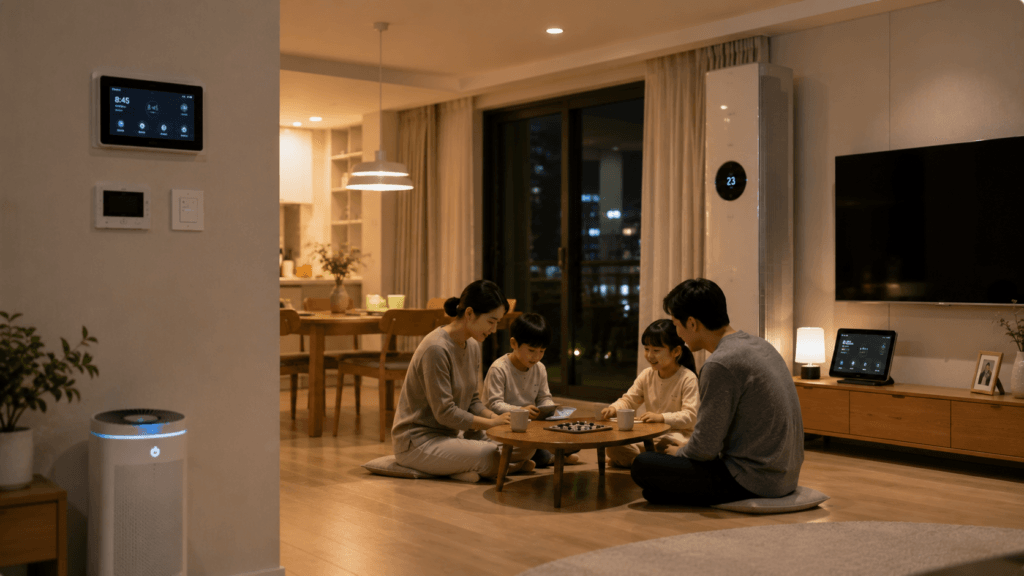
Moving Day Reflects a New Beginning
Although moving day involves logistics, it also carries emotional meaning.
For many families, moving represents the beginning of a new stage in life.
A newly married couple may move into their first apartment together.
Parents may relocate to be closer to a child’s school.
A growing family might move into a larger apartment, while older couples sometimes choose smaller homes after their children become independent.
Because housing decisions in Korea are closely connected to education, commuting, employment, and changing family needs, moving often reflects much more than a change of address.
It marks the start of a different daily routine.
A new neighborhood.
New walking routes.
Different local cafés.
A different subway station.
New neighbors who will gradually become familiar faces.
The home changes, but so does the rhythm of everyday life.
Why Korean Moving Services Feel So Different
The most distinctive part of moving day in Korea is often the level of service.
Many moving companies offer what is commonly understood as a full-service move. The family does not necessarily spend the previous night sealing dozens of cardboard boxes or wrapping every plate by hand.
Instead, the moving team arrives with containers, protective materials, portable wardrobes, and equipment designed for apartment buildings.
Kitchen cabinets are emptied.
Dishes are wrapped.
Clothing is transferred while still hanging.
Large appliances are disconnected and prepared for transport.
At the new home, the process happens in reverse.
Furniture is placed where the family wants it. Refrigerators and washing machines are reconnected. Kitchen items may be returned to cabinets. Clothing can be placed back into closets.
The exact service varies by company and contract, but the overall expectation is clear.
Moving professionals are not hired only to lift heavy objects.
They are hired to restore the household.
That difference matters because Korean homes often depend on carefully organized storage. A move can disrupt every system inside the apartment at once, from the kitchen and laundry area to the shoe cabinet and built-in closets.
A service that simply leaves boxes in the living room would transfer the physical belongings without restoring the family’s routine.
Professional movers solve a larger problem.
They help transform an unfamiliar apartment into a functioning home within a single day.
This practical approach reflects the same philosophy found in How Korean Apartments Make Small Spaces Feel Bigger. Efficient living depends not only on the amount of space available but also on how quickly and logically everything can be returned to its proper place.
High-Rise Apartments Require Specialized Equipment
Not every sofa fits inside an elevator.
Not every refrigerator can turn through an apartment hallway.
And not every high-rise building allows movers to carry large furniture through the main entrance without careful coordination.
Korean moving companies have adapted to this reality with specialized equipment.
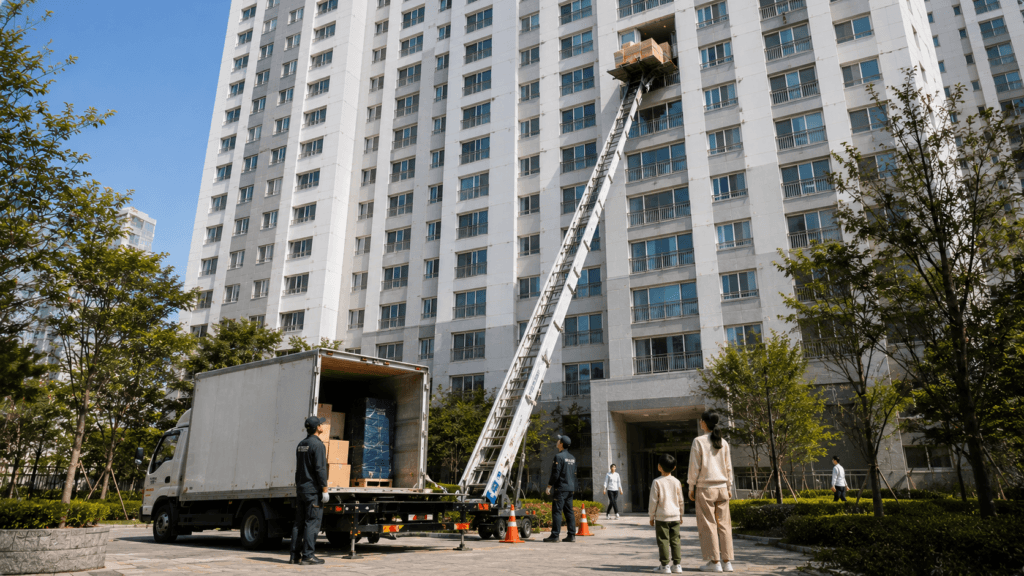
One of the most recognizable sights on moving day is an exterior lifting platform positioned beside an apartment building. Furniture and appliances can be raised directly toward a balcony or large window rather than being carried through narrow shared spaces.
To someone seeing it for the first time, the process may look dramatic.
A wardrobe appears to float beside the building.
A sofa rises several floors above the ground.
Large items disappear into an apartment without ever passing through the lobby.
Yet for experienced moving teams, this is a controlled and familiar procedure.
The method reduces pressure on elevators, protects common areas, and makes it possible to move oversized belongings more efficiently. It also helps explain why utility balconies and accessible exterior spaces can matter during major household transitions.
The equipment itself is only one part of the process.
Parking space must be secured.
Building rules must be followed.
The moving company may need to coordinate with the apartment management office.
Neighbors must still be able to use entrances and shared roads.
Once again, the success of moving day depends on several systems working together.
The truck, the building, the management office, the movers, and the family all become part of one carefully timed operation.
The New Neighborhood Changes Daily Life
A move does not end when the last piece of furniture enters the apartment.
The family must also learn the rhythm of a new neighborhood.
The nearest supermarket may now be in a different direction.
The walk to school changes.
A different bus stop becomes part of the morning commute.
The pharmacy, dry cleaner, café, clinic, and convenience store all have to be discovered again.
These details may seem minor, but together they determine how the new home feels.
In Korea, housing and neighborhood life are closely connected. Choosing an apartment often means choosing the daily environment surrounding it.
That may include access to public transportation, school districts, walking paths, local shops, parks, medical facilities, and delivery services.
This is why moving between two apartments can still create a meaningful lifestyle change, even when the homes themselves have similar layouts.
As explored in Why Korean Neighborhoods Are Designed for Everyday Convenience, the surrounding streets are not separate from the home experience. They support the routines that begin and end at the apartment door.
During the first few days after a move, families begin rebuilding those routines.
They learn which entrance is fastest in the morning.
They discover where packages are delivered.
They find the recycling area.
Children begin recognizing the playground.
Parents identify the most practical route to work or school.
Older residents may search for a comfortable walking path nearby.
The apartment becomes familiar through repetition, but so does the neighborhood.
A new home feels settled only when the surrounding area also begins to feel predictable.
Moving Reveals How Much the Home Supports Daily Life
Most people rarely think about the systems inside their home while everything is working normally.
The shoes have a place.
The kitchen is organized.
Laundry supplies are within reach.
Heating, storage, and appliances quietly support the day.
Moving makes all of this visible.
For a brief period, every routine is interrupted.
Objects lose their usual places.
The family must decide what to keep, what to discard, and where everything should belong in the new apartment.
This is one reason moving can feel emotionally exhausting even when professionals handle most of the physical work.
The family is not simply transporting possessions.
It is rebuilding the structure of everyday life.
A familiar mug must find a new cabinet.
A child’s study area must be recreated.
The washing machine must fit into a different utility space.
The dining table may change position because sunlight enters from another direction.
Small decisions slowly turn the apartment from an empty unit into a personal home.
Moving day therefore reveals something important about Korean home culture.
Comfort does not come only from expensive furniture or a large floor plan.
It comes from knowing where things belong and being able to move through daily routines without unnecessary difficulty.
That is also why professional moving services are valued so highly.
They shorten the uncomfortable period between leaving one familiar system and creating another.
Conclusion
Moving day in Korea may appear unusually fast from the outside.
A team arrives in the morning.
Furniture disappears from one apartment.
By evening, much of the household is already functioning somewhere else.
But speed alone does not explain the process.
The efficiency comes from an entire apartment culture built around coordination.
Professional movers understand standardized residential spaces.
Management offices organize access.
Specialized equipment handles high-rise buildings.
Neighborhood infrastructure allows families to rebuild their daily routines quickly after arrival.
The result is a moving experience that reflects many of the same priorities found throughout Korean home life.
Organization.
Practicality.
Convenience.
And the desire to return to an ordinary family rhythm as quickly as possible.
Moving day in Korea is therefore more than changing homes.
It is the moment when one system of everyday life is carefully dismantled and another begins.
Frequently Asked Questions
How does moving day in Korea usually work?
Many families hire professional movers who pack, transport, unpack, and arrange household belongings. The exact level of service depends on the moving package selected.
Do Korean movers pack everything for you?
Full-service moving companies often pack most household items, including kitchenware, clothing, furniture, and appliances. Some families still prepare personal documents, valuables, and fragile items themselves.
Why do Korean movers use exterior lifting platforms?
Large furniture may not fit easily inside apartment elevators or hallways. Exterior lifts allow movers to transport bulky items through balconies or large windows while reducing disruption inside the building.
Do residents need permission before moving into a Korean apartment?
Apartment management offices often require advance notice or reservations for elevators, parking areas, or exterior lifting equipment. Specific rules vary by building.
Is moving in Korea expensive?
Costs depend on distance, household size, floor level, equipment requirements, season, and the amount of packing and unpacking included. Full-service moves generally cost more than basic transportation.
Continue Exploring
If you enjoyed this article, you may also like: