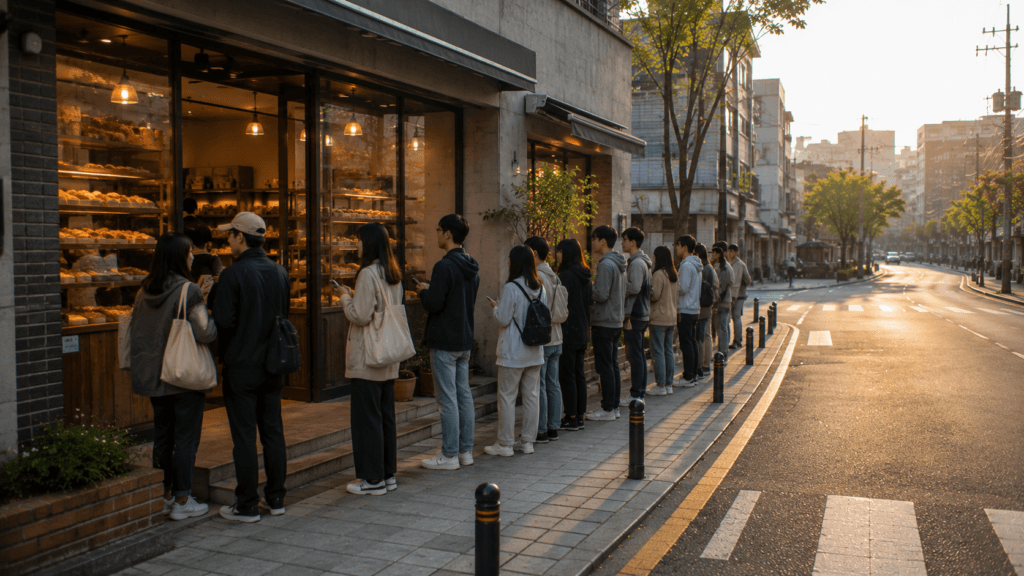
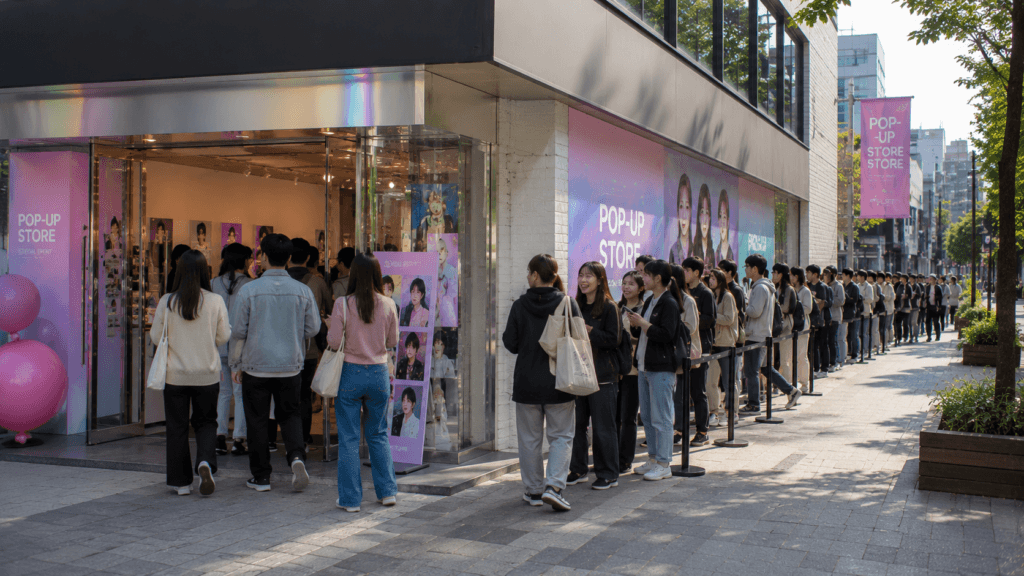
On a busy weekend in Korea, you may see a long line outside a famous bakery, a crowd waiting for a new pop-up store, or dozens of groups hoping to get into the same restaurant.
Then, a few hours later, you might encounter a completely different kind of queue.
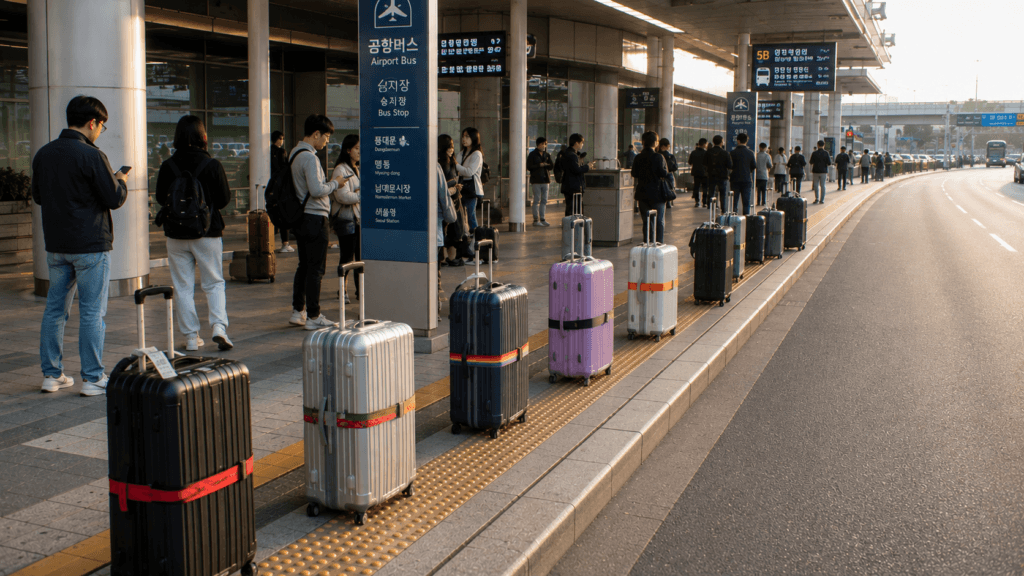
At an airport bus stop, several suitcases are lined up neatly near the boarding point while their owners stand somewhere nearby. Nobody is physically occupying those spots, yet when the bus arrives, people generally understand whose turn comes first.
At some restaurants, even the suitcases have disappeared. Customers register digitally, walk away, and return after receiving a notification that their turn is approaching.
These scenes may look unrelated, but they share something important.
The physical line is not always what creates order. The order exists because people understand and recognize whose turn comes next.
Of course, lining up is hardly unique to Korea. People queue for restaurants, transportation, concerts, and stores around the world. It would be misleading to suggest that Koreans somehow invented waiting in line or are naturally more willing to wait than everyone else.
What can be interesting to visitors, however, is how easily the idea of an orderly turn carries across different parts of everyday Korean life. Sometimes people form an obvious line. Sometimes a numbered ticket replaces it. Sometimes an app manages it. Occasionally, an object is enough to mark someone’s place.
Understanding that difference reveals much more about waiting in Korea than simply counting how many people are standing outside a popular restaurant.
Why Are Queues So Visible in Korea?
The most noticeable queues are usually the easiest to understand.
Popular restaurants attract diners. Famous bakeries draw people before opening. Limited-time pop-up stores can create long lines on weekends, while exhibitions and seasonal events bring many visitors to the same place at roughly the same time.
Korea’s dense urban environment can make these queues particularly visible.
In neighborhoods such as Seongsu, Hongdae, Gangnam, or parts of central Seoul, restaurants, cafés, shops, and entertainment spaces are often concentrated within a relatively small area. When one destination becomes especially popular, demand can quickly become visible on the street.
But most customers did not simply walk past, see a line, and decide to join it without knowing why.
They may already have searched for the restaurant, saved it on a map, seen photos online, heard about it from a friend, or planned the visit as part of their weekend.
The queue is therefore often the last stage of a decision that was made much earlier.
This distinction matters because there is a big difference between unexpectedly waiting 40 minutes for an ordinary meal and deliberately traveling somewhere while knowing that a popular restaurant may have a wait.
In the second situation, waiting has already been included in the mental cost of the experience.
A Long Queue Can Still Act as Social Proof
There is also a simple psychological reason busy places continue attracting attention.
When people see others willing to wait, they become curious about what is at the other end of the line.
A queue does not prove quality. An excellent neighborhood restaurant can have empty seats, while a fashionable place with a long line can still disappoint.
But popularity is visible.
If you have already heard about a bakery several times and then arrive to find people waiting before it opens, the crowd can reinforce the idea that there really is something worth trying.
In Korea, that effect can become stronger when recommendations spread quickly through social media, map reviews, friends, and online communities. A restaurant or dessert that becomes popular can suddenly appear in many people’s weekend plans at once.
Temporary experiences add another reason to wait.
A restaurant will probably still exist next month. A three-week pop-up store may not. Seasonal food, limited products, exhibitions, and temporary events create a different kind of urgency because postponing the visit can mean missing it completely.
This does not mean everyone joins the line. Plenty of people see a long wait and leave.
But it does explain why some queues keep growing even when everyone can clearly see how long they are.
Waiting Is Less About Patience Than Whether Something Feels Worth It
It is easy to look at a long restaurant queue and conclude that Koreans must be unusually patient.
Everyday behavior suggests something more ordinary.
People generally do not want to waste their time.
An office worker with a limited lunch break is unlikely to celebrate discovering a one-hour wait. Friends deciding where to eat may abandon one restaurant when they hear there are 50 groups ahead of them. Someone who lives nearby may decide to return on a weekday rather than spend Saturday afternoon in a crowd.
What changes is the perceived value of the destination.
Imagine two friends who have been talking about the same restaurant for several weeks. They finally meet on Saturday and travel across Seoul to try it. When they arrive, the restaurant has a wait.
They may stay because the meal is not simply lunch anymore. Visiting that particular place was already part of the plan.
While waiting, they decide what to order, look around the neighborhood, talk about whether the restaurant will live up to its reputation, and find somewhere else to spend the remaining time.
The wait itself is still inconvenient. What makes it acceptable is that the experience seems worth the inconvenience.
That is a more useful way to understand many Korean queues than calling them a sign of patience.
People are constantly making a calculation, even if they never express it directly:
How badly do I want this, and how much of my time is it worth?
In Korea, Waiting No Longer Always Means Standing There
This is where modern Korean waiting culture becomes especially interesting.
At many popular restaurants, the queue may be much longer than the number of people physically standing outside suggests.
Customers can register their place through a digital waiting system, and depending on the restaurant, receive updates as their turn approaches. Catchtable is one widely used example, and participating businesses can use waiting numbers and mobile notifications to manage people in order. Some restaurants specifically instruct customers to check KakaoTalk notifications as their place in the queue gets closer.
So imagine arriving at a restaurant and learning that there are 20 groups ahead of you.
You may not have to spend the next hour standing beside the door.
Instead, you register, check your position, and go somewhere nearby. You might visit a café, browse a shop, or simply walk around until it is nearly your turn.
For someone unfamiliar with the system, the scene can be confusing. A restaurant may have a significant waiting list while only a handful of people appear to be outside.
The queue still exists.
It has simply become invisible.
Catchtable’s own information for international visitors describes systems in which diners can register for waiting and check their status through the app, illustrating how digital queue management has become part of the restaurant experience.
This fits naturally with Korea’s broader preference for reducing unnecessary friction in everyday routines.
If people must wait, there is little reason to require them to stand in exactly the same place while doing it.
Technology does not eliminate the wait.
It makes the wait easier to manage.
The Most Interesting Part May Be the Order, Not the Line
This brings us to something more revealing than the restaurant queue itself.
A physical line only works when everyone accepts what the line represents.
The person ahead of you gets to enter first because that person arrived first. You may not enjoy waiting behind them, but there is an obvious reason why their turn comes before yours.
That reason makes the outcome easier to accept.
Imagine instead that 20 groups were standing outside a restaurant and nobody knew who should enter when a table became available. Every opening would create uncertainty. Someone would need to argue that they had arrived earlier, staff would constantly have to make judgments, and customers might wonder whether someone else was receiving preferential treatment.
A queue removes most of that negotiation.
You know where you stand.
The person behind you knows where they stand.
The restaurant knows who comes next.
Waiting is still waiting, but there is a clear rule explaining the result.
That is why the more interesting feature of Korean queue culture is sometimes not the line itself, but the willingness to preserve an understood order even when the physical line disappears.
Sometimes a Suitcase Can Hold Your Place
Airport and intercity transportation can produce one of the clearest everyday examples.
At some bus stops used by travelers, you may occasionally see suitcases placed in a sequence near the boarding area while their owners wait nearby rather than standing directly behind their luggage.
To someone encountering the scene for the first time, it can look strange.
Are the suitcases waiting for the bus?
In a practical sense, they are marking the order.
The important part is that this only works when the people waiting generally recognize what those objects represent. If everyone ignored the bags and rushed toward the door when the bus arrived, the arrangement would be meaningless.
Instead, the luggage can function as a placeholder because the sequence itself matters.
It is a small example, and certainly not something that happens at every Korean bus stop, but it reveals the same principle seen in restaurant waiting systems.
A person does not necessarily have to remain physically inside a line for their place to remain meaningful.
At the restaurant, a number can represent you.
At the bus stop, sometimes your suitcase does.
What matters is not the object. What matters is the shared understanding of the order.
Digital Waiting Uses the Same Rule
Seen from this perspective, a modern waiting app is not such a dramatic departure from traditional queuing.
It is the same social system with a different marker.
In a physical queue, your body marks your position.
In some informal situations, an object may mark it.
In a restaurant’s digital queue, a number marks it.
The technology can tell customers when their turn is getting close and allow them to move elsewhere, but the central principle has not changed: someone who joined earlier is normally ahead of someone who joined later.
This is also why a functioning waiting system can reduce frustration.
If you are number 32 and the restaurant is currently serving people around number 20, you understand why you are not entering yet.
You may dislike the delay, but the delay has an explanation.
The frustration is more likely to appear when the rule seems to break—when someone who apparently arrived later goes first without an obvious reason, or when customers cannot understand how the order is being determined.
In that sense, orderly waiting is partly about fairness.
People do not necessarily need everything to happen immediately. It is often enough to know that the same understandable rule applies to everyone.
This Sense of Order Appears Beyond Restaurant Queues
Visitors sometimes notice similar behavior in other parts of Korean public life.
At subway platforms, floor markings often indicate where passengers should wait while leaving space for people to exit first. At busy venues, customers may take numbers instead of forming a dense physical line. In many everyday settings, people quickly look for the existing order before deciding where they should stand.
Pedestrian crossings can sometimes produce another small moment that catches a visitor’s attention: a group may remain at the curb waiting for the signal even when there appears to be little traffic.
None of these behaviors is uniquely Korean, and individual behavior naturally varies. Koreans cross against signals too, people misunderstand queues, and crowded situations are not always perfectly orderly.
The point is not that Korea follows every public rule flawlessly.
What is more interesting is how frequently everyday systems are built around a shared expectation that there should be an understandable order, and how readily people use that order to coordinate themselves without having to discuss it every time.
That makes crowded urban life easier.
Millions of people share trains, buses, restaurants, apartment complexes, shopping districts, and public spaces every day. Small rules about whose turn comes next prevent ordinary encounters from becoming constant negotiations.
Koreans Will Still Walk Away From a Bad Wait
None of this means waiting is automatically accepted.
If anything, mobile waiting systems make it easier to see how selective people can be.
A customer may check the number of groups ahead and decide immediately that the restaurant is not worth it. Friends may choose another place nearby. Someone may arrive earlier the next time or visit on a weekday.
Convenience and queue culture are therefore not opposites.
They work together.
People accept an order when demand exceeds capacity, but they also use technology and planning to reduce how much of their day must actually be sacrificed to that order.
This is an important correction to the stereotype that long Korean queues reveal some unusual love of waiting.
They do not.
A person willing to wait 90 minutes for a famous bakery today may refuse to wait 20 minutes for an ordinary meal tomorrow.
The difference is not patience.
It is value.
What Waiting in Line in Korea Really Reveals
A queue outside a Korean restaurant may initially seem like a simple story about popularity.
Sometimes it is.
Someone saw the restaurant online, decided it looked good, arrived on Saturday, and discovered that hundreds of other people had made exactly the same decision.
But look beyond the popular restaurant and a more interesting pattern appears.
The physical line can disappear while the order survives.
Customers can leave a restaurant and return when their digital number approaches. Travelers can sometimes let luggage represent their place while they stand nearby. A numbered system can organize people who never physically line up together at all.
What connects these situations is not a uniquely Korean invention called queuing. People around the world understand the basic rule of first come, first served.
What makes these everyday Korean scenes worth noticing is how comfortably that rule can move between physical and invisible forms.
The person who goes before you has a reason to go before you.
They arrived first.
They registered first.
Their number came first.
Once everyone understands that reason, waiting becomes much easier to organize without argument or constant supervision.
And perhaps that is the most useful way to understand waiting in Korea.
It is not really a story about people who love standing in line.
Sometimes, there is not even a line to stand in.
It is a story about how people agree on whose turn comes next.
FAQ
Why do people wait in line so much in Korea?
Visible queues often form at popular restaurants, bakeries, pop-up stores, exhibitions, and limited-time events. People may already know a destination is popular before arriving, making the expected wait part of their decision about whether the experience is worthwhile.
Do Koreans enjoy waiting in line?
Not necessarily. People frequently avoid peak times, choose another destination, or use digital waiting services so they do not have to stand outside for the entire wait. A person’s willingness to wait usually depends on how much they value the particular experience.
How does digital restaurant waiting work in Korea?
Depending on the restaurant, customers can register for a waiting list and track their place or receive mobile notifications as their turn approaches. This can allow them to spend part of the waiting time somewhere nearby rather than remaining outside the restaurant.
Does Catchtable send waiting notifications in Korea?
Participating restaurants can use Catchtable to manage waiting, and some restaurants provide instructions for customers to check mobile or KakaoTalk notifications as their turn approaches. The exact process can differ by restaurant.
Is orderly queuing unique to Korea?
No. Queuing and first-come, first-served systems exist around the world. What can be interesting in Korea is how the same sense of order can continue through physical queues, numbered systems, mobile waiting services, and occasionally informal placeholders such as luggage.
Continue Exploring
If you enjoyed this article, you may also like:
Why Korean Weekends Feel Different
Popular restaurants and crowded neighborhoods are only one part of the story. See how cafés, parks, shopping districts, and everyday routines change the rhythm of Korean cities once the weekend begins.
Why KakaoTalk Is Essential to Everyday Life in Korea
KakaoTalk is not only where friends make plans. Notifications, businesses, services, and everyday communication help explain why a messaging app has become so deeply woven into daily life.
Why the Han River Is Part of Everyday Life in Seoul
From evening walks to weekend picnics, the Han River shows another side of how Seoul residents use shared public space in ordinary life.