two adults are in love. They have jobs, their own lives, and apparently no reason to ask anyone for permission to date.
Then the parents find out.
Suddenly, what seemed like a relationship between two people becomes a family matter. A mother demands to meet the boyfriend. A father questions the girlfriend’s background. Someone asks what the other person’s parents do for a living. Marriage is mentioned, and before long, people who were not part of the romance are sitting across from each other discussing its future.
For international viewers, especially those accustomed to seeing adult relationships as largely private decisions, the reaction can feel extreme.
Why do the parents have so much say when their children are already adults?
Some of what you see is obviously drama. Wealthy families trying to separate couples, envelopes of money offered in exchange for a breakup, and parents treating a relationship like a corporate merger make excellent television precisely because they create conflict.
But underneath those exaggerated scenes is something more recognizable: in Korea, marriage has historically been understood not only as a relationship between two individuals but also as a connection between two families.
That does not mean Korean adults simply let their parents choose whom they marry. Modern relationships are far more individual than that.
But it does help explain why the question in a K-Drama can move surprisingly quickly from “Do you love this person?” to “What kind of family do they come from?”
Why Dating Suddenly Becomes a Family Issue
At the beginning of many K-Drama romances, the family may barely matter.
Two people meet at work, through friends, at school, or by coincidence. They spend time together and develop feelings without their parents being involved.
Then the relationship becomes serious.
That is often when the questions change.
Where is the other person from?
What do they do?
What kind of family did they grow up in?
What do their parents do?
Would the two families get along?
To an international viewer, some of these questions can feel intrusive. Why should the occupation of someone’s father have anything to do with whether two adults are compatible?
The cultural background becomes easier to understand when marriage is viewed as creating relationships beyond the couple.
Traditionally, marriage in Korea connected families socially as well as legally. Weddings, holidays, family events, responsibilities toward parents, and relationships with in-laws meant that the person someone married could become deeply involved in the wider family network.
Modern Korean couples do not all approach marriage this way, and attitudes continue to change. Yet traces of that older expectation remain familiar enough for dramas to use without explaining why parents suddenly become interested once a relationship looks serious.
The parents are not necessarily reacting to dating itself.
They are beginning to imagine what might happen if dating turns into marriage.
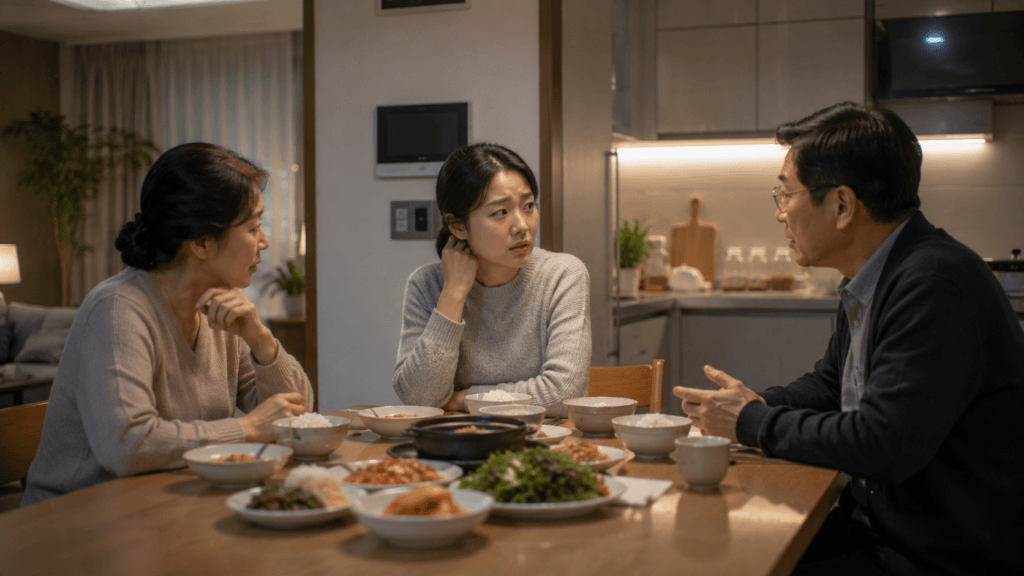
Why Parents Ask About Someone’s Family Background
This is one of the K-Drama details that can be especially uncomfortable for overseas viewers.
A parent hears that their son or daughter is dating someone and immediately begins asking about that person’s family.
Sometimes the questions are subtle.
Sometimes they are not subtle at all.
In dramas centered on wealth or social status, this can become extreme. A powerful family investigates a potential partner’s parents, education, job, financial situation, and social standing as though they were evaluating an investment.
Those plots are deliberately heightened for entertainment.
But the idea that family background can matter in discussions about marriage has a real cultural history.
The Korean concept of family traditionally placed strong emphasis on the wider household and lineage rather than treating every adult decision as entirely separate from the family. Marriage therefore had implications for parents and relatives as well as the couple.
This is also why meeting someone’s parents in a K-Drama can carry more weight than an ordinary introduction.
A casual “This is the person I’m dating” can become a signal that the relationship has reached a different stage.
The questions become more serious because the future being considered is more serious.
That does not mean every Korean parent interrogates potential partners about their family or income. Many parents care far more about whether their child is happy and whether the relationship is healthy.
But K-Dramas often take the older expectation that families should be compatible and turn the volume up.
That is how viewers end up with one of the genre’s most recognizable conflicts: two people who are perfectly happy together but whose families are not.
Why Rich Families Object So Often in K-Dramas
Then we reach the version international viewers probably recognize immediately.
The chaebol family.
A wealthy heir falls in love with someone from an ordinary background, and the family reacts as though the entire future of the business is in danger.
A parent objects. Another marriage partner is preferred. Social status becomes more important than the couple’s feelings.
Does this mean wealthy Korean families routinely control their children’s relationships this way?
No.
This is where cultural context and dramatic convention need to be separated.
Class differences are useful for storytellers because they turn family approval into a visible conflict. If both families have similar expectations, there may be very little story. Give one character enormous wealth and the other an ordinary background, and suddenly every family expectation becomes more dramatic.
But these plots work partly because viewers already understand the underlying question:
How much should family expectations influence an individual’s choice of partner?
That question is much broader than chaebol romance.
It can appear when parents worry about financial stability, education, career prospects, age, divorce history, or whether the other person’s family will create difficulties after marriage.
The wealthy-family storyline exaggerates those concerns until they become impossible to miss.
What international viewers are seeing, then, is often a real tension pushed to television extremes: the desire to choose your own life versus the expectation that major decisions should not completely ignore the family around you.
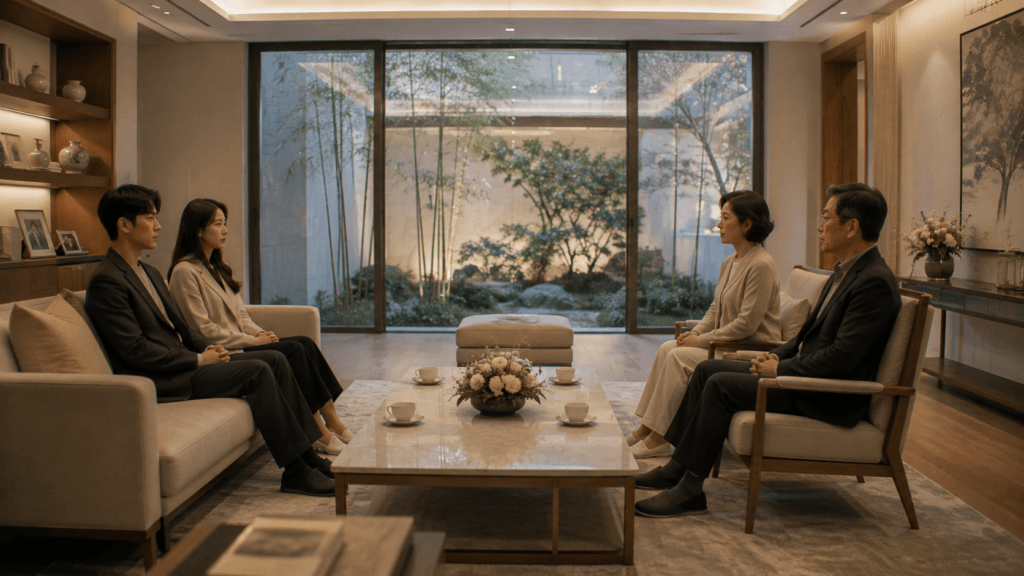
Why Meeting the Parents Can Feel Like a Major Turning Point
This is why “meeting the parents” can change the atmosphere of a K-Drama romance so quickly.
Before that moment, the relationship belongs mostly to the couple.
Afterward, another layer has been added.
A parent may ask about career plans. Someone may want to know whether marriage is actually being considered. The couple themselves may suddenly realize that introducing each other to family has made the relationship feel more serious.
The important thing is not that every Korean couple follows one fixed sequence.
They do not.
It is that family introductions can carry a recognizable implication of seriousness, particularly when a relationship is moving toward marriage.
That gives K-Dramas an efficient cultural signal.
A character saying, “I want you to meet my parents,” can mean more than arranging dinner.
It can mean:
I am beginning to imagine you as part of my future.
And once the families enter the story, the relationship is no longer quite as private as it was before.
Does Family Approval Still Matter in Korea Today?
This is where K-Dramas can make the situation look more absolute than it really is.
Modern Korean adults generally choose their own partners. Parents may have opinions, sometimes strong ones, but that is very different from saying that adult children routinely need parental permission to date or marry.
Still, approval can matter emotionally and practically.
Marriage can bring two families into regular contact through weddings, holidays, celebrations, and other family occasions. If parents strongly dislike a partner or the two families have serious conflict, the couple may worry that the tension will continue long after the wedding.
That helps explain a distinction international viewers can easily miss.
A character may not be asking:
“Am I allowed to marry this person?”
They may really be asking:
“What will my life look like if my family never accepts this person?”
Those are very different questions.
The second one leaves the final decision with the couple while acknowledging that family relationships can still affect the life they build afterward.
Korean Attitudes Are Changing Too
There is also a generational story behind many of these scenes.
Younger Koreans have grown up with stronger expectations of personal choice in dating, marriage, career, and lifestyle. At the same time, parents may have grown up when family involvement in those decisions was more accepted.
That difference can create exactly the kind of conversation K-Dramas like to show.
A parent may believe they are protecting their child by questioning a partner’s career or financial stability.
The adult child may hear the same questions as unwanted interference.
Neither side necessarily thinks they are talking about control.
They may simply have different ideas about where parental concern should end and personal choice should begin.
This is also why newer Korean dramas do not always portray parental authority as something characters simply accept. Adult children argue back, set boundaries, delay marriage, or decide that parental opposition will not determine their relationships.
The family is still important.
But what that importance allows parents to decide is changing.
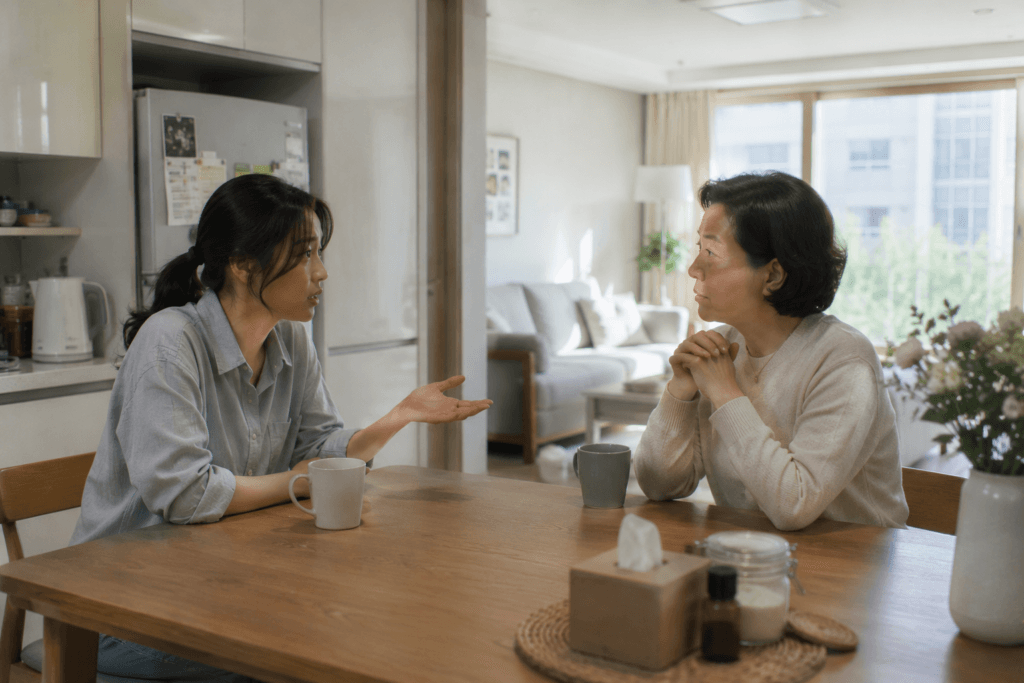
Where K-Dramas Turn Reality Into Drama
And then, of course, television takes over.
A disapproving parent discovering a relationship is useful.
A parent who says, “I trust your judgment,” is probably less useful if the writer needs six more episodes of conflict.
That is why K-Dramas often push family opposition much further than viewers should expect from ordinary Korean life.
The wealthy mother trying to break up a couple, the family demanding a socially suitable spouse, or the dramatic meeting where someone’s background is judged in minutes are familiar storytelling devices.
They should not be treated as a guide to how Korean families normally behave.
But they are not completely random either.
They amplify recognizable questions about family responsibility, marriage, social expectations, and independence.
The drama lies in the scale of the conflict.
The cultural clue lies underneath it.
What to Watch the Next Time the Parents Find Out
The next time a K-Drama romance reaches the inevitable moment when the parents discover the relationship, watch what they actually ask.
Are they worried about the person?
Or their job?
Their family?
Their financial stability?
Are they opposed to dating, or has the possibility of marriage suddenly made the relationship more serious?
Then watch the younger characters.
Do they ask for permission?
Do they want acceptance?
Or do they intend to stay together but fear what permanent family conflict could mean later?
Those differences matter.
They also make these scenes more interesting than the simple explanation that “Korean parents are strict.”
Family approval in Korean dramas sits at the intersection of older expectations and modern individual choice. Dramas exaggerate that tension because conflict makes good television, but the reason the theme remains recognizable is that marriage can still involve relationships extending beyond the two people getting married.
So when two perfectly independent adults suddenly become nervous about telling their parents they are dating, the scene is not necessarily saying they cannot make their own decision.
Sometimes the real question is much more complicated:
Can we build the life we want without losing the family relationships that still matter to us?
That is the tension hiding underneath many of K-Drama’s most familiar family conflicts.
Frequently Asked Questions
Do Korean adults need their parents’ permission to marry?
No. Korean adults make their own legal decisions about marriage. However, some couples may still value parental approval because marriage can create ongoing relationships between both families.
Why do K-Drama parents care about a partner’s family?
This reflects both dramatic convention and the historical idea that marriage connects families, not only individuals. K-Dramas often exaggerate concerns about family background, wealth, education, or social status to create conflict.
Are chaebol parents in Korean dramas realistic?
Chaebol-family opposition is a popular dramatic trope and should not be treated as typical Korean family behavior. It amplifies broader themes involving wealth, status, family expectations, and personal choice.
Is family influence on relationships changing in Korea?
Yes. Younger generations generally place greater emphasis on individual choice and personal boundaries, although family opinions can still matter, especially when a relationship becomes serious or moves toward marriage.
Continue Exploring
If you enjoyed this article, you may also like:
Why Korean Dramas Have So Many Drinking Scenes
Family is not the only place where invisible social rules shape relationships. See what happens around the drinking table when age, seniority, and familiarity begin to matter.
Why Korean Drama Characters Always Meet at Convenience Stores
What happens when characters finally step away from family, work, and other expectations? Discover why the humble convenience store becomes the setting for so many unexpectedly personal K-Drama moments.
What Makes Korean Dramas Different from Western TV?
Family approval, drinking etiquette, and everyday meeting places are only part of the picture. Explore why Korean dramas can feel so different even when the stories themselves seem familiar.