A new employee is sitting at a company dinner with a small glass in front of them. When a senior colleague reaches for the bottle, the employee suddenly becomes more attentive. Later, someone pours a drink for the boss before filling their own glass. A few seats away, another coworker looks tired but does not seem ready to leave.
To a Korean viewer, none of this necessarily needs explaining. To someone watching from overseas, the scene can raise several questions at once.
Why are coworkers still together when work ended hours ago? Why do they keep pouring drinks for one another? Why does age or job title seem to matter even in a restaurant?
And after watching several K-Dramas, there is an even more obvious question: why are there so many drinking scenes in the first place?
Alcohol appears in television around the world, so drinking itself is hardly unique to Korean dramas. What makes these scenes worth looking at is the culture around the table. Company dinners, age and seniority, the way drinks are offered and received, and the expectation that people sometimes continue socializing after work can add meanings that subtitles do not explain.
The bottle may be the easiest thing to notice. The relationships around it are usually more interesting.
Why Coworkers Keep Drinking Together After Work
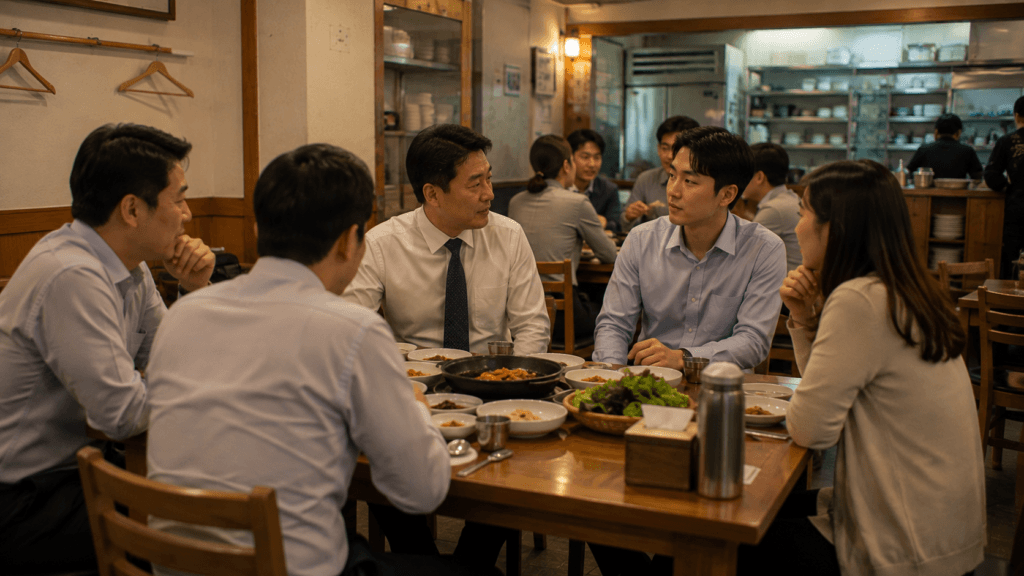
One of the most familiar K-Drama settings is the company dinner.
The characters spent all day sitting a few desks apart, yet when evening comes, the entire team moves to a restaurant and continues spending time together.
This is where hoesik comes in.
Hoesik refers to a company or team gathering outside regular work, usually centered around eating together and sometimes drinking. It might happen to welcome a new employee, celebrate something, or simply bring coworkers together outside the office.
For someone unfamiliar with Korean workplace culture, however, one part can seem strange: if it happens after work, why does a reluctant employee sometimes act as though they still have to go?
Historically, company gatherings could blur the boundary between professional and personal time. An invitation from a manager did not always feel exactly like an invitation from a friend, particularly in workplaces with stronger seniority structures.
That tension gives K-Dramas plenty to work with.
At the same table, one employee may be genuinely enjoying the evening while another keeps checking the time. A junior employee may be careful around the department head, while longtime coworkers are already joking with each other.
The office is gone, but the relationships from the office have followed them into the restaurant.
That is an important distinction.
A K-Drama company dinner is not simply a group of friends having drinks after work. It can be a social space where professional hierarchy becomes more relaxed without disappearing completely.
This is also why these scenes should not be taken as a perfect picture of every Korean workplace today. Expectations around company dinners have changed, and many younger workers place greater importance on keeping personal evenings separate from work. Teams and companies also vary widely.
That generational change can itself appear in dramas: one character may see a company dinner as essential team bonding while another wonders why leaving work does not actually mean being finished with work.
Why Do They Keep Pouring Drinks for Each Other?
Once you notice it, this behavior becomes difficult to miss.
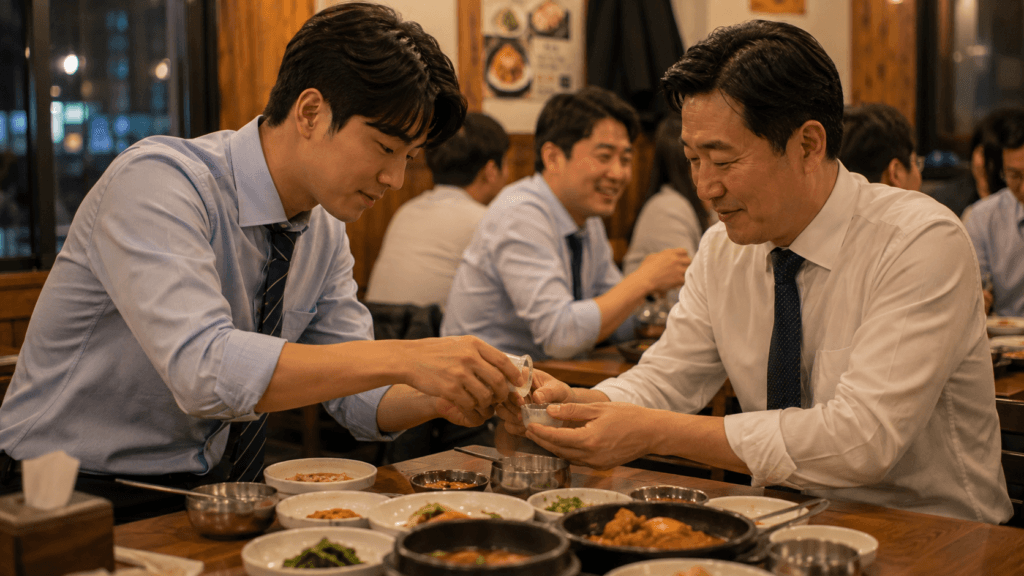
Someone picks up a bottle but does not immediately fill their own glass. Instead, they reach across the table and pour for someone else.
In some Korean social settings, particularly when age or seniority is involved, offering a drink can be part of showing attention and respect. Receiving a drink from someone senior may also involve slightly different body language than drinking casually with close friends.
For international viewers, the gesture can look surprisingly formal.
But this is exactly the kind of cultural detail that a K-Drama does not need to explain in dialogue.
Imagine a new employee sitting beside a senior manager. The younger employee becomes noticeably careful when pouring or receiving a drink. Later in the same drama, that person drinks with childhood friends and behaves completely differently.
The contrast tells you something.
The alcohol has not changed. The relationship has.
This is why it would be misleading to turn Korean drinking etiquette into a rigid list of rules. A relaxed group of friends may pay very little attention to formality, while a gathering involving different generations or workplace ranks can feel different.
Context matters more than the bottle.
For viewers relying on subtitles, however, that context can be easy to miss because the dialogue may translate perfectly while the social meaning of a small gesture remains unexplained.
The Same Drinking Scene Changes With the Relationship
Now compare the company dinner with another scene K-Drama viewers know well.
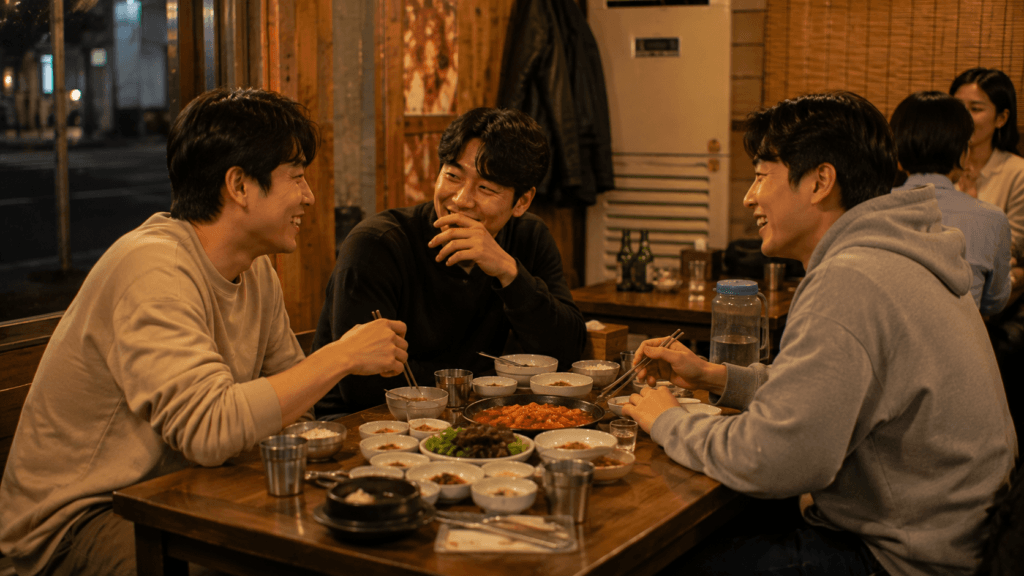
A character has been dumped and meets an old friend for drinks.
Immediately, the atmosphere changes.
Nobody is worried about a department head. Nobody is trying to impress a senior employee. The heartbroken friend complains, the other person listens, they share food, and the conversation may become louder or more personal as the evening continues.
This difference matters because there is no single “Korean drinking behavior.”
People behave differently depending on who is sitting across from them.
With close friends, the formality visible at a workplace gathering may largely disappear. With someone older, a senior colleague, or a person they barely know, the same character may become noticeably more careful.
K-Dramas can show that difference without explaining it.
Watch the same character in two drinking scenes and you may learn where they actually feel comfortable.
At work, they carefully choose their words.
With an old friend later that night, they complain about the boss before the first plate of food is finished.
That contrast is much more revealing than simply saying Korean dramas contain a lot of alcohol.
The drinking table changes depending on the relationship around it.
And once you start watching who behaves differently with whom, many of these familiar scenes become easier to understand.
Why the End of the Drinking Scene Can Matter More Than the Drinking
There is another moment worth watching closely.
The gathering ends.
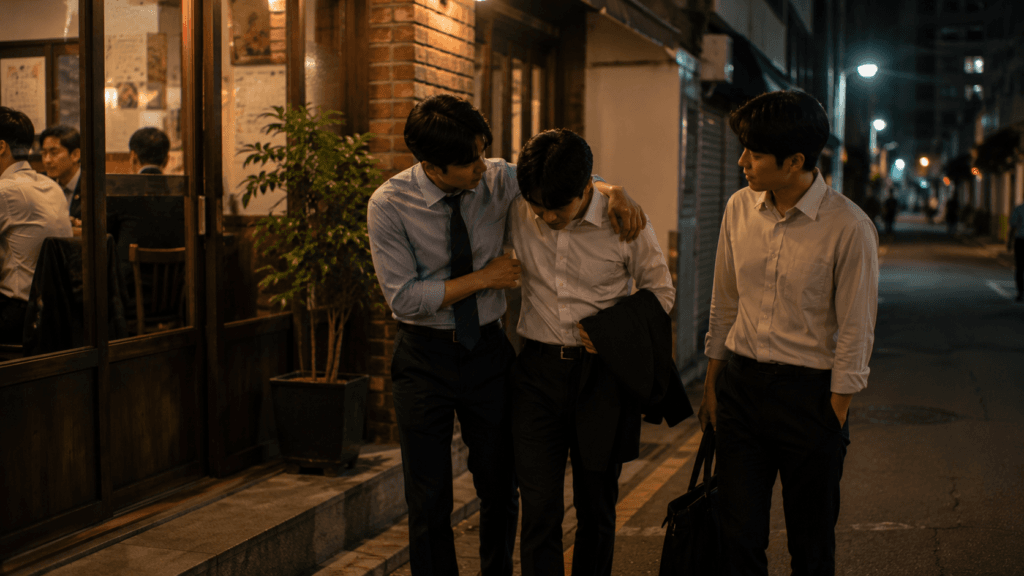
People begin putting on their coats and leaving, but one character has clearly had too much to drink.
What happens next can reveal another side of the relationship.
Someone takes their bag. A friend waits with them for transportation. Another person makes sure they get home rather than simply saying goodbye outside the restaurant.
K-Dramas sometimes exaggerate this for romance or comedy, of course. Not every night out in Korea ends with someone carrying another person home.
But the smaller idea behind the scene is recognizable: when people drink together, paying attention to whether someone can get home safely can become part of taking care of the group.
For the story, that creates a useful question.
Who stays?
A character may insist all episode that they do not care about someone, then be the person who waits until that person gets home safely.
No confession is necessary.
Their behavior has already told the viewer something.
Is K-Drama Drinking Culture Really Like Korea?
This is where K-Dramas can create the wrong impression if every scene is taken literally.
Drinking has long had a visible place in Korean social and workplace culture, but that does not mean everyone drinks frequently or that every company expects employees to spend their evenings at alcohol-heavy gatherings.
The reality varies enormously.
Some people enjoy drinking with coworkers or friends. Others rarely drink. Some company teams still gather regularly after work, while others keep these events short, optional, or centered around a meal rather than alcohol.
Generational change matters too.
Younger workers have increasingly questioned the idea that building good relationships with coworkers should require giving up personal evenings or accepting pressure to drink. As attitudes toward work-life balance change, the stereotypical K-Drama scene in which an entire department drinks late into the night should not be treated as a universal picture of Korean office life.
In fact, dramas can sometimes show that change happening.
An older manager may think organizing a company dinner is a friendly way to bring everyone together. A younger employee at the same table may be wondering why a work obligation has followed them into their evening.
Neither reaction needs a long explanation.
The tension itself tells us something about how Korean workplace culture is changing.
What International Viewers Should Watch Instead of the Bottle
So the next time drinks appear in a K-Drama, counting how much the characters consume is probably the least interesting thing you can do.
Watch the people instead.
At a company dinner, notice whether junior employees behave differently around senior colleagues. Watch who pours for whom and whether the atmosphere changes after the most senior person leaves.
Then compare that scene with the same character drinking with close friends.
The difference may be immediate.
A character who carefully watches every word around coworkers might complain freely with a childhood friend. Someone who sits stiffly beside a manager may become completely relaxed with people their own age.
And when the evening ends, notice who stays behind.
Who makes sure someone gets home?
Who carries the bag?
Who waits until transportation arrives?
These small actions can reveal relationships that the characters themselves may not yet be willing to describe.
Why These Scenes Feel So Korean
Alcohol itself is not what makes a K-Drama drinking scene Korean.
Characters drink, confess, argue, and make mistakes in television around the world.
What gives many Korean scenes their distinctive layer is everything happening around the drinking: the company gathering that continues after office hours, the awareness of age and seniority, the way behavior changes depending on who is at the table, and the small gestures people use to show respect or care.
Some of those customs are changing. Others become much more relaxed among friends. And dramas naturally exaggerate situations when it makes the story more entertaining.
That is exactly why context matters.
A bottle on a table between childhood friends does not tell the same story as a bottle between a new employee and a department head.
The next time a K-Drama moves from the office to a restaurant, watch what happens before anyone gets drunk.
You may notice a junior employee becoming slightly more careful, a manager trying to make the atmosphere less formal, or someone quietly waiting to see what the senior person does first.
Then watch what happens later, when those same people begin to relax.
The scene is no longer simply about drinking.
It is showing you how relationships in Korea can shift depending on age, familiarity, workplace rank, and the people sitting around the table.
And once you notice that, those seemingly repetitive K-Drama drinking scenes start telling a much more interesting story.
Frequently Asked Questions
Why do Korean dramas show so many company drinking scenes?
Company gatherings, or hoesik, have been a recognizable part of Korean workplace culture, making them a familiar setting for stories involving coworkers. Modern workplace attitudes vary considerably, and not every gathering involves heavy drinking.
Why do Koreans pour drinks for each other?
In some situations, particularly when age or seniority is involved, pouring a drink for another person can be a gesture of attentiveness or respect. The level of formality depends heavily on the people and setting.
Do Korean employees have to drink with their bosses?
There is no universal expectation that Korean employees must drink with their bosses. Workplace cultures differ, and attitudes toward compulsory after-work gatherings and pressure to drink have changed significantly.
Is drinking culture in K-Dramas exaggerated?
K-Dramas use recognizable social settings but concentrate interesting, emotional, or humorous situations for storytelling. Drinking scenes can reflect aspects of Korean culture without representing how every Korean person or workplace behaves.
Continue Exploring
If you enjoyed this article, you may also like:
What Makes Korean Dramas Different from Western TV?
The drinking table is only one place where K-Dramas can feel different. Discover the storytelling choices and cultural details that give Korean dramas their distinctive rhythm.
Why Korean Dramas Feel More Emotional Than Hollywood Shows
Why can an ordinary conversation in a K-Drama suddenly feel so intense? Explore how Korean dramas build emotion through relationships, silence, and small everyday moments.
How Koreans Balance Work, Wellness, and Social Life
K-Drama company dinners offer a glimpse of life after office hours, but what does the real balance look like? See how work, personal time, and social life fit together in everyday Korea.