If you arrive in Korea on a Friday, one thing quickly becomes clear.
The city never seems to slow down.
Subway stations remain crowded until late in the evening. Office workers stream out of high-rise buildings, restaurants buzz with dinner conversations, and traffic continues long after sunset.
It feels like another ordinary weekday.
Then Saturday arrives.
You leave your hotel expecting a quieter city.
Instead, you find something completely different.
The streets are still busy.
The cafés are even more crowded than yesterday.
Families stroll through neighborhoods without any obvious destination. Couples wander between bookstores and bakeries. Friends line up outside restaurants before lunchtime. Along the Han River, picnic blankets begin covering the grass while cyclists, runners, and people walking their dogs share the same riverside paths.
The city hasn’t become quieter.
It has simply changed its rhythm.
For many first-time visitors, that’s the surprising part.
Weekends in Korea don’t feel like an escape from everyday life.
They feel like everyday life unfolding in a different way.
Understanding why reveals something much deeper than how people spend their Saturdays.
It explains how Korean cities were built, how neighborhoods function, and why public spaces have quietly become an extension of home.
Korean Weekends Don’t Slow Down—They Simply Change Direction
Friday night finally comes to an end.
Before sunrise on Saturday, delivery trucks begin arriving at neighborhood cafés. Bakers prepare fresh pastries behind glass windows while market vendors arrange fruit, flowers, and handmade goods before the first customers appear.
A few hours later, the same streets that carried office workers yesterday are filled with completely different people.
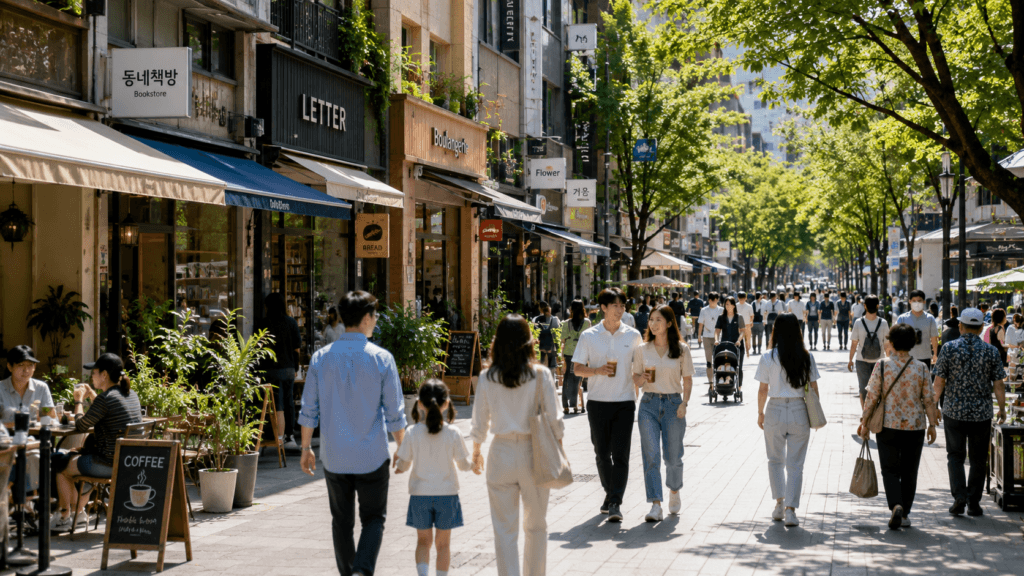
Parents push strollers along tree-lined sidewalks.
University students meet outside cafés, deciding where to spend the afternoon.
Older couples take slow morning walks through neighborhood parks before stopping for coffee.
Children run ahead while grandparents patiently follow behind.
Nobody appears to be rushing anywhere.
If you only counted the number of people outside, you might think Saturday is just as busy as Friday.
But after watching for a while, you realize the purpose has changed.
On weekdays, movement is directed.
People know exactly where they’re going.
The subway is simply a way to reach work.
Lunch is carefully timed.
Errands are squeezed into whatever free moments remain before the next appointment.
Saturday feels almost the opposite.
People pause in front of bookstores without intending to buy anything.
Friends walk several blocks just because a side street looks interesting.
Families stop to watch musicians performing in a public square before continuing their walk with no particular schedule to keep.
Time itself seems to move differently.
Visitors often describe Korean weekends as relaxing, but that’s not quite the right word.
The city is still energetic.
The sidewalks remain crowded.
Restaurants still require waiting lists.
What changes isn’t the level of activity.
It’s the reason people are outside.
Instead of moving because they have to, they’re moving because they want to.
That subtle difference changes the atmosphere of an entire city.
Why Korean Weekends Feel So Social
You decide to follow the crowd.
Not because you know where they’re going.
Simply because everyone seems to be enjoying the journey.
A family walks into a department store without carrying shopping bags.
Two friends stop outside a café, only to change their minds and continue exploring the next street.
Another couple disappears into a small exhibition they hadn’t planned to visit.
No one seems to be following a schedule.
They’re simply spending time together.
That’s when you begin noticing something unusual.
In many countries, weekends often mean staying home after a busy week.
In Korea, weekends often begin by stepping outside.
People meet for brunch instead of inviting friends over.
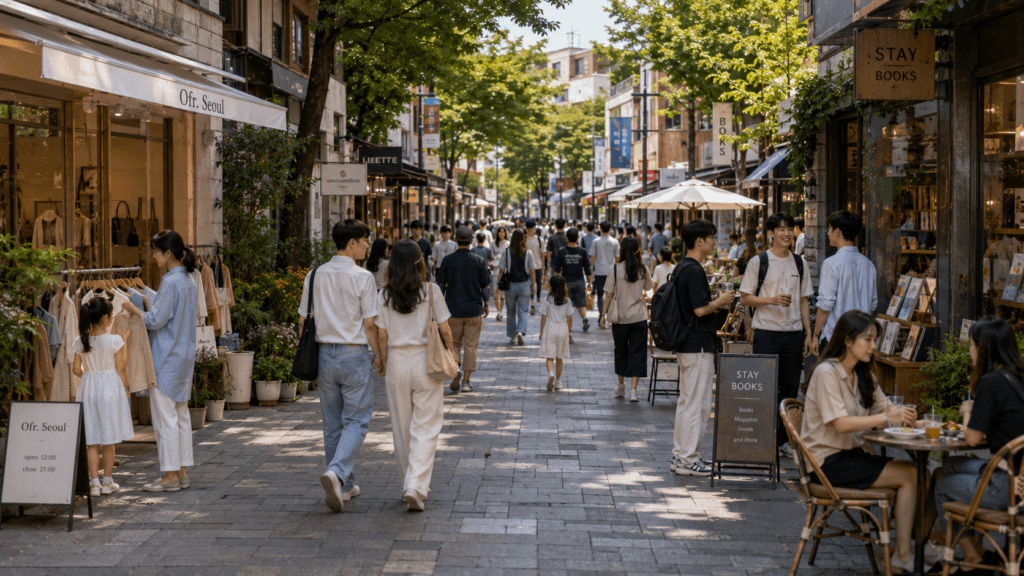
They spend the afternoon wandering neighborhoods like Seongsu, Yeonnam-dong, or Ikseon-dong.
They browse bookstores without buying anything.
They walk through department stores just to enjoy the atmosphere.
The destination almost doesn’t matter.
Being together does.
Part of the reason is hidden in the way Korean cities developed over the past few decades.
As apartment living became the standard, neighborhoods grew around shared public spaces rather than large private homes. Instead of expecting every home to have a spacious backyard or entertainment room, daily life naturally expanded into the city itself.
Cafés became meeting places.
Parks became living rooms.
Walking streets became somewhere to spend an entire afternoon rather than simply a route between two destinations.
This also explains why so many Korean neighborhoods feel busy even when nobody appears to be in a hurry.
People aren’t commuting.
They’re participating in everyday community life.
You begin seeing the same pattern everywhere.
A group of friends chats outside a bakery before deciding where to eat.
Parents let children choose dessert after lunch.
An older couple quietly watches people pass from a bench beneath the trees.
None of these moments feel like special events.
They simply happen every weekend.
In many countries, weekends mean escaping the city.
In Korea, weekends often mean rediscovering it.
Once you notice that difference, the crowds begin to make sense.
And nowhere does that feeling become clearer than inside Korea’s cafés, where people happily spend hours without feeling the need to go anywhere else.
Cafés Become the City’s Living Room
By early afternoon, you begin noticing something else.
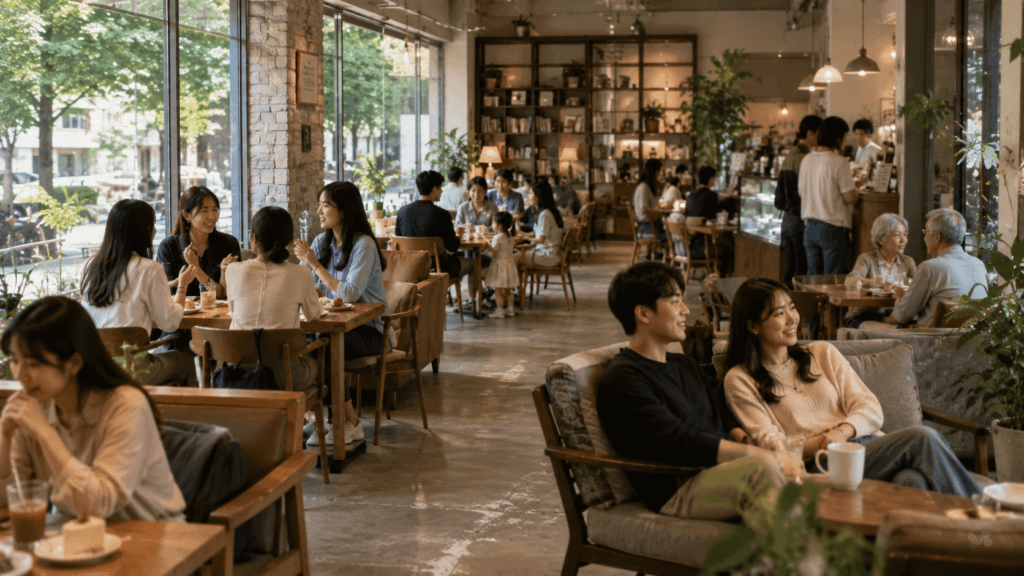
Almost every café is full.
Not just the famous ones with long waiting lines.
The small neighborhood café tucked beside an apartment building.
The quiet bakery with only a few tables.
Even the coffee shop inside a bookstore has people sitting for hours.
At first, you assume everyone came for coffee.
But after sitting down yourself, another pattern begins to emerge.
The drinks arrive quickly.
The conversations last much longer.
At the next table, two university friends have spread notebooks across the table, yet they spend more time laughing than studying.
Near the window, an elderly couple quietly shares a slice of cake while watching people pass outside.
A family celebrates a child’s birthday with dessert instead of a large party at home.
Nobody seems to be looking at the time.
Nobody appears eager to leave simply because they finished their drink.
For many visitors, this feels unusual.
In some countries, cafés are somewhere to grab coffee before heading to the next destination.
In Korea, the café often becomes the destination itself.
That difference didn’t appear overnight.
As Korean cities became denser and apartment living became the norm, public places gradually took on roles that larger private homes often serve elsewhere.
Meeting friends.
Relaxing after lunch.
Working on personal projects.
Reading a book.
Celebrating small occasions.
All of these naturally moved into cafés.
That’s one reason visitors often notice just how many cafés exist within a single neighborhood.
Competition certainly plays a role, but so does lifestyle.
People aren’t simply buying coffee.
They’re borrowing a comfortable place to spend time.
If you’ve already read Why Korean Cafés Are More Than Coffee Shops, you’ve seen how cafés quietly support everyday routines throughout the week.
On weekends, that role becomes even more visible.
Instead of office workers holding meetings, you see families lingering over dessert.
Instead of students rushing between classes, friends slowly decide where to go next.
The atmosphere feels almost like visiting someone’s living room—only everyone is welcome.
As the afternoon passes, some people eventually stand up, return their trays, and step back outside.
But the weekend still isn’t over.
For many, the next stop isn’t another café.
It’s somewhere filled with trees, rivers, and open space.
Nature Is Never Far Away
Walk just a few minutes from the busy cafés, and the atmosphere changes once again.
The sidewalks become wider.
Trees begin lining the streets.
The sounds of conversations mix with bicycle bells and children’s laughter.
Without ever feeling like you’ve left the city, you’ve somehow arrived somewhere much quieter.
This is another part of Korean weekends that surprises many visitors.
Nature doesn’t usually require a road trip.
It often begins just beyond the next intersection.
In Seoul, families spread picnic blankets along the Han River while cyclists and runners share riverside paths stretching for kilometers.
Neighborhood parks fill with parents watching children play as older residents enjoy slow afternoon walks beneath rows of trees.
On the edge of the city, hiking trails leading toward mountains like Bukhansan or Namsan become crowded with people carrying backpacks instead of briefcases.
The transition feels remarkably natural.
One moment you’re standing in front of a busy café.
Twenty minutes later, you’re listening to birds while overlooking the skyline.
This accessibility is no accident.
Korean cities have long been designed to connect residential neighborhoods with public parks, walking paths, rivers, and nearby mountains.
Rather than separating urban life from nature, the two often exist side by side.
That changes how weekends are spent.
People don’t necessarily plan an entire day around escaping the city.
Instead, they weave moments of nature into an ordinary afternoon.
A coffee becomes a walk.
A walk becomes a riverside picnic.
A picnic becomes an evening watching the sunset over the Han River.
Without realizing it, you’ve experienced several completely different environments without traveling very far at all.
Perhaps that’s why Korean weekends rarely feel divided into “city time” and “nature time.”
Both belong to the same day.
By early evening, families begin packing their blankets.
Cyclists head home.
Restaurant lights gradually replace the afternoon sunlight.
The city is preparing for another week.
Yet something about it still feels different from Friday evening.
You finally realize why.
The weekend wasn’t about escaping everyday life.
It was about experiencing the same city through a different rhythm.
Conclusion
Visitors often expect weekends in Korea to feel slower.
Instead, they discover something much more interesting.
The streets remain lively.
The cafés stay full.
Parks, rivers, bookstores, restaurants, and neighborhoods continue buzzing with activity.
What changes isn’t how busy the city is.
It’s how people choose to spend their time.
Instead of commuting, they explore.
Instead of rushing, they wander.
Instead of treating public spaces as somewhere to pass through, they treat them as places to enjoy.
That rhythm has grown naturally from Korea’s urban design, apartment living, neighborhood culture, and strong emphasis on spending time together.
Once you notice it, weekends in Korea begin to feel less like a break from everyday life and more like another expression of it.
And that’s often the moment when visitors stop feeling like tourists and start understanding how everyday life in Korea really works.
FAQ
Why do Korean weekends feel so busy?
Because many people choose to spend their free time outdoors in cafés, parks, shopping streets, and public spaces rather than staying home. The city remains active, but for leisure instead of work.
Why are Korean cafés always crowded on weekends?
Cafés serve as social spaces where people meet friends, study, relax, celebrate small occasions, or simply spend time together. They’re much more than places to buy coffee.
Do Koreans usually leave the city on weekends?
Some people travel, but many stay in their own neighborhoods or explore different parts of the city. Parks, rivers, cafés, and cultural districts provide plenty of places to enjoy without traveling far.
Why is the Han River so popular on weekends?
The Han River offers walking paths, cycling routes, picnic areas, and open green spaces that are easily accessible from many parts of Seoul, making it a favorite destination for families, couples, and friends.
What makes Korean weekends different from weekends in other countries?
Many visitors notice that Korean weekends focus on enjoying shared public spaces. Rather than escaping the city, people often rediscover it through cafés, neighborhoods, parks, and local culture.
Continue Exploring
If you enjoyed this article, you may also like:
- Why Koreans Love Spending Time Along the Han River
- Why Picnics Are So Popular in Korea: The Rise of Korean Picnic Culture
- Weekend Getaways in Korea: Why Koreans Love Short Nature Escape
- Korean Park Culture: Why Parks Matter in Everyday Korean Life
- Outdoor Exercise in Korea: Why Koreans Stay Active All Year Round
- Korean Lifestyle Guide: Daily Habits Behind Korea’s Global Fascination
- The Ultimate Guide to Everyday Life in Korea
- Why Waiting in Line Is So Common in Korea
- Why Seasonal Festivals Bring Korean Communities Together