The things that surprise people most about Korea are not always the things found in travel guides.
It may happen at 8 a.m., when a crowded subway platform somehow absorbs another trainload of commuters without the confusion you expected. Or at noon, when groups of office workers seem to leave their buildings at almost the same time and disappear into nearby restaurants. Perhaps you notice a café full of people who have been sitting there far longer than it takes to drink a cup of coffee.
Then evening arrives, and another strange thing happens.
The offices begin emptying, but the neighborhood does not.
Restaurants get busier. Friends meet near subway exits. People stop at shops on their way home. Some head to the gym, while others continue dinner at a café or take a walk before finally starting the journey home.
None of these moments is uniquely Korean on its own. People commute, eat lunch, drink coffee, meet friends, and relax after work everywhere.
What makes everyday life in Korea interesting is how these ordinary activities fit together.
Dense neighborhoods shorten the distance between work, food, shopping, transportation, and leisure. Digital services remove small inconveniences. Shared spaces play several roles throughout a single day. Public routines often depend on an understood sense of order, while social habits make meals and free time feel different depending on who is there.
To understand daily life in Korea, then, it helps to stop looking for one unusual custom.
The more revealing question is how an ordinary Korean day is built.
Everyday Life in Korea Is Shaped by Density
A typical Korean neighborhood can be difficult to understand by looking only at a map.
An apartment building may appear residential, yet within a short walk there can be a bakery, pharmacy, convenience store, several cafés, restaurants, a clinic, a gym, a subway entrance, and countless smaller businesses.
That closeness changes behavior.
You do not necessarily need to plan a separate shopping trip simply because you need something on the way home. A commuter can leave the subway, buy groceries, pick up dinner, stop at a pharmacy, and walk home without getting back into a car.
The same density affects social life.
Meeting a friend does not always require choosing one destination and remaining there for the entire evening. Dinner may be near the station, dessert around the corner, and another subway entrance only minutes away.
In a less dense city, each part of the evening might require another drive.
In Korea’s larger cities, especially Seoul, much of it can happen on foot once you reach the right neighborhood.
This is one reason Korean streets can feel busy for much of the day. The same area keeps changing functions as different people need it.
A restaurant street serves office workers at lunch and friend groups at dinner. A café holds students in the afternoon and couples after dinner. A subway station moves workers in the morning, then becomes a meeting point in the evening.
The buildings stay in place.
The way people use them changes by the hour.
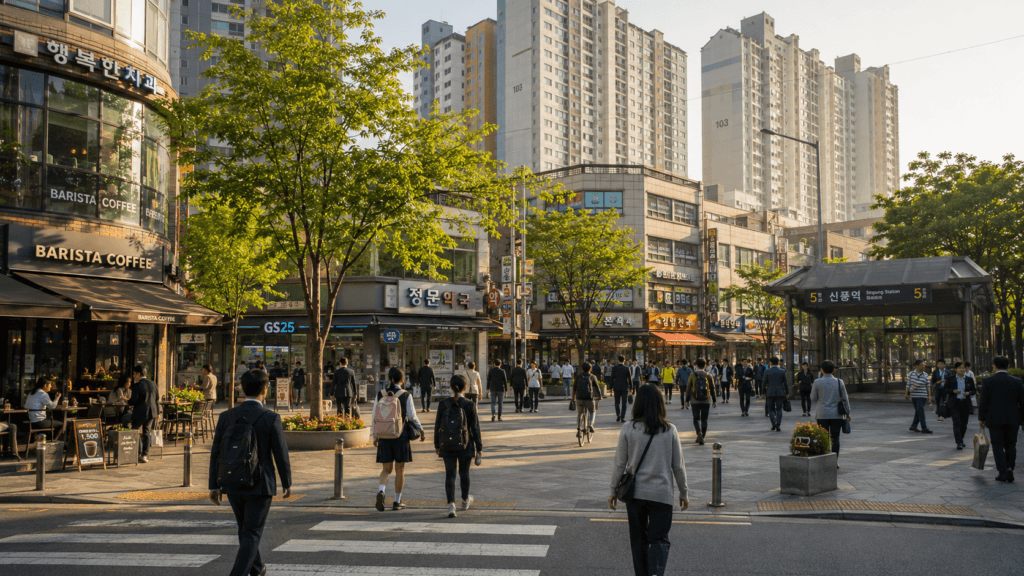
The Commute Is One of the First Daily Rhythms You Notice
Morning transportation reveals how much Korean urban life depends on shared infrastructure.
Rush-hour subway trains can be extremely crowded, particularly in the Seoul metropolitan area. Yet for many commuters, the train is not an occasional alternative to driving. It is simply how the working day begins.
That shapes the rest of the city.
Businesses cluster near stations because people are already passing them. Friends choose meeting points based on lines and transfers. Restaurants around office districts know when the lunch rush will arrive. Evening plans can happen somewhere between the office and home because the transportation network makes another stop possible.
The commute is therefore more than movement.
It organizes where everyday life happens.
You can also see small examples of shared public order during these routines. Floor markings indicate where to wait for trains. People usually leave space for passengers getting off before boarding. At bus stops and other crowded places, people look for an existing order rather than negotiating from the beginning every time.
None of this functions perfectly, of course. Rush hour can be exhausting, people become impatient, and crowded stations are still crowded stations.
But the routine works because millions of small decisions are repeated in roughly predictable ways each day.
Lunch Is Often More Social Than It First Appears
Around noon, office districts reveal another characteristic of Korean daily life.
People often leave their workplace together.
At first this may seem like nothing more than convenience. Everyone is hungry at approximately the same time, and nearby restaurants are built around the lunch rush.
But the shared meal also has a social function.
Colleagues who spend the morning focused on work can speak more casually once they leave the office. Teams decide where to eat, walk there together, and return at roughly the same time.
This does not mean every Korean worker eats every meal with coworkers. Some prefer eating alone, schedules differ, and workplace cultures vary considerably.
Still, shared lunches remain visible enough that they can surprise visitors from work cultures where everyone routinely disappears in separate directions at noon.
Food also makes this pattern easier.
Many Korean dishes are naturally ordered for a table or eaten as part of a shared meal. Even when everyone receives an individual dish, side dishes and conversation often make lunch feel communal.
The important part is not that Koreans cannot eat alone.
It is that eating together remains one easy way relationships are maintained during an otherwise structured working day.
KakaoTalk Sits Quietly Behind Much of the Day
Not all of Korean everyday life is visible on the street.
A significant amount of coordination happens on the phone, and KakaoTalk plays an unusually broad role in that process.
Friends use it to arrange dinner.
Families share information.
Work groups communicate.
Businesses and services may send notifications.
A message can change an evening plan before anyone has left the office.
This is what makes Why KakaoTalk Is Essential to Everyday Life in Korea useful for understanding more than messaging culture. KakaoTalk often operates as connective tissue between the physical routines happening around the city.
A restaurant meeting begins with a message.
Someone changes subway stations because a friend is running late.
A notification arrives while a person is waiting for a service.
The technology itself is not the most interesting part. What matters is that digital coordination has become so integrated into ordinary routines that the border between online planning and offline life can be difficult to see.
People are not constantly stopping daily life to “go online.”
The online layer is already inside the routine.
Cafés Are Not Just About Coffee
Foreign visitors quickly notice how many cafés there are in Korean cities.
The obvious explanation would be that Koreans drink a lot of coffee.
That only explains part of their role.
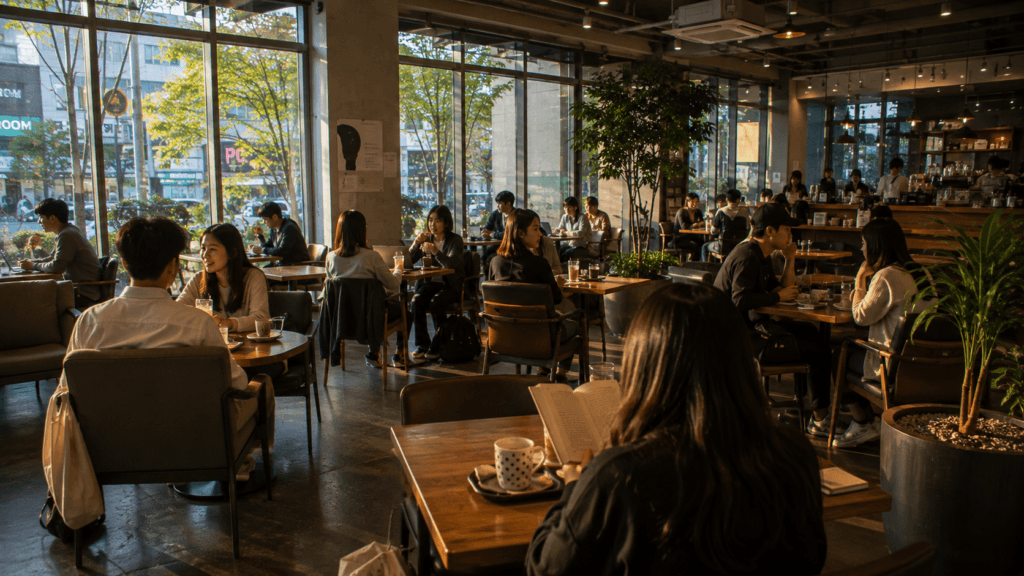
A café can function as somewhere to meet between appointments, study for several hours, work outside the office, wait for another person, rest during shopping, continue talking after dinner, or simply spend time somewhere other than home.
That flexibility helps explain why Korean cafés are more than coffee shops.
Their role changes throughout the day much like the neighborhoods around them.
A customer sitting alone with a laptop at 2 p.m. and a group talking after dinner at 8 p.m. may be using the same café for completely different reasons.
The common element is access to comfortable semi-public space.
Unlike a restaurant, there is usually no expectation that a full meal marks the beginning and end of the visit. Unlike home, the space does not belong to one person. And unlike an outdoor park, it works regardless of rain, cold, heat, or darkness.
In a dense city, that kind of flexible space becomes surprisingly valuable.
Convenience Is Built Into Small Daily Decisions
One of the easiest mistakes to make when describing Korea is to treat convenience as a collection of impressive technologies.
Fast delivery.
Mobile payments.
Convenience stores.
Digital reservations.
These things matter, but their deeper effect appears in much smaller decisions.
If you become hungry late in the evening, finding food is often relatively easy in an urban neighborhood. If a restaurant has a long wait, a digital queue may allow you to register and spend that time elsewhere. If you need something on the commute home, there may be several places to buy it without making a separate journey.
Over time, these conveniences change expectations.
People begin organizing life around the assumption that many ordinary problems can be solved nearby and relatively quickly.
That does not mean every service is instant or every part of Korea operates with the same level of convenience. Rural areas, smaller cities, individual businesses, and personal circumstances vary.
But in dense urban areas, convenience becomes part of the background rather than an event people stop to admire.
You notice it most when it is suddenly missing.
Waiting Shows Another Side of Korean Daily Order
The presence of convenience does not mean nobody waits.
Popular restaurants, bakeries, pop-up stores, exhibitions, and limited events can still attract significant queues.
What is interesting is how the idea of a queue has evolved.
A traditional physical line operates on an easy rule: people who arrived first go first. That creates an understandable order and reduces the need to negotiate who deserves the next turn.
Digital waiting systems preserve the same idea while removing the need for everyone to stand in the same place.
A person can register, receive a number, spend time nearby, and return as their turn approaches.
The visible line disappears.
The order remains.
This is a better way to understand waiting in line in Korea than assuming Koreans simply enjoy waiting. People abandon long waits too, choose quieter times, make reservations, or go elsewhere.
What often matters is whether the expected experience feels worth the time—and whether the waiting process itself feels orderly and fair.
After Work, the City Changes Purpose Again
A Korean business district can look completely different once offices begin emptying.
But it would be misleading to say that everyone avoids going home.
Many workers want exactly that.
Long commutes, family responsibilities, exhaustion, and a growing emphasis on personal time all shape modern evenings.
The interesting point is that after-work evenings in Korea offer many possible directions.
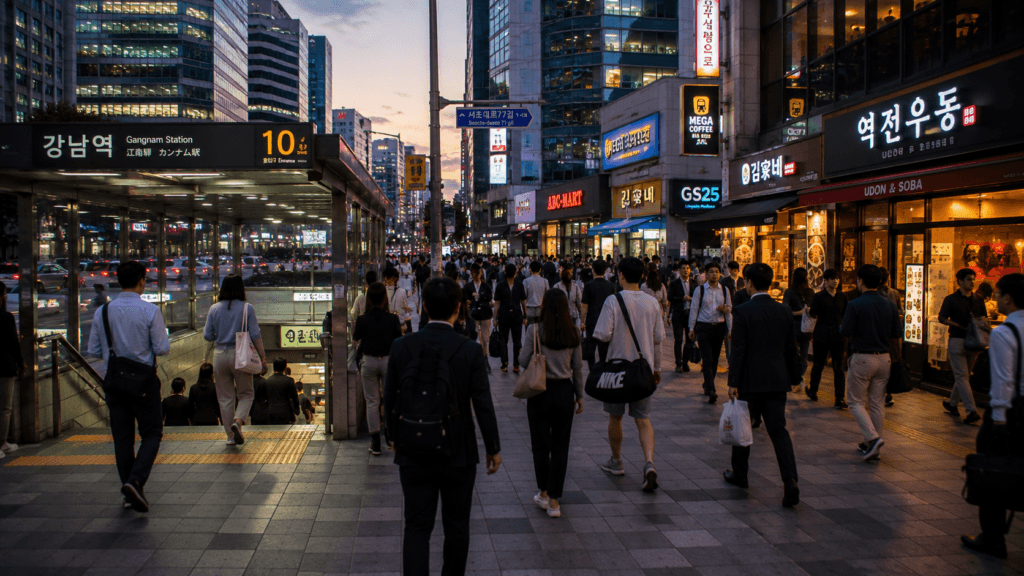
Restaurants around office districts become busy. Friends can meet near a convenient subway station. Someone may exercise before going home. Another commuter handles shopping and errands along the route back.
For others, dinner becomes the first stop rather than the entire evening.
Korean expressions such as 1-cha (1차) and 2-cha (2차) describe the first and second rounds of a gathering. Historically, workplace evenings could involve dinner followed by drinking or karaoke, especially in the context of hoesik, the company gathering.
That culture still exists, but modern after-work life is more varied.
A second stop may simply be a café or dessert shop. Some employees decline company gatherings and go home. Others meet people completely unrelated to work.
The shift matters because it shows how Korean evening culture is becoming less about what workers are expected to do and more about what the city makes possible once they regain control of their own time.
The Han River Shows Why Public Space Matters
Much of Korean urban life happens indoors.
Apartments, offices, restaurants, cafés, malls, academies, and subway stations structure enormous parts of the day.
That is one reason the Han River feels so different.
In Seoul, a vast open space cuts through the middle of one of the country’s densest urban environments. Along it, parks and riverside paths give residents space to cycle, run, walk, picnic, meet friends, or simply sit without needing to enter another commercial space.
The river’s role today is also the result of urban and environmental change rather than geography alone. Decades of riverfront development, water-quality management, park construction, and ecological restoration helped transform the riverside into a place people could actively use.
This is why the Han River is part of everyday life in Seoul, not simply a tourist attraction.
A famous landscape becomes ordinary when residents stop needing a special reason to visit it.
Someone goes there for exercise.
Another meets friends.
A family needs somewhere children can move freely.
The skyline may be spectacular, but for locals it often becomes background scenery.
Weekends Reveal a Different Version of the Same City
The structure of Korean daily life becomes particularly visible when the weekday routine loosens.
On Saturday morning, the city has not changed physically.
Yet familiar neighborhoods can feel different.
Office crowds thin while cafés, parks, shopping districts, restaurants, riverside areas, and leisure destinations fill with another mix of people. Families who spent the week following work and school schedules have more time together. Friends can travel farther to meet without calculating how quickly they need to return home.
This is why Korean weekends feel different without requiring completely different activities.
People still eat, shop, drink coffee, exercise, and move around the same city.
The difference is control over time.
A weekday lunch may have a clear deadline.
Saturday lunch can stretch into a café visit and then an unplanned walk.
A weekday evening has tomorrow morning hanging over it.
A weekend evening often has more room to expand.
The city suddenly feels less like something people are moving through on schedule and more like something they have time to use.
Seasonal Life Matters More Than It May Seem
Everyday routines in Korea also change noticeably with the seasons.
Spring weather brings people outdoors again after winter. Parks and walking areas become more attractive, while seasonal flowers draw visitors to places they might otherwise pass without much thought.
Summer pushes some routines later into the evening, especially when daytime heat makes outdoor activity uncomfortable.
Autumn can make ordinary walks, riverside outings, and local festivals more appealing.
Winter sends more social life indoors while creating a completely different relationship with cafés, shopping areas, food, and seasonal events.
This does not mean Koreans completely reorganize their lives four times a year.
Work still happens.
School still happens.
The commute remains.
But leisure and social habits adjust around temperature, daylight, school schedules, public events, and seasonal food.
That is why the same neighborhood can feel surprisingly different depending on when you return.
Technology and Tradition Constantly Overlap
It is tempting to explain Korea through a simple contrast between old traditions and modern technology.
Daily life rarely works that neatly.
A family might order food through an app and eat it together in a traditional shared-meal style.
A restaurant may preserve a decades-old recipe while managing customers through a digital waiting system.
Friends arrange plans through KakaoTalk and then spend several hours sitting together in person.
Company dinners continue while younger employees negotiate stronger boundaries around personal time.
Even public order moves between old and new forms. The first person in a physical line and the first person registered digitally are following the same basic idea of turn-taking.
This overlap is one reason everyday Korea can feel modern without feeling culturally detached from the past.
New tools often replace inconvenience before they replace the underlying social habit.
There Is No Single “Korean Lifestyle”
Of course, the routines described throughout this guide should not be mistaken for a single Korean way of life. A university student in Seoul may experience the city very differently from a family living in a new apartment district, an older resident in a smaller city, or an office worker commuting across the capital.
Age, income, family responsibilities, location, and working hours all influence how people spend their days. Some rely on public transportation while others drive, and a shared lunch with coworkers may be completely normal in one workplace but uncommon in another. The same is true of evenings: while busy restaurants and cafés make after-work social life highly visible, many people would rather finish their commute and spend the rest of the day at home.
The patterns in this guide are therefore better understood as recurring features of contemporary Korean life rather than rules that everyone follows. What makes them worth exploring is not their universality, but how Korea’s cities, workplaces, technology, public spaces, and social customs make certain routines particularly visible or convenient.
Seen this way, Korean culture becomes less about identifying what “Koreans do” and more about understanding why particular habits have become part of everyday life.
Conclusion
Everyday life in Korea does not feel different because Koreans spend their days doing things nobody else does.
They work, commute, eat, message friends, shop, exercise, rest, and go home.
The difference is often found in how closely those parts of life connect.
Dense neighborhoods place necessities within walking distance. Public transportation links work, social plans, and home. KakaoTalk coordinates decisions almost invisibly. Restaurants and cafés change roles throughout the day. Digital services remove some forms of waiting while preserving clear order. Parks and the Han River give dense cities space to open up again.
Evenings reveal the choices available after work, while weekends reveal what happens when people regain more control over their time.
None of these details explains Korea by itself.
Together, they create its rhythm.
That is why the best way to understand everyday life in Korea may not be to look for the country’s most unusual customs.
Watch what happens on an ordinary Tuesday instead.
The morning subway, the shared lunch, the message sent at 4 p.m., the café after dinner, the quick stop on the way home, and the crowded park when the weather finally becomes pleasant often tell you far more about how Korea works than the extraordinary moments do.
FAQ
What is everyday life in Korea like?
Everyday life varies widely, but urban Korean routines are strongly influenced by dense neighborhoods, public transportation, digital services, cafés, shared meals, and easy access to restaurants and everyday businesses. Work and school schedules structure weekdays, while evenings and weekends create more flexible social and leisure time.
Is life in Korea very fast-paced?
Parts of Korean urban life can feel fast because commuting, digital services, delivery, and dense commercial areas make many activities happen efficiently. However, daily life also includes slower routines such as long café visits, walks, shared meals, and time spent in parks or along the Han River.
Do Koreans spend a lot of time outside the home?
Some do and some do not. Dense neighborhoods make restaurants, cafés, gyms, shops, and public spaces easy to use after work or school, but many people also value staying home, particularly after long commutes or demanding workdays.
Why are cafés so important in Korea?
Korean cafés often function as flexible social spaces rather than only places to drink coffee. People use them to meet friends, study, work, rest between activities, or continue conversations after meals.
What is the best way to understand Korean daily culture?
Rather than focusing only on unusual customs, pay attention to ordinary routines: commuting, meals, messaging, shopping, public etiquette, after-work activities, and how neighborhoods change throughout the day. These small patterns often reveal more about contemporary Korean life.
Continue Exploring
If you enjoyed this article, you may also like:
Why KakaoTalk Is Essential to Everyday Life in Korea
See how one messaging app became deeply connected to plans, communication, notifications, and everyday coordination.
Why Korean Lunch Culture Surprises Foreigners
Shared lunchtime routines reveal how food, work schedules, and workplace relationships overlap during the Korean workday.
Why Korean Cafés Are More Than Coffee Shops
Discover why cafés function as some of Korea’s most flexible places for meeting, resting, studying, and spending time.
Why After-Work Evenings Feel Different in Korea
Follow what happens when offices empty but restaurants, cafés, stations, shops, and personal routines continue.
Why the Han River Is Part of Everyday Life in Seoul
Explore how geography, public space, environmental improvement, and urban life turned the Han River into far more than a famous view.