Two K-drama characters have been getting closer for episodes. They already eat together, call each other late at night, and know far too much about each other’s lives to feel like strangers.
Then one of them asks a question that can seem surprisingly important:
Can we speak casually now?
If you are watching with English subtitles, the moment may not seem big enough to deserve the nervous pause that follows. But for Korean viewers, the question can mark a genuine change in the relationship.
Korean characters can speak differently depending on familiarity, age, social position, and the situation they are in. That means a drama writer does not always need a confession or argument to show that two people have become closer—or more distant. Sometimes the change is already audible in how they speak.
This is one of the details that can become partially hidden in translation. The subtitles usually tell you what the characters said, but they cannot always show everything the Korean dialogue says about their relationship.
Once you know what to listen for, some of the smallest conversations in a K-drama become much more revealing.
Polite Speech and Casual Speech Are About Relationships
The two terms K-drama fans are most likely to encounter are jondaetmal (존댓말), broadly referring to polite or respectful speech, and banmal (반말), casual speech.
It is tempting to understand them simply as polite versus rude, but that misses much of what makes them interesting in dramas.
Banmal is completely normal between close friends and in many family or romantic relationships. Jondaetmal is commonly used when adults first meet, in professional situations, and in relationships where politeness or social distance is appropriate.
Age can influence which style feels natural, but it is not the only factor. How well two people know each other and the context in which they meet also matter.
This is why one K-drama character may sound different depending on who enters the scene. Someone can speak casually with a childhood friend, politely with a new acquaintance, and more formally in a professional setting without changing personality.
For Korean audiences, those differences help establish relationships almost automatically.
The interesting part begins when the expected way of speaking changes.
Why Switching to Banmal Can Feel Like a Romantic Milestone
K-dramas, especially slow-burn romances, can make a surprisingly big moment out of two characters deciding to speak casually.
There is a reason for that.
Imagine two adults who met as strangers and have continued using polite speech even as they spend more time together. Their behavior may already suggest growing intimacy, but their language still preserves some of the distance that existed when they first met.
Moving to banmal can acknowledge that the relationship no longer feels the same.
It does not automatically mean romance. Friends can make the same transition, and every relationship develops differently. But in a romantic drama, writers can use the change to show progress without requiring either character to define their feelings directly.
This is why a simple request to “speak comfortably” can produce an awkward smile, hesitation, or playful negotiation.
The characters are not merely choosing different grammar. They are deciding whether their relationship is close enough for a different way of speaking to feel natural.
For international viewers, the subtitles may make the conversation seem almost trivial. For Korean viewers, the scene can carry a clear implication: these two people have crossed another small boundary between unfamiliarity and closeness.
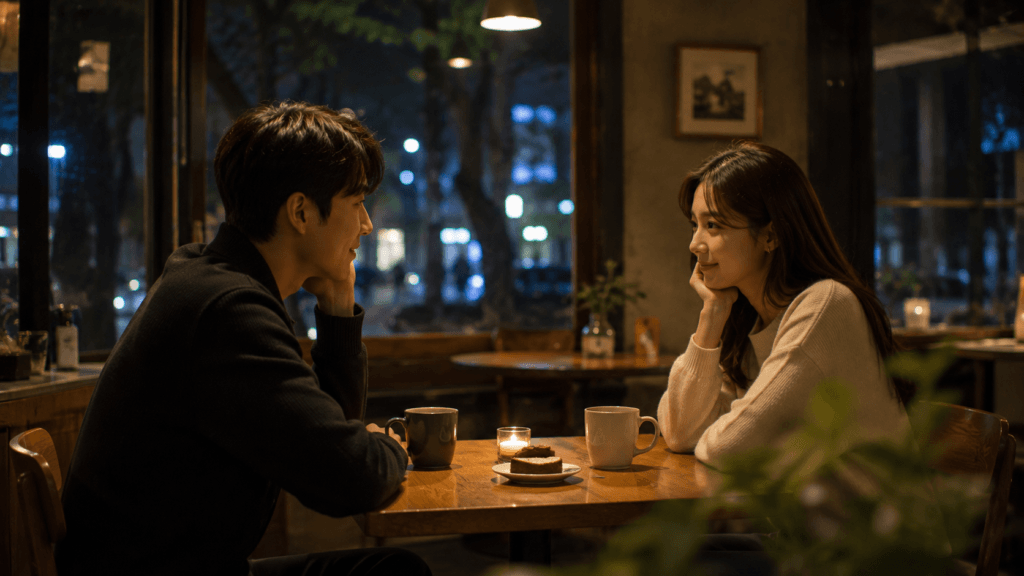
Sometimes Becoming More Polite Is the Bad Sign
The reverse can be even more interesting.
Suppose two characters have been speaking casually for a long time. They are comfortable with each other, perhaps as friends or as a couple.
Then they have a serious argument.
One of them suddenly begins speaking more formally.
To an English-speaking viewer, that might appear more respectful. In context, however, it can sound noticeably colder because the character has reintroduced distance into a relationship where that distance had previously disappeared.
The words themselves may not even be harsh.
That is precisely why the scene can work so well.
Instead of announcing, “I’m angry with you and I don’t want to be close right now,” the character can communicate part of that feeling simply by changing how they speak.
This is an important reason not to think of Korean speech as a scale running from rude to polite. More formal language is not automatically friendlier, just as casual language is not automatically disrespectful.
The relationship determines what the change means.
For K-drama fans, that makes the switch particularly worth noticing. If someone suddenly sounds different with a person they have known for several episodes, there is usually a reason.
Names and Relationship Terms Carry Clues Too
Speech levels are not the only thing subtitles can struggle to reproduce.
K-dramas frequently use relationship terms such as oppa (오빠), eonni (언니), hyeong (형), and nuna (누나). These words relate to the speaker’s gender, the other person’s age, and the relationship between them.
Many international fans already recognize oppa, but its use illustrates why direct translation can be difficult.
A younger woman may use oppa for her actual older brother, but the term can also be used for an older male with whom she has an appropriately close relationship. Translating it simply as “brother” in every scene would often give English viewers the wrong impression.
The same problem appears with names and titles.
A character may stop using a professional title and begin using a more personal form of address as a relationship develops. Another may deliberately return to a formal title after conflict.
English dialogue can communicate the main conversation without reproducing every one of these shifts.
That is not necessarily a failure of translation. Languages simply package social information differently.
The result, however, is that international viewers sometimes receive the meaning of a sentence without receiving every clue about the relationship surrounding it.
Age Matters, but K-Dramas Are More Complicated Than an Age Rule
International viewers often notice K-drama characters asking each other’s age relatively early.
Age can help establish how people address each other and understand their relationship, which is why the question can matter more in Korean conversation than some viewers expect.
But treating Korean speech as a simple formula—older person gets one form of speech, younger person gets another—quickly becomes misleading.
Two adults meeting for the first time may both use polite speech even when they know who is older. Close friends can speak casually. Coworkers may maintain professional language because of the setting, while a couple might continue using polite speech simply because it has become natural within their relationship.
This flexibility is exactly what makes speech useful for drama.
Writers can create an awkward situation when age and professional rank do not line up, or when two people who are close privately have to interact differently in front of colleagues.
The workplace hierarchy itself is explored more deeply in Why Korean Dramas Show So Many Workplace Hierarchies, but the language adds something an organizational chart cannot: it shows how the characters themselves are navigating that relationship.

Why English Subtitles Cannot Show Every Difference
English subtitles have a difficult job here.
They need to communicate meaning quickly enough for viewers to follow the story while still sounding natural in English. Translating every Korean title, honorific, relationship term, and speech-level change literally could make the subtitles harder rather than easier to understand.
Imagine two characters switching from jondaetmal to banmal.
English has no direct grammatical switch that tells the viewer, “These characters have just agreed to reduce the social distance between them.”
A translator can make the dialogue sound slightly more relaxed, but some of the significance inevitably depends on context.
The same applies when someone suddenly becomes formal after an argument. The English sentence might remain almost identical even though the Korean delivery has changed the emotional temperature of the conversation.
Fortunately, K-drama fans do not need to study Korean grammar to start noticing this.
Listen for moments when characters discuss speaking casually, change what they call each other, or suddenly sound different after a major shift in their relationship. Even recognizing a few familiar terms can help reveal why a seemingly ordinary conversation receives so much attention from the camera and actors.
The Dialogue May Tell You Before the Plot Does
This is where Korean speech becomes particularly useful as a storytelling device.
A drama does not always need to tell viewers that two characters are becoming close. Their conversations can gradually become more familiar.
It does not need a character to explain that an argument has damaged a relationship if the warmth that existed in their speech suddenly disappears.
And when a character moves between home, work, friendship, and romance, the way they speak can help distinguish those relationships without lengthy exposition.
For international viewers, the emotional meaning is usually still understandable through acting, context, and subtitles. Knowing about these language shifts simply reveals another layer that was there all along.
The next time a character pauses before asking, “Can I speak casually with you?”, the scene may make more sense.
The question is not really about making conversation easier.
It is about whether the relationship is ready to change.
Conclusion
Korean drama characters use different ways of speaking because Korean language choices can reflect familiarity, age, social position, and the relationship between the people talking.
That gives K-drama writers a subtle way to develop characters. Moving from polite speech to banmal can mark growing closeness, while suddenly becoming more formal can create distance. Changes in names, titles, and relationship terms can provide similar clues.
English subtitles usually preserve what viewers need to understand the story, but some of these social signals are difficult to translate naturally.
So rather than trying to memorize every Korean speech rule, watch for the moments when something changes.
Sometimes the most revealing part of a K-drama conversation is not what a character says, but the fact that they have started saying it differently.
FAQ
What is the difference between jondaetmal and banmal?
Jondaetmal (존댓말) broadly refers to polite or respectful speech, while banmal (반말) is casual speech commonly used in appropriately familiar relationships. Their use depends on the relationship and situation, not simply whether someone wants to be polite.
Why do K-drama couples ask to speak casually?
Changing from polite speech to banmal can reflect growing familiarity. In romance dramas, writers sometimes use that transition as a subtle milestone in the relationship.
Why don’t English subtitles show these speech changes?
English does not have direct equivalents for many Korean speech levels and relationship terms. Translators therefore prioritize natural English and the meaning of the dialogue, which can make some social nuances less visible.
Continue Exploring
If you enjoyed this article, you may also like:
Why Korean Dramas Show So Many Workplace Hierarchies
If speech changes depending on who is talking, what happens when job rank enters the picture? Korean office scenes often contain clues about power and relationships that subtitles cannot fully show.
Why Family Approval Matters So Much in Korean Dramas
Meeting the parents can change far more than the mood of a K-drama romance. The family relationship introduces another set of expectations that international viewers may not immediately recognize.
What Makes Korean Dramas Different from Western TV?
Speech levels are only one detail that can make a K-drama feel different. Explore how relationships, pacing, emotion, and cultural context shape the stories international audiences have come to recognize.