Visit a Seoul business district at 4 p.m. and again around 7 p.m., and you may feel as though the neighborhood has changed shifts.
The office towers are beginning to empty, but the streets below are not. Restaurants that looked quiet in the afternoon are suddenly filling tables. Small groups stand outside deciding where to eat, cafés are receiving customers rather than closing for the day, and subway entrances are busy with people heading in several different directions.
Some are going straight home, of course. Others are meeting friends, eating with coworkers, going to the gym, shopping, or stopping somewhere before beginning the commute home.
That distinction matters, because Korean after-work culture is sometimes described too simply. It is not that Koreans dislike going home or routinely turn every weekday into a night out. In fact, attitudes toward personal time and traditional company dinners have changed considerably.
What makes evenings in Korea interesting is something more practical: once the workday ends, the city still gives people an unusually large number of easy ways to continue the day.
A restaurant may be downstairs from the office. A friend can meet you two subway stops away. Dinner can lead naturally to a café without anyone having planned it beforehand. Shops, gyms, convenience stores, and entertainment businesses are often clustered around the same station you already use to commute.
This creates a different kind of transition between work and home.
The office closes, but much of the surrounding city is entering one of its busiest periods.
The Workday Ends, but the Neighborhood Is Still Fully Awake
One reason Korean evenings can surprise visitors has little to do with personality and a great deal to do with urban structure.
Many Korean business districts are not isolated collections of offices that become empty once employees leave. Restaurants, cafés, bars, pharmacies, gyms, convenience stores, beauty shops, and other businesses are often packed into the streets immediately around office buildings and subway stations.
During the day, many of those businesses serve the working population.
At lunchtime, restaurants fill quickly and then quiet down again. In the afternoon, cafés may hold people working on laptops or having meetings. Once offices begin closing, the same neighborhood changes purpose.
Now the demand is for dinner.
A street that functioned mainly as a route between an office and a station a few hours earlier can become a place where people decide to spend another hour or two.
This is not uniquely Korean. Business districts around the world have restaurants and nightlife. The difference is better understood as a combination of density and convenience. In many Korean urban neighborhoods, several possible evening activities can exist within a few minutes’ walk of one another.
You do not necessarily need to make a separate journey to begin your evening.
You are already standing in the middle of it.
That makes spontaneous decisions easier.
Two coworkers can leave the building planning to go home, reach the corner, and decide to eat together because a familiar restaurant is right there. Someone can finish dinner and notice a café across the street. Another person can stop at the gym located near the station they would have used anyway.
The evening does not require a major plan. It can grow out of the route home.
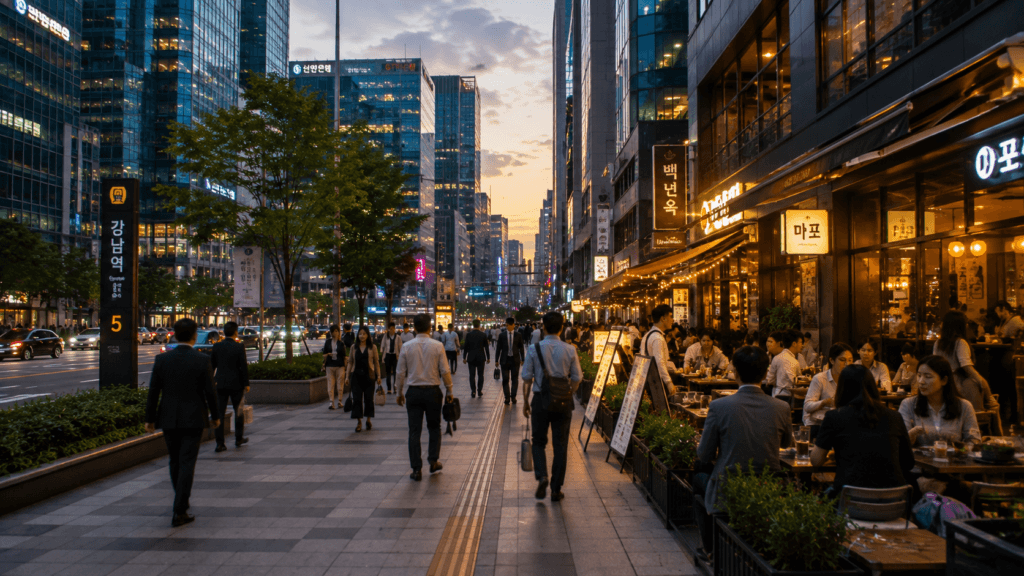
Public Transportation Makes an Extra Stop Much Easier
Transportation is another important part of this pattern.
Imagine finishing work and wanting to meet a friend who works in a different part of Seoul.
If both of you depend heavily on private cars, the decision may involve traffic, parking, where to leave each vehicle, and how everyone will get home afterward.
In a city built around extensive subway and bus use, the calculation can be different.
You can leave work, take the subway to a station that works for both people, have dinner, and continue home afterward without returning to the office or retrieving a parked car.
That makes office → meeting place → home a practical weekday route.
The geography of Seoul’s subway system also helps explain why certain stations become evening meeting points. People coming from different offices can meet around a convenient transfer station or busy commercial area before continuing toward separate homes later.
This does not mean commuting is effortless. Seoul rush hour can be extremely crowded, and many people have long journeys home. For someone facing a lengthy commute, going anywhere except home may be the last thing they want.
But the transportation network gives people the option.
That option matters.
It means that meeting someone after work does not always need to be treated like a weekend event requiring a car, parking reservation, or complicated travel plan. Sometimes it begins with a short KakaoTalk message sent in the afternoon.
“Dinner tonight?”
A few messages later, the station is decided.
The rest can be figured out after arriving.
Dinner Can Be the Beginning Rather Than the Whole Plan
Once people meet, the structure of the evening can also feel different.
In Korea, an evening gathering does not always take place in a single venue from beginning to end.
People commonly talk about il-cha (1차) and i-cha (2차)—literally the first and second rounds.
Traditionally, especially in workplace settings, the first round might be dinner and drinks, followed by another bar, karaoke, or another place for more drinking. That image is closely associated with older Korean company dinner culture.
But the basic idea of moving somewhere else after the first stop is broader than heavy drinking.
Friends may have dinner and then move to a café.
A couple might eat, buy dessert somewhere else, and take a walk afterward.
Coworkers may have an early dinner and finish the evening with coffee rather than alcohol.
Nobody necessarily decided on the second destination when the evening began.
Near busy Korean stations, that spontaneity is easy because the next place is rarely far away.
This is one reason dinner does not always signal that the gathering is ending.
Someone eventually asks, “Should we go somewhere else?”
And the answer may depend less on a detailed plan than on what is nearby.
That simple habit also helps explain why Korean cafés can remain socially important well beyond the morning. Coffee is only part of their role. After dinner, a café provides somewhere quieter to continue a conversation when people no longer want another meal or another round of drinks.
For groups who do not drink at all, it can serve exactly the same function.
The night gains another chapter without becoming a major night out.
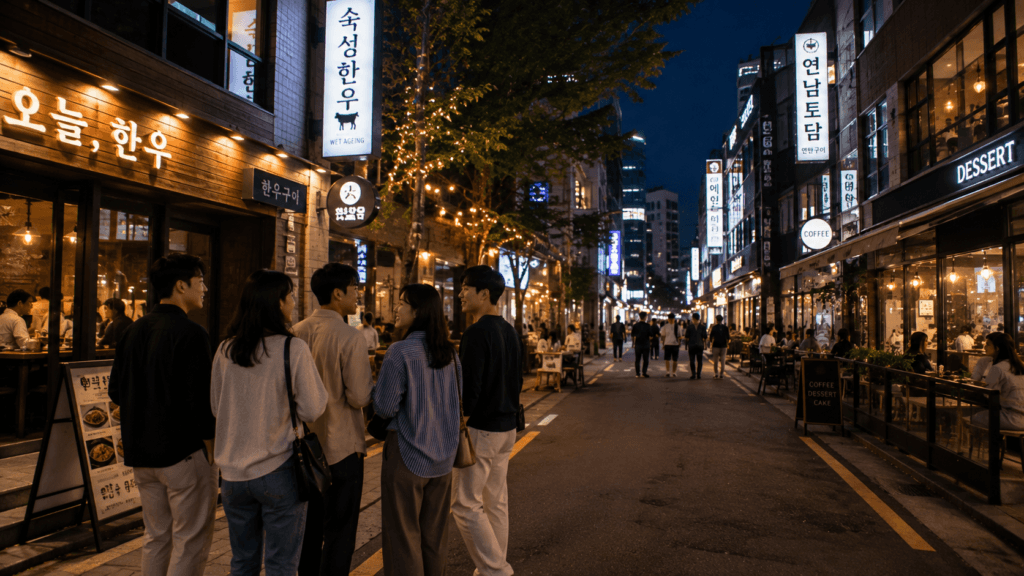
Hoesik Is Part of the Story, but It Is Not the Whole Story
For decades, discussions of Korean after-work life were almost impossible to separate from hoesik, the company dinner.
A hoesik can be as simple as coworkers sharing a meal, but the term also carries memories of a more hierarchical workplace culture in which employees might feel pressure to join dinners and drinking sessions after the official workday had ended.
That older image still shapes how many international visitors imagine Korean office life.
It would be misleading, however, to describe every modern Korean workplace that way.
Attitudes toward work-life balance, personal time, drinking, and workplace hierarchy have changed. Younger employees in particular are less likely to view long, obligatory after-work gatherings as an unquestioned part of professional life, while many companies have also moved toward shorter meals or more voluntary forms of socializing.
The interesting change is not that hoesik has disappeared.
It has not.
Coworkers still eat together, celebrate team milestones, welcome new employees, and occasionally continue the evening elsewhere.
What has changed is the assumption that an employee’s time automatically belongs to the workplace simply because the office closed.
That shift makes today’s Korean evening culture more varied than the familiar stereotype suggests.
Someone leaving an office at 6 p.m. might have dinner with the team.
The person beside them may be rushing home to pick up a child.
Another may be meeting an old university friend.
Someone else may put on headphones and head directly to the gym.
All of those choices belong to modern Korean after-work life.
And that is where the evening becomes more interesting than the old image of compulsory company drinking.
Cafés Give the Evening Somewhere Else to Go
One reason an evening in Korea can continue so easily after dinner is that the next destination does not have to involve more food or alcohol.
Often, it is simply a café.
In some countries, coffee shops are strongly associated with mornings and afternoons. In Korea, cafés can remain active well into the evening, particularly in busy commercial neighborhoods. That makes them useful for a completely different moment of the day: the time after dinner when people are not ready to go home but no longer want to sit in a restaurant.
This helps explain a common pattern. Friends meet after work, eat together, and then start looking for somewhere they can continue talking. Instead of extending the meal indefinitely, they pay the bill and move.
The café becomes the second space.
That role is especially useful because it works for many kinds of relationships. Coworkers can talk more casually once dinner is over. Friends who have not seen each other for months can stay another hour. Couples can move somewhere quieter after eating. People who do not drink can continue the evening without needing a bar.
The coffee itself may be almost secondary.
What people are really buying is somewhere comfortable to remain together.
This connects closely with the broader role cafés play in Korean daily life. They are used for studying, working, meeting, resting between appointments, and spending time when going home immediately is inconvenient. After work, the same flexibility gives the evening somewhere to continue.
That does not mean every café in Korea stays open late or that every dinner ends with coffee. Opening hours vary widely by neighborhood and business.
What matters is the availability of choices.
In a dense commercial district, finishing dinner rarely leaves a group wondering what they could possibly do next. There is often another place within walking distance.
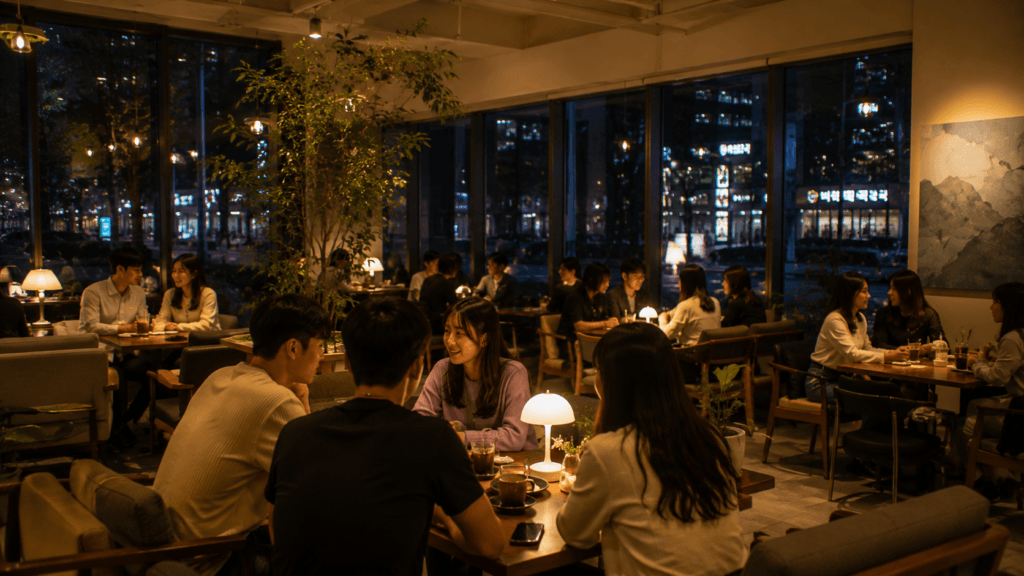
After-Work Time Is Becoming More Personal
The changing meaning of after-work time may be even more important than where people spend it.
For an older generation of Korean workers, leaving the office did not necessarily mean the company had finished with their time. Team dinners and drinking gatherings could extend workplace relationships well into the evening.
Modern expectations are more complicated.
Workplace hierarchy still exists, and company dinners remain part of Korean professional culture, but personal time has become much harder to treat as automatically available.
That changes what happens at the moment employees leave work.
Going home immediately is one option, not a failure to participate.
So is exercising.
So is meeting someone outside the company.
So is taking a class, shopping for groceries, having dinner alone, or spending the evening doing absolutely nothing productive.
This shift matters because it changes the meaning of Korea’s busy evening streets.
A crowded restaurant district at 7 p.m. should not automatically be interpreted as hundreds of workers continuing their jobs socially.
Some are with coworkers, certainly.
Others have just reclaimed the part of the day that belongs to them.
A person may have spent nine hours following a company schedule and now want an hour at the gym. Someone else may meet a friend who works on the opposite side of the city. Another person may pick up dinner and head directly home.
These choices can exist side by side.
That makes contemporary Korean after-work culture less uniform than the old image of the entire office heading out for hoesik together.
Why Some Korean Neighborhoods Get Busier After Work
The transformation becomes especially visible around major office and transportation areas.
During working hours, much of the population is hidden inside buildings. When offices begin emptying, those people suddenly return to street level.
Restaurants prepare for dinner customers. Subway entrances fill. People wait outside buildings for friends and coworkers. Cafés receive another wave of visitors, while gyms and other businesses begin serving people who have finished work.
The neighborhood has not suddenly gained more residents.
The same population has simply moved from private working spaces into public and commercial ones.
This helps explain why an area can appear more energetic after office hours than it did in the middle of the afternoon.
Urban density amplifies the effect.
When thousands of people work within a relatively compact area and many businesses are positioned around the stations they use, the transition happens in the same streets at roughly the same time.
There is also less separation between the places where different parts of the evening happen.
Dinner might be on one side of the station. Coffee is around the corner. A subway entrance is two minutes away. A convenience store sits between all three.
Instead of making separate journeys, people move through a tightly connected neighborhood.
That physical convenience makes an unplanned extra stop much easier to say yes to.
The Evening Economy Serves People on Their Way Home
Not every after-work stop is social.
This is another part of Korean evening life that can disappear when the story focuses too heavily on restaurants and nightlife.
For many people, the journey home is also the practical part of the day.
Someone stops at a supermarket or neighborhood grocery store. Another person picks up something they ordered earlier. A commuter walks into a pharmacy or beauty store before taking the subway. Others buy a simple dinner from a convenience store because cooking after getting home feels like too much work.
In a dense neighborhood, these errands can often be folded into the commute rather than requiring another trip later.
This is one reason the boundary between “work time” and “home time” can contain so much activity.
The period after leaving the office is not necessarily leisure, but it is no longer work either.
It is when people take care of all the small things that did not fit into the working day.
For a visitor walking through Seoul at 8 p.m., the result can look like a city where everyone is still out enjoying themselves.
Look more closely and the reality is more ordinary.
Some people are having fun.
Some are buying toothpaste.
Some are picking up dinner.
Some are trying to get home as quickly as possible.
All of them contribute to the sense that the city is still awake.
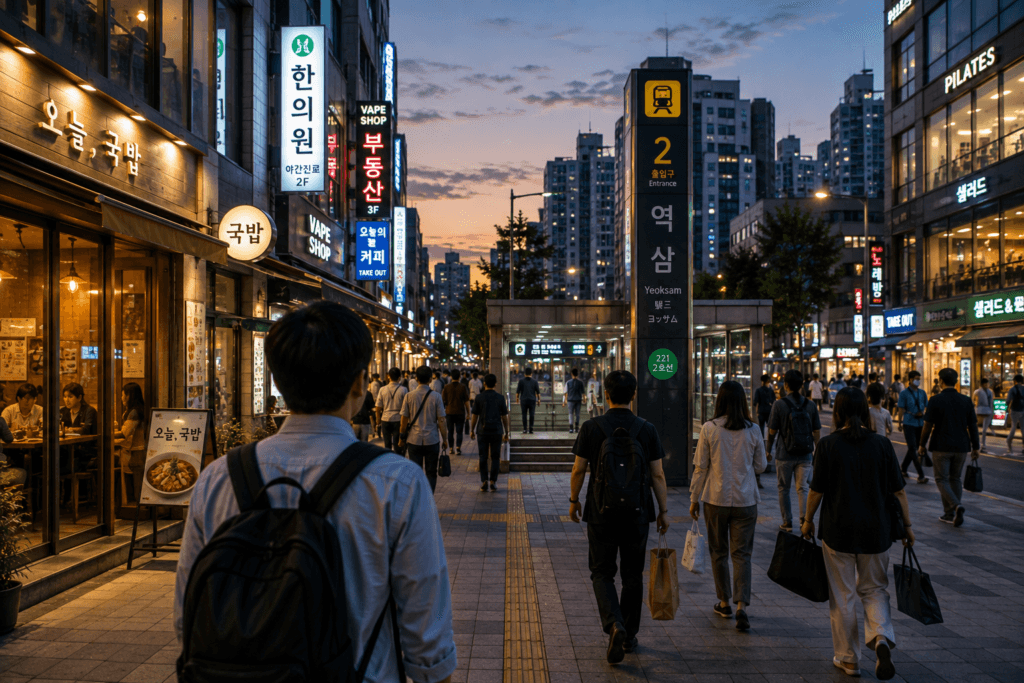
Going Straight Home Is Just as Much a Part of Korean Life
There is an obvious problem with any article about Korea’s active evenings: the people who go directly home are much harder to see.
They disappear from the street.
That creates a kind of observational bias.
Walk through a busy restaurant district after work and you naturally notice the people eating outside, meeting friends, or waiting for tables. You do not see the person who left the office 40 minutes earlier and is already changing into comfortable clothes at home.
Yet that person is just as representative of modern Korean life.
Long commutes can make staying out unattractive. Parents may need to return home quickly. Some workers are simply exhausted. Others prefer eating alone, watching something at home, gaming, exercising privately, or having an evening without social obligations.
The growth of delivery services also makes staying home easier than it once was. A person does not have to choose between cooking and going to a restaurant simply because they want a particular meal.
This is another reason the traditional image of Korean workers constantly drinking with colleagues needs updating.
A busy evening city and a strong desire for personal time can exist at the same time.
In fact, they are connected.
The city offers many possibilities after work, but increasingly, choosing none of them is also treated as a legitimate choice.
Why Korean Evenings Can Feel So Different
So what actually makes an after-work evening in Korea feel different?
It is not one particular activity.
Koreans do not have a uniquely Korean need to eat dinner with friends, drink coffee after work, exercise in the evening, or buy groceries on the way home. People do all of those things around the world.
The difference emerges from how easily those activities can fit together.
Dense neighborhoods put restaurants, cafés, shops, gyms, and transportation close to one another. Extensive public transit makes it possible to meet somewhere between work and home without bringing a car. Evening-oriented businesses give people somewhere to go after offices close. The familiar habit of moving from a first stop to a second means a gathering does not necessarily end when dinner does.
At the same time, the culture surrounding work itself is changing.
Hoesik still exists, but it no longer explains every crowded restaurant after 6 p.m. The person leaving the office is increasingly making their own decision about what happens next.
That combination is what makes the evening interesting.
The infrastructure makes continuing the day easy.
Changing social expectations make the choice more personal.
And because so many of those choices happen in the same dense neighborhoods, they remain highly visible on the street.
Conclusion
Stand outside a Korean office building around quitting time and there is no single direction everyone goes.
Some people walk toward the subway because they want to get home.
Some turn toward a restaurant with coworkers.
Others are already messaging friends about where to meet. Someone has a gym bag over one shoulder. Another person stops to buy dinner before beginning a long commute.
A generation ago, the story of Korean after-work culture could more easily be dominated by the company dinner and the expectation that coworkers would continue spending time together after the official workday.
That culture has not vanished, but it now shares the evening with something increasingly important: personal choice.
Korean cities make that choice unusually visible.
The infrastructure that carried people to work in the morning can take them somewhere else before home. The neighborhoods around offices remain useful after the offices themselves empty. Restaurants lead easily to cafés, while shops and everyday services fit naturally into the commute.
This is why the streets can still feel active long after the working day is ending.
It is not because everyone wants to stay out late.
It is because going home is only one of many things that are easy to do next.
FAQ
What do Koreans usually do after work?
There is no single routine. Many people go directly home, while others eat with coworkers or friends, exercise, shop, visit cafés, run errands, or spend time on hobbies. After-work routines vary significantly depending on age, family responsibilities, commute time, workplace culture, and personal preference.
What does hoesik mean in Korea?
Hoesik (회식) generally refers to a meal or social gathering involving coworkers. It has historically been associated with Korean workplace culture and sometimes with drinking, although modern hoesik can be shorter, less alcohol-focused, and more voluntary than the stereotype suggests.
What do 1-cha and 2-cha mean?
1-cha (1차) refers to the first stop or round of an evening gathering, often dinner. 2-cha (2차) is the next destination. Traditionally this might have meant another drinking venue or karaoke, but it can also be a café, dessert shop, or another casual place.
Why are Korean cafés busy at night?
Cafés in Korea often function as social spaces as well as places to buy coffee. After dinner, friends, couples, and coworkers may move to a café because it provides somewhere comfortable to continue talking without ordering another meal or drinking alcohol.
Do Korean workers still have mandatory company dinners?
Company dinners remain part of Korean workplace culture, but expectations vary greatly between workplaces. Broader changes in attitudes toward work-life balance and personal time have weakened the assumption that every employee should spend long evenings socializing with coworkers.
Continue Exploring
If you enjoyed this article, you may also like:
Why Korean Office Workers Eat Together So Often
Shared meals are still an important part of many Korean workplaces, but the reasons go beyond traditional company dinners and reveal how relationships are built during the working day.
Why Korean Cafés Are More Than Coffee Shops
From afternoon study sessions to conversations after dinner, Korean cafés fill a much broader social role than their menus might suggest.
Why KakaoTalk Is Essential to Everyday Life in Korea
A quick message can turn the commute home into an unexpected dinner plan. See why KakaoTalk has become part of organizing both practical and social life in Korea.
Why the Han River Is Part of Everyday Life in Seoul
Not every evening ends inside a restaurant or café. The Han River shows how Seoul residents also use large public spaces for exercise, foo