A junior employee has barely started presenting when a manager interrupts. Nobody else at the table says anything. Later, the same employee complains freely to a coworker but immediately changes their tone when the manager walks into the room.
If you rely only on the subtitles, the difference may not seem dramatic.
Listen to the Korean dialogue, however, and there may be much more happening.
The employee may be using the manager’s job title instead of a name, speaking at a noticeably different level of politeness, and carefully choosing how directly to disagree. Age and seniority can add another layer that the organizational chart does not show.
Workplace hierarchy is certainly not unique to Korea. Companies around the world have managers, executives, reporting structures, and differences in authority. What makes hierarchy particularly useful in Korean dramas is that several signals of status can appear at the same time—and some of them do not translate neatly into English.
Once you begin recognizing those signals, familiar K-drama office scenes become more interesting. A title can reveal distance, a change in speech can suggest that a relationship is shifting, and an awkward interaction between an older employee and younger manager can make more sense than it did from the subtitles alone.
So why do Korean dramas return to workplace hierarchy so often, and how much of what we see actually reflects Korean office culture?
The answer begins with something as ordinary as how coworkers address one another.
Job Titles Tell You More Than Who the Boss Is
Korean dramas frequently use workplace titles such as daeri (대리), gwajang (과장), bujang (부장), and sajang (사장). Their exact responsibilities and English translations can vary depending on the organization, so subtitles may simplify them into terms such as assistant manager, manager, department head, or president.
There is nothing uniquely Korean about having job titles. The more interesting difference is how those titles can become part of everyday forms of address.
An employee may address a manager as Kim Gwajangnim, combining the family name, job title, and respectful -nim (님). Instead of hierarchy appearing only when someone gives an order or makes a decision, the relationship can remain audible during ordinary conversation.
For Korean viewers, this provides immediate context. They can often understand roughly where characters stand within an organization simply by listening to how people address one another.
K-dramas can also make a change in address meaningful. If two characters normally use formal workplace titles and one suddenly chooses something different, the shift may indicate growing familiarity, anger, disrespect, or a relationship that has begun to move beyond the office.
International viewers usually understand the larger emotion from the acting and subtitles. What they may miss is why the change feels significant before anyone explains it.
That becomes even more important when the title is combined with the way the character speaks.
What English Subtitles Cannot Fully Show
Korean speech changes according to relationships and situations.
Age, familiarity, social position, and professional context can all influence how politely or formally someone speaks. This does not mean every interaction follows one rigid formula, but it gives drama writers another way to communicate relationships without explaining them directly.
Consider a junior employee disagreeing with a manager.
An English subtitle might simply read:
“I don’t think that’s the right decision.”
The meaning is clear, but the Korean dialogue can contain additional information. The employee might express the disagreement while carefully maintaining polite speech, making the scene feel cautious rather than openly confrontational. In another scene, the same character might become noticeably more direct because frustration has finally overcome that restraint.
The words communicate the disagreement. The speech level helps communicate what the disagreement costs socially.
Changes can work in the opposite direction too. Characters who initially maintain formal distance may gradually speak more comfortably as they become closer. After an argument, someone may deliberately return to more formal language, creating distance even though the English translation looks almost unchanged.
This is one reason K-drama fans sometimes sense that a scene carries more tension or intimacy than the subtitles alone seem to explain.
There may be another relationship being communicated inside the language itself.
Age and Job Rank Can Complicate the Same Relationship
The organizational chart is not always the only hierarchy in the room.
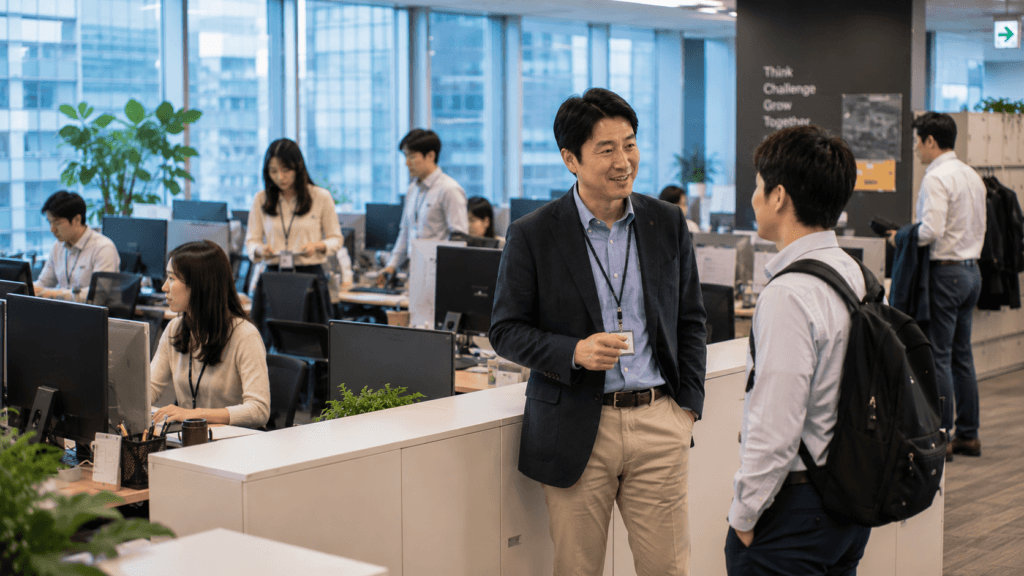
Age has traditionally influenced Korean social relationships, while workplaces create a separate structure based on position, responsibility, and seniority within the company. Most of the time these factors coexist without becoming a dramatic problem.
K-dramas naturally prefer the moments when they do.
An older employee may report to a younger manager. Someone who joined the company earlier may have more experience but hold a lower position. Two people who knew each other outside work may suddenly find themselves expected to interact according to professional roles once they enter the office.
These situations are useful because nobody necessarily has to behave badly for the relationship to feel awkward.
A younger manager still has legitimate authority over an older employee. At the same time, the age difference may affect how both people approach one another socially. A drama can use that tension to explore pride, respect, insecurity, or resentment without needing a villain.
Chaebol dramas take this mismatch much further.
A young executive may outrank employees with decades more professional experience because the character belongs to the family controlling the company. Corporate position, age, experience, family power, and wealth suddenly point in different directions.
That is not an ordinary picture of Korean office life. It is an exaggerated setting designed for television.
But it works because viewers already understand the underlying question: what happens when different kinds of status do not match?
Hierarchy Turns Ordinary Office Problems Into Drama
This is where workplace hierarchy becomes particularly valuable to writers.
Imagine a junior employee discovers that a manager’s plan has a serious flaw. The professional solution seems obvious: explain the problem.
The dramatic question is how.
Should the employee challenge the manager during the meeting or wait until afterward? How directly can they speak? Will correcting a superior publicly be interpreted as useful feedback, embarrassment, or disrespect?
Suddenly, a routine workplace disagreement reveals character.
One employee may speak immediately because they value the result more than office politics. Another may raise the same concern privately. A third may remain silent because they believe challenging the decision could damage their position.
The hierarchy gives each choice a consequence.
K-dramas can then amplify that structure when they need bigger stakes. A terrible manager can abuse authority. A chaebol heir can possess power far beyond their experience. A hardworking employee can struggle for recognition while someone with stronger connections advances more easily.
These stories are dramatic exaggerations, but the underlying mechanics are recognizable enough that audiences understand the conflict quickly.
The same hierarchy can even follow characters after they leave the office.
A hoesik (회식)—a company meal or gathering—places coworkers in a more relaxed setting, but their professional relationships do not instantly disappear. That makes the restaurant table useful dramatically: characters can speak more openly while still being aware of who is senior, who is junior, and who will be sitting across from them again tomorrow morning.
Real Korean Offices Are Changing
This is also where K-drama needs to be separated from everyday reality.
Korean workplaces are not all organized or managed in the same way. A large corporation, government office, startup, technology company, and small family business may have very different communication styles.
Some companies continue to use traditional titles extensively, while others have experimented with simplified titles or more horizontal forms of address. Expectations around company dinners and after-work socializing also vary considerably.
Generational change is part of the story.
Older workplace culture often placed greater emphasis on seniority, loyalty to the organization, and socializing with colleagues after work. Those expectations have not disappeared, but younger workers have pushed harder for work-life balance, clearer personal boundaries, and communication based more on job responsibilities than age or tradition.
That makes the familiar K-drama scene of employees being dragged into a long night of mandatory drinking with the boss increasingly incomplete as a picture of modern Korean working life.
Hoesik still exists. Hierarchy still exists. Titles still matter in many workplaces.
But the way employees negotiate those traditions is changing.
For drama writers, that creates new material. A younger employee and older manager may clash not simply because one is rude, but because they have different ideas about what respect at work should require. One may see staying late with the team as loyalty, while the other believes professionalism should end when the work is finished.
Modern workplace dramas can therefore show not only hierarchy itself, but what happens when people begin questioning its older forms.

What K-Drama Fans Should Watch for Next Time
The next time a drama moves into an office, try listening beyond the subtitle.
Notice whether characters address one another by title, name, or another form of address. Pay attention when that changes, particularly during arguments or as relationships become closer.
Also consider age and company position together. A character who appears strangely uncomfortable around a younger coworker may be responding to a professional rank that is not obvious from age alone.
And when a junior employee hesitates before contradicting a manager, the scene may be doing more than showing nervousness. The drama may be using workplace expectations to make an otherwise ordinary disagreement feel consequential.
None of this means every K-drama office scene is a realistic lesson in Korean business culture. Writers exaggerate bad bosses, corporate politics, chaebol families, and workplace conflict because quiet, perfectly functional offices rarely produce exciting television.
The cultural details are most useful when they help explain the scene rather than when they are treated as rules every Korean workplace must follow.
That distinction makes the dramas more interesting, not less.
Conclusion
Workplace hierarchy appears so often in Korean dramas because it can communicate several things at once.
Job titles establish professional position, Korean speech levels can reveal respect or distance, and age or seniority may complicate relationships that look straightforward on an organizational chart. Writers can then turn those differences into conflicts over authority, loyalty, promotion, friendship, or romance.
Real Korean workplaces are more varied than television suggests, and workplace culture continues to change as companies experiment with flatter communication and younger employees place greater value on personal boundaries.
For international K-drama fans, the most interesting details may therefore be the ones that subtitles struggle to show.
The next time a junior employee suddenly changes how they address a manager, or a room becomes uncomfortable after someone challenges a superior, there may be more happening than the translated dialogue suggests.
Understanding those signals does not simply explain Korean workplace culture.
It can help you read the drama itself.
FAQ
Are Korean workplaces really as hierarchical as K-dramas show?
Hierarchy remains relevant in many Korean workplaces, but dramas often exaggerate conflict for storytelling. Workplace culture varies considerably by company, industry, generation, and management style.
Why do Korean employees use job titles when speaking to coworkers?
Job titles can function as forms of address in Korean workplaces, often combined with a family name and the respectful suffix -nim. However, practices differ, and some companies now use simpler or flatter forms of address.
Why do K-drama subtitles miss some workplace hierarchy?
Korean speech can communicate levels of politeness, formality, familiarity, and social distance that do not always have natural English equivalents. Subtitles usually preserve the main meaning but may not reproduce every relationship signal.
Does age matter in Korean workplaces?
Age can influence social interactions, but professional authority is also determined by organizational position. The overlap between age, experience, and job rank can create situations that Korean dramas frequently use for character conflict.
Continue Exploring
If you enjoyed this article, you may also like:
What Makes Korean Dramas Different from Western TV?
Workplace hierarchy is only one detail that can feel different in a K-drama. From pacing and relationships to the way everyday social rules shape a story, there is much more happening beneath the surface.
Why Family Approval Matters So Much in Korean Dramas
Why can a parent’s opinion create so much tension between two adults in love? The answer reveals another kind of hierarchy that K-dramas use especially well.
Why Korean Dramas Have So Many Drinking Scenes
Those company dinners are rarely included just because the characters need a drink. See what can change when bosses and junior employees leave the office but bring their workplace relationships with them.
Why Korean Office Workers Eat Together So Often
K-dramas make shared lunches and company meals look almost automatic, but how close is that to real Korean office life? The everyday reasons are more practical than they may first appear.