For decades, companies measured success using familiar numbers.
Sales.
Market share.
Advertising reach.
Customer acquisition.
Those metrics still matter.
But many global brands are now asking a different question.
How do you build a community that chooses to stay, participate, and grow together over many years?
Interestingly, one of the most compelling answers isn’t coming from Silicon Valley or Madison Avenue.
It’s coming from Korean entertainment.
The worldwide success of Korean fandom has shown that long-term engagement is not created by advertising alone.
It grows through shared experiences, meaningful participation, and communities where people feel that their contributions matter.
That shift has attracted attention far beyond the music industry.
Today, marketers, researchers, sports organizations, technology companies, and consumer brands are increasingly studying Korean fandom—not because they want to create the next K-pop group, but because they want to understand why millions of people willingly become active participants instead of passive customers.
Companies No Longer Want Passive Customers
Traditional marketing often treated customers as audiences.
Brands created campaigns.
Consumers watched advertisements.
Then they decided whether to buy a product.
Modern communities work differently.
People expect interaction.
They want to comment.
Share ideas.
Create content.
Meet others with similar interests.
Contribute something meaningful.
Korean fandom has demonstrated that participation itself can become one of the strongest reasons people remain connected to a brand or community.
Instead of asking, “How can we sell another product?”
Many companies now ask,
“How can people feel that they belong here?”
That represents a fundamental change in how organizations think about long-term customer relationships.

Community Creates Loyalty That Advertising Cannot Buy
One successful advertisement may attract attention for a few days.
A strong community can create loyalty that lasts for years.
This is one of the biggest lessons companies have observed from Korean fandom.
Fans don’t return simply because new content appears.
They return because they have built friendships, traditions, and shared experiences within the community itself.
Many global brands now recognize that emotional connection between community members is often just as valuable as the relationship between the customer and the brand.
When people begin identifying with a community rather than a product, loyalty becomes far more resilient.
This helps explain why businesses across industries—from entertainment and gaming to sports and consumer technology—have invested heavily in community-building strategies over the past decade.
As explored in Why Korean Fandom Culture Is Different From Western Fandom, collaboration often becomes the foundation that keeps communities active long after individual campaigns have ended.

Korean Fandom Shows the Power of Shared Ownership
One reason Korean fandom has attracted so much attention is that fans rarely feel like passive audiences.
They feel involved.
Communities celebrate milestones together.
Members create artwork, organize charity projects, translate content, welcome newcomers, and preserve years of shared memories.
None of these activities are required.
People participate because they believe their contributions matter.
From a business perspective, this is remarkable.
Many companies spend enormous resources trying to increase customer engagement.
Korean fandom demonstrates that engagement becomes much more sustainable when people are given meaningful ways to participate rather than simply consume.
That doesn’t mean every business should copy fandom culture directly.
Instead, it highlights a broader principle.
Communities grow strongest when people feel they are helping shape them rather than merely observing them.
The Biggest Lesson Isn’t About Entertainment
It is easy to assume that Korean fandom is only relevant to music companies.
In reality, its influence reaches much further.
Technology companies study online communities.
Sports organizations look at fan engagement.
Fashion brands explore community-driven campaigns.
Universities research digital participation and cultural exchange.
Even nonprofit organizations have adopted ideas inspired by volunteer-led fan projects.
What connects these very different industries is not entertainment.
It is community.
Korean fandom has shown that people are more likely to remain engaged when they feel connected not only to an organization, but also to one another.
This shift from customer relationships to community relationships has become one of the most important trends in modern marketing.
As discussed in How Korean Fans Influence Global Music Charts, long-term influence is built through thousands of small contributions rather than one large campaign.
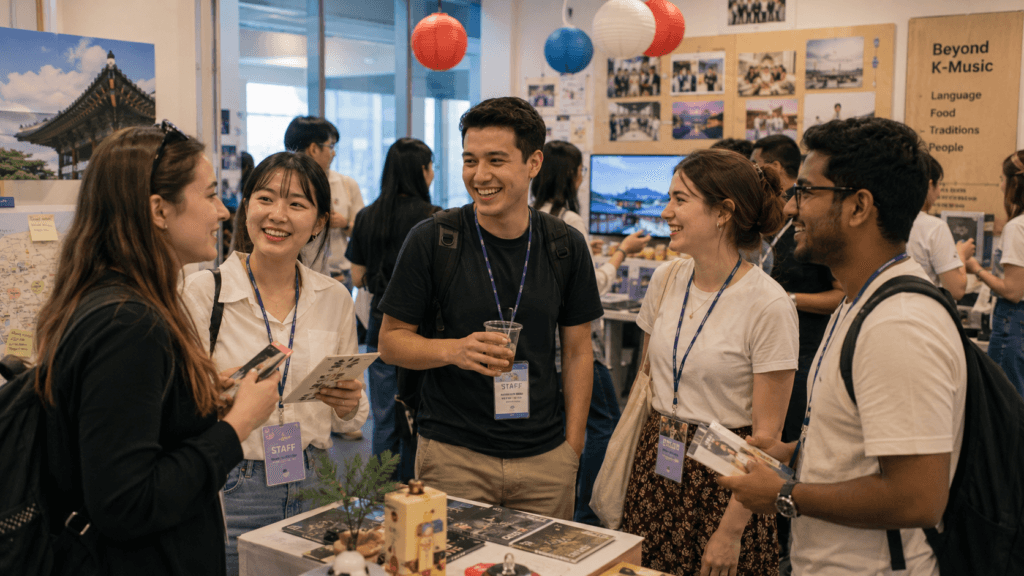
Community Is Becoming a Competitive Advantage
For years, companies competed through better products, lower prices, or larger advertising budgets.
Those factors still matter.
Increasingly, however, they are no longer enough.
Products can often be copied.
Prices change quickly.
Advertising campaigns eventually end.
Strong communities continue growing.
That is why more organizations are investing in spaces where customers can interact with one another instead of simply interacting with the brand.
Korean entertainment demonstrated that people often stay because of the friendships, traditions, and shared identity surrounding the experience—not only because of the content itself.
Businesses in many industries are beginning to recognize that community is no longer just a marketing tool.
It has become a long-term competitive advantage.
Looking Beyond K-pop
Although K-pop introduced many international audiences to Korean fandom, the underlying ideas extend far beyond music.
The same community-first approach can be found in Korean dramas, webtoons, esports, and many other areas of Korean entertainment.
People gather around stories.
Share experiences.
Help newcomers.
Create traditions.
Celebrate together.
These patterns reveal something much larger than a successful entertainment industry.
They demonstrate how communities built on participation and shared purpose can continue growing even as technology, platforms, and trends evolve.
For companies studying Korean fandom, this may be the most valuable lesson of all.
The strongest communities are not built around products.
They are built around people.
Conclusion
Global companies are studying Korean fandom because it offers a new way of thinking about engagement.
Rather than relying solely on advertising or promotional campaigns, Korean fan communities have shown how participation, collaboration, and shared experiences create lasting loyalty.
The real lesson isn’t how to build a larger audience.
It’s how to create an environment where people genuinely want to return, contribute, and grow together.
As businesses continue searching for stronger relationships with their customers, the principles behind Korean fandom will likely remain an important source of inspiration.
What began as a unique aspect of Korean entertainment has gradually become a global example of how communities can shape the future of modern marketing.
Frequently Asked Questions
Why are global companies interested in Korean fandom?
Many companies study Korean fandom because it demonstrates how strong communities can create long-term engagement, loyalty, and meaningful participation.
Is Korean fandom only relevant to entertainment companies?
No. Businesses in technology, sports, retail, education, and nonprofit sectors have also explored community-building strategies inspired by Korean fandom.
What can companies learn from Korean fan communities?
They can learn how shared experiences, active participation, and member-to-member relationships often create stronger loyalty than traditional advertising alone.
Why is community becoming more important than advertising?
Modern audiences increasingly value interaction and belonging. Communities encourage long-term participation that continues even after individual marketing campaigns end.
Can Korean fandom influence the future of global marketing?
Many experts believe so. Its emphasis on collaboration, trust, and sustained engagement has already influenced how organizations think about customer relationships and brand communities.
Continue Exploring
If you enjoyed this article, you may also like: