You have probably seen the scene before.
It is late at night. A character has had a terrible day and, instead of going straight home, stops at a convenience store. They sit outside with instant noodles, a drink, or something small to eat. Then, almost inevitably, someone else appears.
Sometimes it is a coworker. Sometimes it is the person they have been avoiding all day. And sometimes two people who could not have an honest conversation anywhere else finally start talking at a tiny table outside a brightly lit store.
After watching enough K-Dramas, it is difficult not to wonder: why do Korean drama characters always seem to meet at convenience stores?
Part of the answer comes from real Korean life. Convenience stores are woven into many residential and commercial neighborhoods, making them believable places to stop without planning ahead. But dramas also use them for something more interesting. A convenience store creates a rare space where characters can temporarily step outside the roles they normally play.
That is why the most important part of these scenes is often not what the characters buy.
It is who decides to sit down beside them.
Why Convenience Stores Appear So Often in Korean Dramas
A restaurant usually requires a reason to be there. Someone suggests dinner, chooses a place, and makes time for the meal.
A convenience store requires almost nothing.
A character can stop because they are hungry, want a drink, need something on the way home, or simply do not feel ready to go inside their apartment yet.
For drama writers, that flexibility is incredibly useful.
Imagine a character leaving the office after an argument with a manager. Sending that character directly to a restaurant raises an obvious question: who are they meeting?
Put the same character outside a neighborhood convenience store and no explanation is necessary. They can sit alone for a while. A coworker can walk past. A friend can unexpectedly appear. Someone they have been avoiding can turn the corner.
The story suddenly has somewhere to go without making the encounter feel completely arranged.
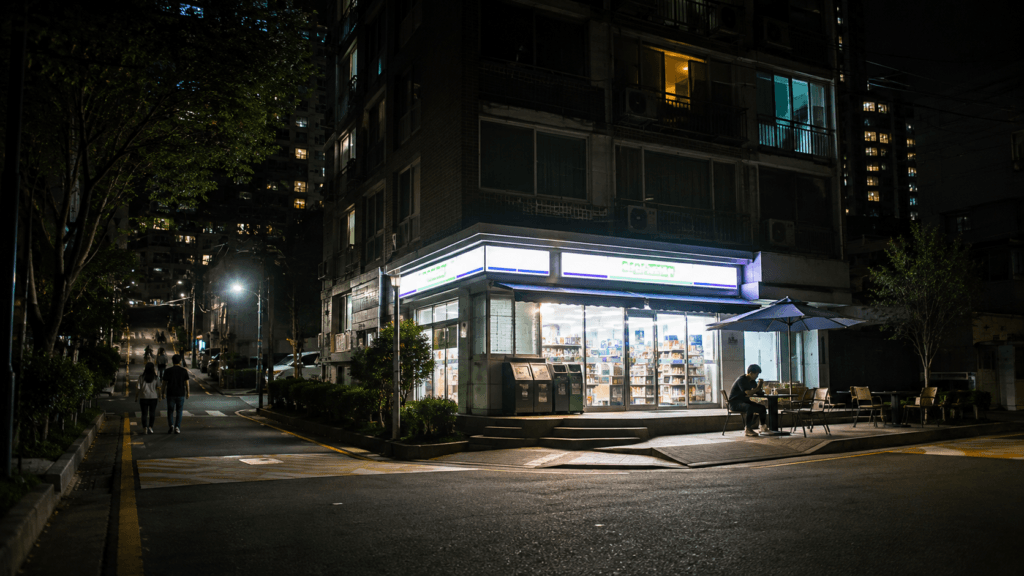
That works because the location itself is recognizable in Korea. Convenience stores can be found around apartment neighborhoods, office districts, schools, subway stations, and residential streets. For many people, stopping at one can simply be part of the journey between somewhere else and home.
K-Dramas take that ordinary familiarity and turn it into a storytelling advantage.
A Space Between Public and Private
There is another reason convenience stores work so well in romantic and relationship-driven dramas.
They sit somewhere between a private room and a formal social destination.
If one character invites another into their home, that can carry meaning of its own. Depending on the relationship, entering someone’s private space may suggest trust, intimacy, family involvement, or a significant step forward.
A café or restaurant is more neutral, but it often feels like a planned meeting.
The convenience store occupies a useful middle ground.
Two characters do not need to call what they are doing a date. Coworkers do not have to arrange dinner. Someone can sit down for five minutes and accidentally stay for an hour.
That makes the setting particularly useful when a relationship has not yet been defined.
Two coworkers who normally interact formally can talk differently there. Two people attracted to each other but unwilling to admit it can spend time together without acknowledging that they deliberately chose to do so. Someone having a difficult night can sit alone until another person quietly decides to stay.
The location does not force the relationship forward.
It simply gives the characters room to move closer on their own.
Why So Many of These Scenes Happen at Night
Pay attention to when convenience stores appear and another pattern becomes noticeable.
Many of the memorable scenes happen after the normal day is supposedly over.
The office has emptied. School has finished. A company dinner has ended. A character is walking home after an argument, a breakup, or news they are still trying to process.
Yet the convenience store is still brightly lit.
That contrast works beautifully on screen: a small pool of light in an otherwise quiet neighborhood gives a character somewhere to stop when they are not quite ready for the day to end.
It also creates a believable reason for two people to meet outside their normal social environments.
At the office, they may be a manager and an employee.
At school, they may be senior and junior.
At home, they may belong to completely different families and social worlds.
Outside a convenience store late at night, those identities have not disappeared, but the environment reinforcing them has.
Suddenly they are simply two people sitting beside each other.
That small shift can change an entire conversation.
Why Eating and Drinking Matter in These Scenes
There is rarely an elaborate meal at the convenience-store table.
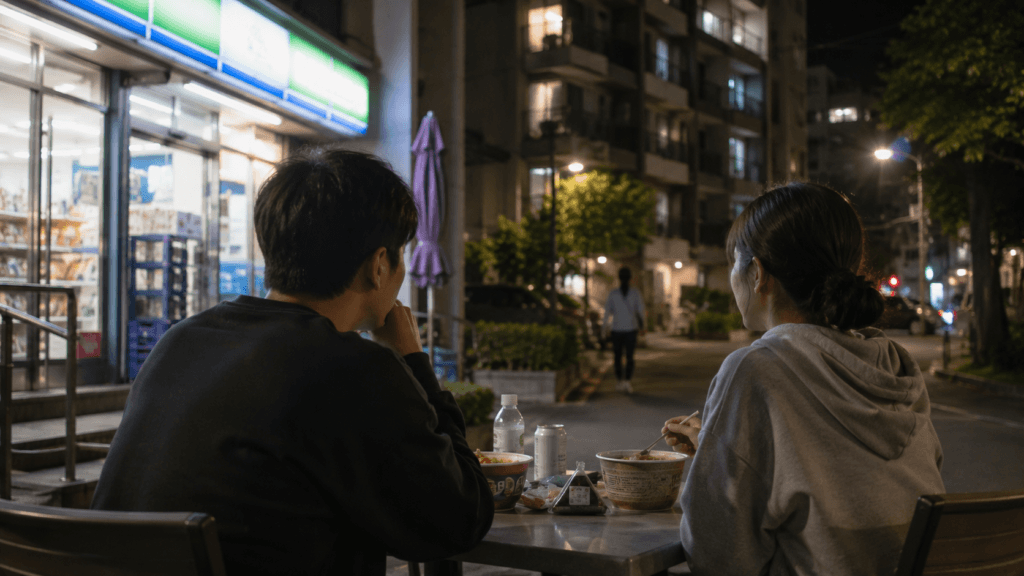
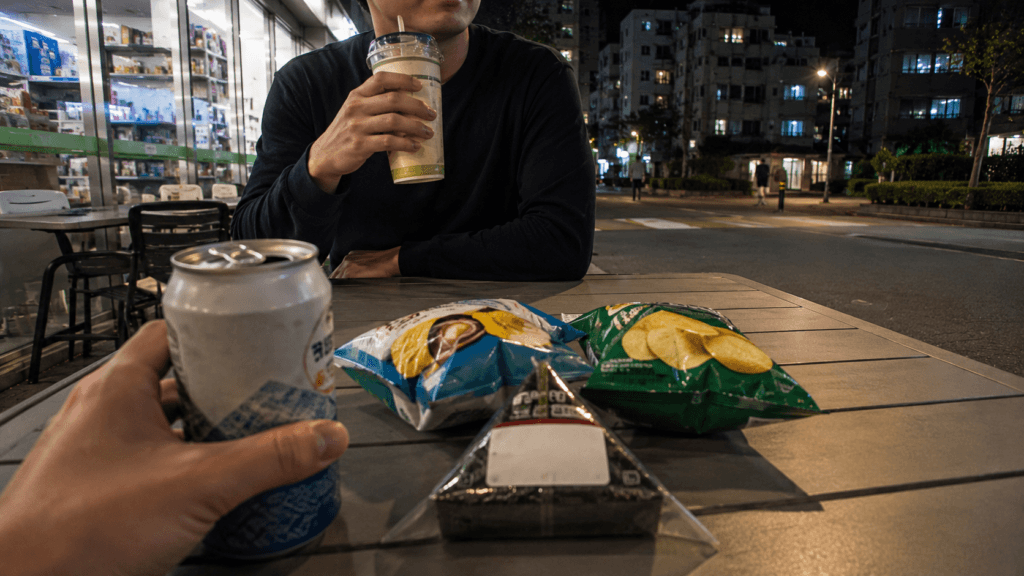
Characters may have instant noodles, packaged snacks, a simple drink, or something quickly heated inside.
That simplicity is part of the appeal.
A formal dinner makes viewers pay attention to the occasion. Convenience-store food removes much of the ceremony, allowing the interaction between the characters to become more important than the meal.
Look closely at what actually happens.
Who buys something for the other person?
Who offers the first bite?
Who pulls out the empty chair?
Who originally planned to leave but decides to stay?
Korean dramas frequently build relationships through these small choices.
A character does not necessarily need to say, “I was worried about you.” Sitting beside someone while they finish a late-night meal can communicate something similar without requiring a declaration.
Alcohol can serve a related storytelling purpose.
A character sitting outside a convenience store with a drink immediately suggests that the day has not gone as planned. But unlike a bar or company dinner, the setting feels temporary and unplanned. The character may not have decided to go drinking at all. They simply stopped on the way home and did not keep walking.
Then somebody notices them.
Often, the emotional point of the scene is not the alcohol. It is that another person recognizes they are having a difficult night and chooses not to leave them alone.
Convenience Stores Make K-Drama Coincidences Work
Korean dramas love unexpected encounters.
The person a character desperately wants to avoid appears at exactly the wrong moment. Someone discovers that another character has been sitting alone. Two people who have barely spoken all day somehow cross paths late at night.
A convenience store makes these coincidences easier to accept.
An office mainly belongs to coworkers. A family home belongs to relatives. A classroom belongs to students.
A neighborhood convenience store can belong to all of them.
That means different parts of a character’s life can plausibly cross in the same place.
This can also change how we see a character.
Imagine a strict manager who has only appeared at work. Everything about that environment reinforces authority: the office, the title, the desk, and the way junior employees behave around them.
Now place that same person outside a convenience store late at night, eating something simple alone.
The hierarchy has not vanished, but the setting has removed many of its visual signals.
For the first time, another character may see a tired parent, a lonely person, or someone uncertain about their future rather than simply “the boss.”
The character has not necessarily changed.
The space around them has.
Are Korean Convenience Stores Really Like This?
The setting itself is not something K-Dramas invented.
Convenience stores genuinely are part of everyday Korean life, and some locations provide indoor or outdoor spaces where customers can eat what they purchase. Their presence around residential and commercial areas also makes a quick stop on the way home believable.
What television does is concentrate meaningful events inside those ordinary places.
Most convenience-store visits do not end with an unexpected encounter with a future romantic partner. Coworkers do not magically appear every time someone has a bad day, and emotional confessions are certainly not included with every bowl of instant noodles.
Drama takes something familiar and makes it unusually eventful.
That distinction matters.
K-Dramas are not necessarily telling international viewers, “This is exactly how Koreans behave every night.”
Instead, they are using a location that feels natural enough that Korean viewers rarely need an explanation for why the characters are there.
The interesting part is what happens once they arrive.
What International Viewers Can Miss
Subtitles can tell you what the characters say.
They cannot always tell you why the place where they say it matters.
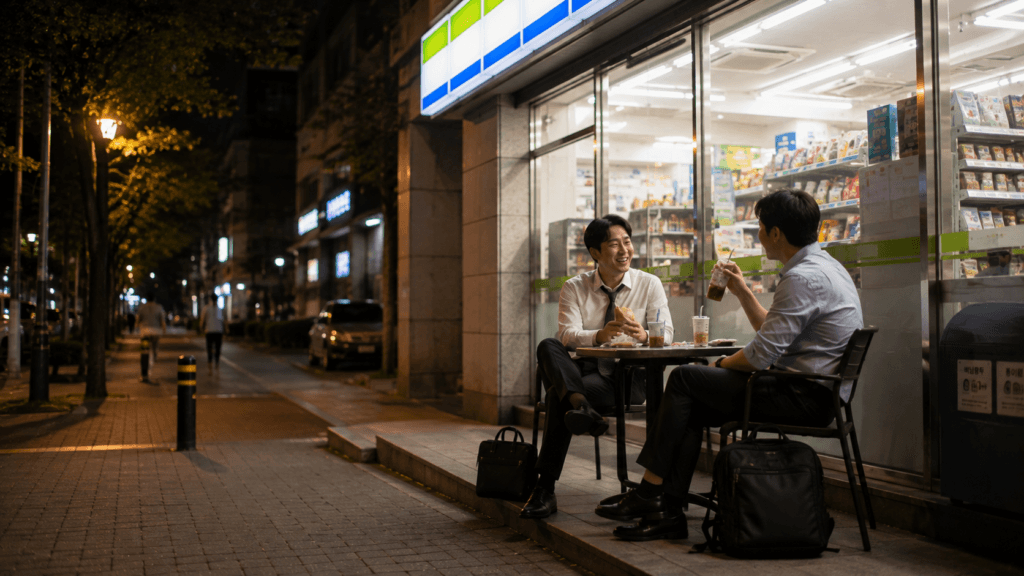
Suppose two coworkers who normally interact formally meet outside a convenience store after work. An international viewer can understand every translated sentence and still miss part of what the scene is communicating.
Watch the details instead.
Does their way of speaking become slightly more relaxed?
Does one person buy something for the other without asking?
Does someone who was about to leave sit down?
Do they reveal something personal they would never have said at the office?
And when the conversation ends, do they walk away separately or go home together?
Those details often tell us where the relationship is going before the characters are willing to say it themselves.
This is part of a larger cultural layer in K-Dramas. A sudden change between formal and informal speech, the way a junior employee responds to a senior colleague, or even a simple question such as “Have you eaten?” can carry meaning that does not transfer perfectly through subtitles.
The convenience store is another part of that language.
Once you start noticing it, the familiar scene becomes much more interesting.
The Next Time You See That Familiar Bright Store
The next time a K-Drama character stops at a convenience store late at night, do not look only at what they buy.
Look at where they came from.
Notice who arrives next, who sits down, who decides to stay, and how the conversation changes once the characters are outside the places where their normal roles usually define them.
The important part of the scene may not be the instant noodles or the drinks.
It may simply be that two people who normally belong to different parts of each other’s lives have found an ordinary place where neither needs a particularly good reason to remain.
For Korean viewers, that setting can be familiar enough to almost disappear into the background.
For international viewers, understanding why it works reveals something larger about Korean drama storytelling: some of the most meaningful cultural details are hidden inside scenes that initially look completely ordinary.
And the convenience store on the corner is a perfect place to start noticing them.
Frequently Asked Questions
Why are convenience stores so common in Korean dramas?
They provide an informal and believable location where characters can meet without making formal plans. This makes them especially useful for unexpected encounters and conversations that would feel different at work, home, or a restaurant.
Do Korean convenience stores really have places to eat?
Some convenience stores have indoor or outdoor seating where customers can eat food purchased there, although the setup varies by location.
Do Koreans really eat instant noodles at convenience stores?
Convenience-store meals, including instant noodles, are a recognizable part of Korean convenience-store culture. Dramas use them especially well because they create an informal reason for characters to sit together.
Are K-Drama convenience-store scenes realistic?
The locations and many everyday behaviors are recognizable, but dramas naturally concentrate coincidences and emotional conversations for storytelling. They should not be interpreted as a literal picture of every convenience-store visit in Korea.
Continue Exploring
If you enjoyed this article, you may also like:
Korean Convenience Store Culture
You have seen what convenience stores do in K-Dramas. Now discover why these small neighborhood stores have become such a familiar part of everyday life in Korea.
What Makes Korean Dramas Different from Western TV?
A late-night convenience-store conversation is only one clue. See why K-Dramas can make seemingly ordinary moments carry so much emotional weight.
Why Korean Cafés Are More Than Coffee Shops
Convenience stores are not the only familiar spaces that mean more than they first appear to. Discover why cafés play a surprisingly large role in everyday Korean life.