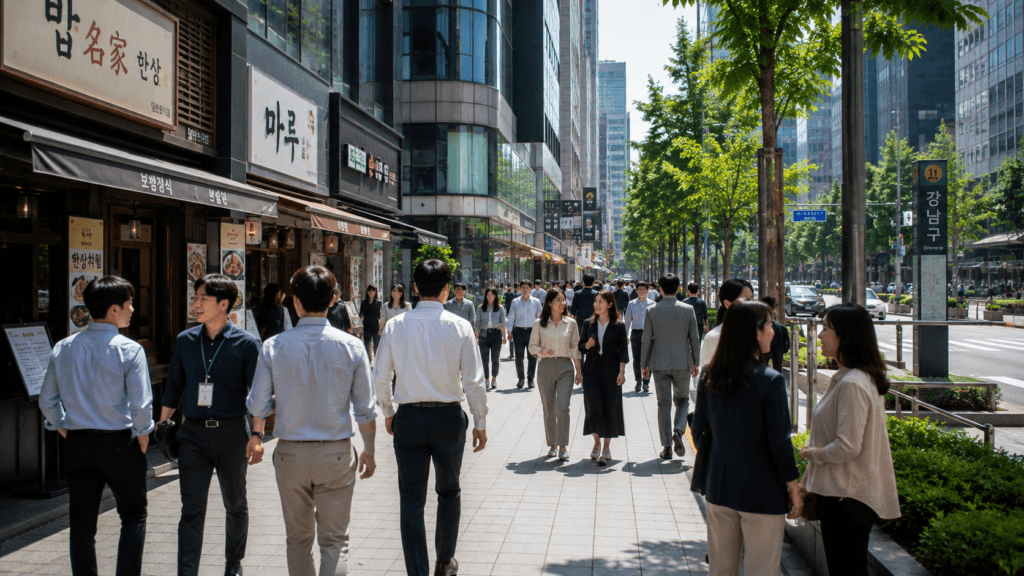
Walk through almost any business district in Korea just before noon, and you’ll notice something happening at exactly the same time.
Office elevators begin filling.
People leave buildings in small groups instead of alone.
Without saying very much, coworkers naturally head toward the same restaurants.
A few minutes later, sidewalks are filled with hundreds of groups all moving in the same direction.
At first, it looks like a citywide rush for lunch.
But after watching more closely, you realize something else.
Very few people are eating alone.
The manager walks beside new employees.
Different departments mix together.
Someone laughs while another recommends today’s special menu.
Nobody seems to have formally organized the outing.
Everyone simply moves together.
For many visitors, this raises an obvious question.
Why don’t people just eat whenever they want?
In many countries, lunch is personal time.
It’s a chance to recharge, catch up on messages, or enjoy a quiet break before returning to work.
In Korea, lunch often serves another purpose.
It becomes part of the working day itself.
The meal may last less than an hour, but the conversations, small jokes, and shared routines quietly strengthen relationships that continue long after everyone returns to the office.
Understanding that changes the way you see an ordinary lunch break.
It’s not only about eating.
It’s about maintaining the rhythm of working together.
Lunch Begins Long Before Anyone Orders Food
Around 11:40, something subtle begins to happen inside the office.
Someone glances at the clock.
Another coworker stands up to refill a water bottle.
A message appears in the team chat.
“Lunch?”
Within a few minutes, everyone is already putting on jackets or gathering their belongings.
Nobody announces a formal meeting.
Nobody sends a calendar invitation.
The routine has repeated so many times that it barely needs words.
Even newcomers quickly notice the pattern.
If everyone else is heading downstairs together, you naturally do the same.
The destination often isn’t decided until people reach the street.
One person suggests Korean stew.
Another recommends noodles because the weather feels warm.
Someone else remembers a recently opened restaurant nearby.
The conversation itself becomes part of the lunch break.
Walking there gives coworkers a few extra minutes to talk about weekend plans, family, sports, or anything unrelated to work.
By the time everyone reaches the restaurant, lunch has already begun.
The meal isn’t only what happens around the table.
It’s the entire routine of leaving the office together.
That small daily habit helps explain why lunchtime feels noticeably different in Korea.
People aren’t simply sharing food.
They’re sharing part of the workday.
As you follow one of those groups inside a restaurant, another question naturally comes to mind.
If eating together happens almost every day, what makes these meals so important?
Shared Meals Build Relationships Without Formal Meetings
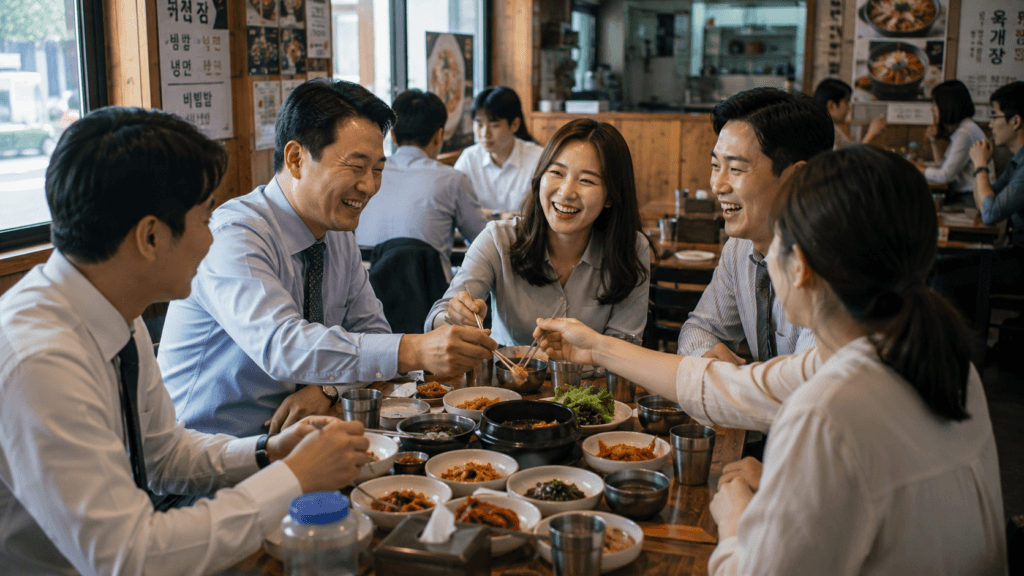
The restaurant is busy.
Tables fill one after another as groups from nearby offices arrive within minutes of each other.
Someone pours water for the people sitting nearby.
Another person passes side dishes around the table before anyone starts eating.
The conversation begins almost immediately.
But surprisingly, very little of it is about work.
Someone asks about a coworker’s new apartment.
Another talks about a baseball game from the night before.
A younger employee recommends a café they visited over the weekend.
Laughter moves naturally around the table while bowls of soup and shared dishes arrive one after another.
To many visitors, this can seem unusual.
If everyone has limited time for lunch, why not eat quickly and return to work?
The answer becomes clearer after you’ve spent more time in a Korean office.
Lunch isn’t viewed as time away from work.
It’s one of the easiest moments to strengthen the relationships that make work run more smoothly.
A conversation that might feel awkward inside a meeting room often happens naturally over a shared meal.
New employees become familiar with teammates.
Managers learn more about the people they work with every day.
Coworkers discover common interests that have nothing to do with deadlines or presentations.
Those small conversations may seem insignificant.
But repeated five days a week, they gradually build trust.
That trust often makes it easier to ask questions, solve problems, or work together once everyone returns to the office.
It’s relationship-building without calling it relationship-building.
If you’ve already read Why Korean Lunch Culture Surprises Foreigners, you’ve probably noticed that lunch in Korea is rarely treated as a quick break.
For office workers, it also becomes one of the few moments in the day when hierarchy softens slightly.
People still respect age and seniority, but the atmosphere feels noticeably more relaxed than it does around a conference table.
A shared meal creates space for ordinary conversations that rarely happen during working hours.
By the time everyone finishes eating, the team often feels a little more connected than it did an hour earlier.
As everyone stands up and begins walking back toward the office, you notice one final part of the routine.
The meal may be over.
But the feeling of moving together hasn’t disappeared.
Eating Together Creates a Shared Daily Rhythm
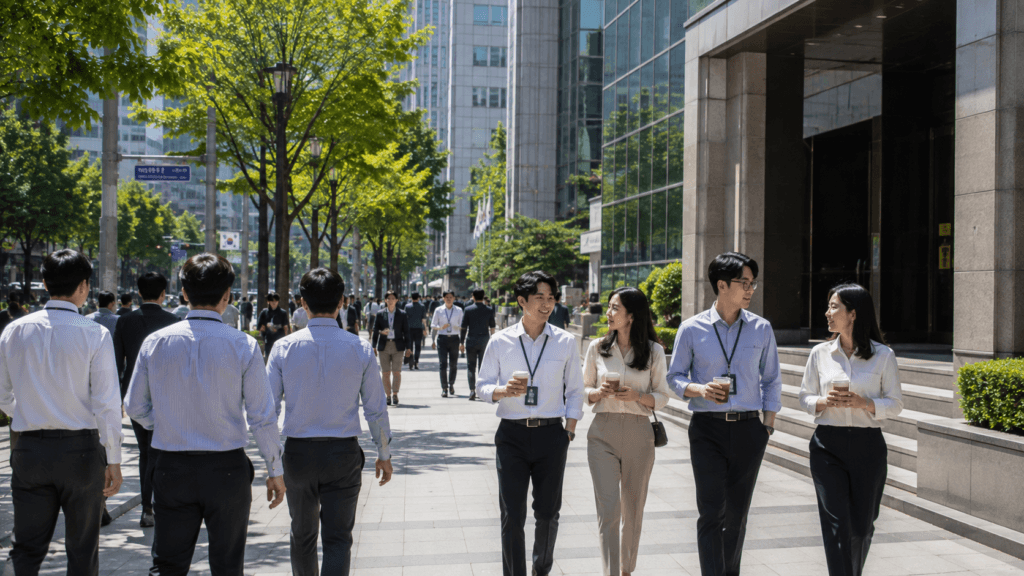
The walk back to the office is usually slower than the walk to the restaurant.
People continue conversations that started over lunch.
Someone stops briefly at a convenience store for coffee.
Another picks up iced drinks for coworkers who stayed behind in the office.
By the time the elevator doors close again, the lunch break has quietly blended back into the workday.
That’s what makes this routine so distinctive.
Eating together isn’t treated as a special team-building activity.
It doesn’t appear on the company calendar.
Nobody calls it an exercise in workplace culture.
It simply happens, almost every day.
Over weeks, months, and years, those ordinary lunches create a familiar rhythm.
New employees gradually become part of the group.
Departments that rarely work together recognize familiar faces.
Even on particularly busy days, sharing forty or fifty minutes around the same table helps preserve a sense of connection that would be difficult to build through emails or meetings alone.
Of course, modern workplaces are changing.
More people occasionally eat alone, order delivery, or use lunch breaks for personal errands.
Hybrid work has also made daily group lunches less common in some companies.
Even so, the idea that lunch is something to be shared remains deeply rooted in many Korean workplaces.
It’s one reason visitors often feel that office culture in Korea appears unusually close-knit.
The teamwork they notice inside the office often begins somewhere much simpler.
Around a lunch table, with coworkers sharing an ordinary meal before returning to another ordinary afternoon.
Conclusion
To many visitors, Korean office workers seem to spend an unusual amount of time eating together.
The restaurants are full.
The sidewalks are filled with groups heading to lunch.
Coworkers rarely appear to be eating alone.
At first, it can seem like nothing more than a workplace habit.
But after spending time in Korea, you begin to understand that these meals serve a much larger purpose.
They’re one of the simplest ways people stay connected during a busy working week.
Conversations continue outside the office.
New employees become part of the team.
Managers and coworkers share moments that have little to do with deadlines but everything to do with trust.
The meal itself is important.
But the time spent together matters even more.
As Korean workplaces continue to evolve, flexible schedules, hybrid work, and changing lifestyles are slowly reshaping lunch routines.
Even so, the idea of gathering around the same table remains an important part of everyday office culture.
That’s why a Korean lunch break often feels different from what many visitors expect.
It isn’t simply a pause in the workday.
It’s another way colleagues work together—without talking about work at all.
FAQ
Why do Korean office workers usually eat lunch together?
Many Korean workplaces view lunch as an opportunity to strengthen relationships between coworkers. Sharing meals helps build trust, improve communication, and create a more connected team.
Is it unusual to eat lunch alone in Korea?
Not anymore. Solo dining has become much more common, especially among younger workers and in large cities. However, eating together is still a common tradition in many offices.
Do managers usually join employees for lunch?
Yes. In many companies, managers and team members eat together regularly. Lunch provides a more relaxed setting where conversations can happen naturally outside formal meetings.
Are business discussions common during lunch?
Sometimes, but many lunch conversations focus on everyday topics such as hobbies, family, travel, or weekend plans. The goal is often to strengthen relationships rather than hold another meeting.
Has Korean office lunch culture changed?
Yes. Hybrid work, food delivery, and changing workplace values have made lunch routines more flexible. Even so, shared meals remain an important part of office culture in many Korean companies.
Continue Exploring
If you enjoyed this article, you may also like: