A first-time visitor to the Han River may arrive wondering what there is to see.
The skyline is impressive, the bridges are easy to photograph, and sunset can turn the water into one of Seoul’s most memorable views. Yet after spending a little time beside the river, something else becomes more interesting than the scenery.
Many of the people around you are barely looking at it.
A cyclist passes as though this were simply part of the road home. Friends struggle with a picnic mat in the wind before sitting down with food. A parent walks beside a child learning to ride a bicycle. Someone finishes a run, checks the time, and heads back toward the subway.
For them, the Han River is not necessarily the destination they have been waiting all week to see.
It is somewhere they use.
That distinction explains why the Han River occupies such an unusual place in Seoul life. Its popularity is not simply the result of having a beautiful river running through the capital. Geography gave Seoul an enormous open corridor through the middle of a dense city, but decades of riverfront development, water-quality management, park construction, transportation, and changing leisure habits helped turn that corridor into a place where ordinary life could happen.
The Han River that people picnic beside today did not always look or function this way.
And that history helps explain why Seoul residents use it so differently from many visitors.
The Han River Runs Through the Middle of Seoul
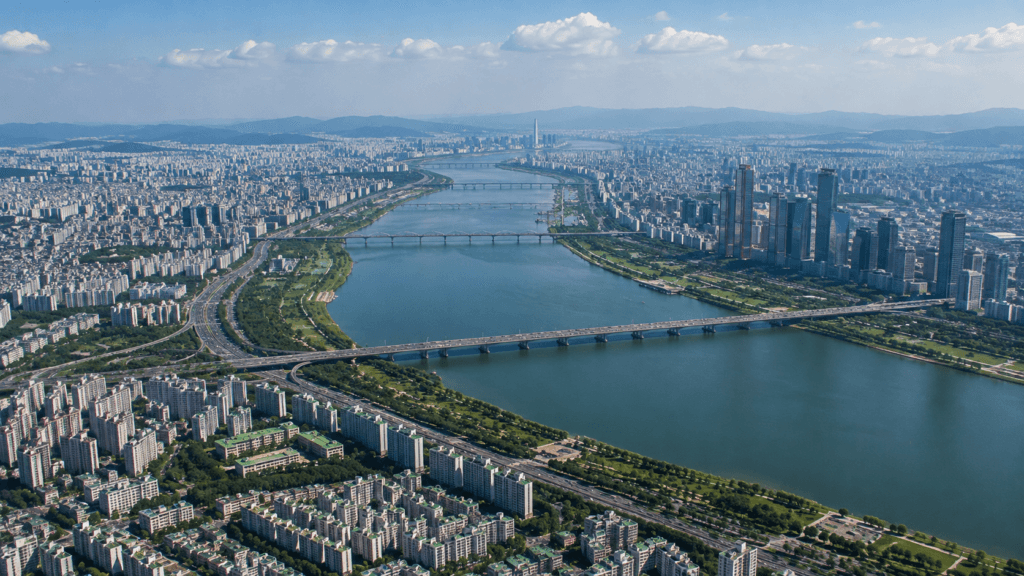
Look at a map of Seoul and the importance of the Han River becomes immediately easier to understand.
The river crosses the city from east to west, rather than sitting beyond the urban center as a scenic destination people must deliberately travel out to find. Seoul itself has grown around it, and everyday descriptions such as Gangnam, literally referring to the area south of the river, show how deeply the Han River is embedded in the city’s geography.
This creates an unusual relationship between a major river and a huge modern city.
From many parts of Seoul, the Han River is not “nature outside the city.” It is part of the city.
Residential neighborhoods rise near it. Business districts are close to it. Subway lines and roads cross it repeatedly, while bridges connect daily life on opposite sides.
Along the river are 11 official Hangang Parks, including Yeouido, Banpo, Ttukseom, Mangwon, Jamsil, Ichon, Jamwon, Gwangnaru, Nanji, Gangseo, and Yanghwa. They do not all serve exactly the same purpose or attract exactly the same crowd.
That matters because there is no single entrance where Seoul residents “go to the Han River.”
Someone living near Ttukseom may develop a completely different riverside routine from someone who usually visits Mangwon or Yeouido. One park may be convenient for cycling, another for meeting friends, another for taking children outside.
The Han River is therefore less like one enormous central park and more like a long public space touching multiple parts of the city.
Its geography made that possible.
But geography alone did not make the river somewhere people wanted to spend their evenings.
Today’s Han River Was Not Always This Inviting
It is easy to sit beside the Han River today, watch runners and cyclists pass, and assume Seoul has always had this comfortable relationship with its river.
It has not.
As Seoul industrialized and urbanized rapidly during the twentieth century, the river had to absorb the environmental consequences of a city growing at extraordinary speed. Protecting water quality and controlling pollution eventually became major public concerns.
The riverside itself also had a different role.
According to the Seoul Metropolitan Government, the transformation that led to today’s Hangang Parks began in 1982. Riverbanks that had primarily served flood-control purposes were gradually developed into green public spaces, and in 1992 the riverside areas officially became known as Hangang Park, consisting of 11 parks.
The environmental work has continued long after the parks were created.
Seoul has tightened wastewater management, monitored pollutants flowing into the river, operated water-quality monitoring networks, and improved sewage-treatment facilities. More recent projects have also replaced sections of concrete riverbank with soil, sand, reeds, trees, and other vegetation to restore more natural waterfront environments.
These efforts are not simply part of an environmental story separate from everyday life.
They helped change the kind of relationship people could have with the river.
A river that residents mainly pass over on a bridge is one thing.
A cleaner river surrounded by lawns, paths, trees, ecological areas, sports facilities, and accessible public parks becomes something else entirely.
It becomes somewhere people can stay.
How Clean Is the Han River Today?
Calling any urban river simply “clean” can be misleading because water quality depends on what is being measured, where, and when.
But there is measurable evidence that conditions in the Han River have improved.
Seoul’s Research Institute of Public Health and Environment reported that major water-quality indicators improved for three consecutive years through 2024. Average dissolved oxygen increased, while total nitrogen and total phosphorus declined. The city attributed the improvement partly to upgrades in wastewater treatment and real-time water-quality management.
Monitoring is ongoing rather than something Seoul completed decades ago. The city operates real-time systems and continues trying to reduce pollutants entering the river, while ecological restoration projects have been changing sections of the waterfront itself.
This distinction is important.
The Han River should not be presented as a pristine wilderness flowing untouched through Seoul. It runs through one of the world’s largest urban areas and is actively managed as such.
What is remarkable is that a river under that kind of urban pressure can simultaneously support ecological areas and become one of the city’s most heavily used public landscapes.
That is part of the story visitors see today without necessarily realizing it.
When someone spreads a picnic mat beside the water or follows a riverside cycling path after work, they are using a landscape shaped by decades of decisions about what Seoul wanted its river to become.
Why the Open Space Feels So Valuable in Seoul
The scale of the Han River becomes especially noticeable once you leave it.
Much of Seoul’s everyday convenience comes from density. Apartment complexes, restaurants, cafés, schools, offices, subway stations, shops, and services can all exist remarkably close together.
That makes the city efficient.
It can also make truly open space feel valuable.
Walking from a busy neighborhood toward the river can create an immediate visual change. Buildings recede. The sky becomes larger. Instead of constantly passing storefronts, intersections, and entrances, you can follow the water or a long path without having to decide where to go next.
This is one reason the Han River does not need to entertain people constantly.
A resident may come simply because they have spent most of the day inside an office, classroom, apartment, or subway.
They do not necessarily need an attraction.
They need space.
And because that space remains inside Seoul, using it does not require planning a trip outside the city.
You can finish work, meet a friend, walk toward the river, and suddenly find yourself somewhere that feels dramatically more open than the neighborhood you left behind.
You Do Not Need to Spend Much to Stay for Hours
There is another reason the Han River works particularly well as an everyday social space.
You do not have to buy your right to remain there.
Much of social life in a large city takes place in commercial spaces. Friends meet at cafés, eat at restaurants, shop, see movies, or move between places where spending money is part of the experience.
The riverside changes that equation.
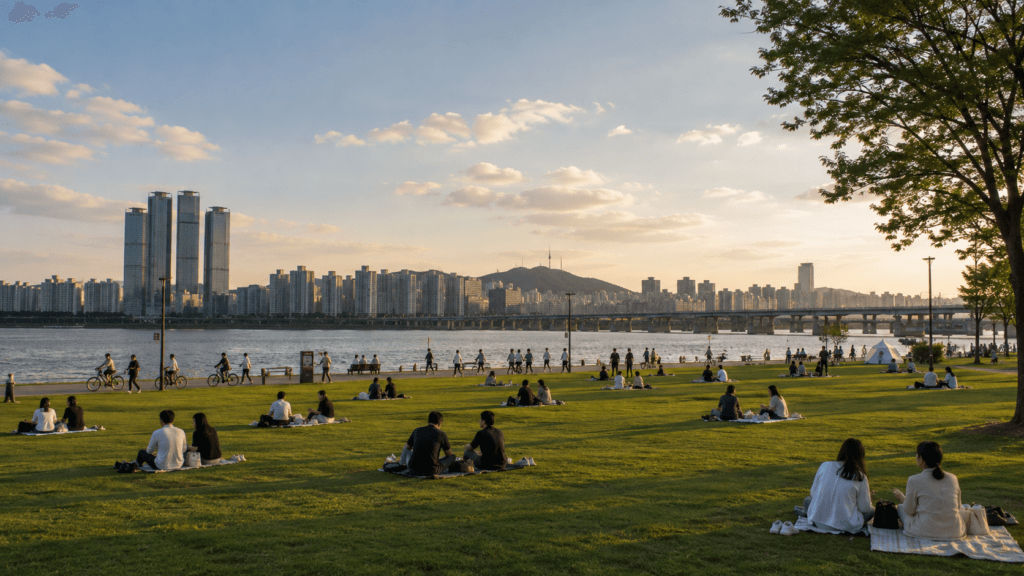
You can bring a picnic mat and talk for three hours.
You can walk with someone without choosing a destination.
You can sit alone with a book.
A family can bring children outside without purchasing admission to anything.
People certainly spend money at the Han River, but consumption is optional rather than the condition for staying there.
That freedom changes the mood of a meeting.
Friends do not have to keep ordering drinks because they have occupied a café table for too long. Nobody needs to decide whether the group should leave after dinner. People can arrive at different times, move around, sit down again, and leave whenever they want.
For younger Seoul residents in particular, an open place where several friends can spend a long evening together without an expensive plan has obvious appeal.
Convenience Stores and Delivery Changed How People Use the River
Of course, staying outdoors for several hours creates a predictable problem.
Eventually someone gets hungry.
This is where Korea’s convenience and delivery culture fits unusually well with the Han River.
Convenience stores around popular riverside areas make it easy to buy drinks, snacks, and simple meals without preparing an elaborate picnic beforehand. Instant ramen has become closely associated with Han River outings because it is inexpensive, easy to prepare, and works perfectly with the casual way people use the parks.
Fried chicken fits the same pattern.
The interesting thing is not that Koreans particularly enjoy eating chicken beside water. It is that food does not necessarily require ending the outdoor part of the evening.
Friends can meet before sunset, sit on the grass, become hungry an hour later, find food nearby or arrange a meal, and continue talking as the city lights appear.
That changes the Han River from somewhere people pass through into somewhere they can remain.
A walk becomes an evening.
An hour outside becomes dinner with friends.
The park begins to function almost like an enormous shared outdoor living room.
The Han River Is Also Part of Seoul’s Exercise Infrastructure
Not everyone comes to sit on the grass.
For runners and cyclists, the river can serve a completely different purpose.
Long riverside paths allow people to move through the city without experiencing the constant pattern of traffic lights and crowded commercial streets found elsewhere. Someone cycling for exercise may pass through several riverside areas without thinking of any particular park as the destination.
For a regular runner, the famous skyline eventually becomes background scenery.
That is when a landmark begins turning into routine.
A person learns which sections become crowded in the evening, where the wind feels stronger, where cyclists gather, and how the riverside changes with the seasons.
The same path might be used repeatedly before work or after dinner.
This everyday repetition matters more than spectacular scenery when explaining why the river feels personal to Seoul residents.
Tourists remember the view.
Residents often remember their route.
Evening May Be When the Han River Makes the Most Sense
The Han River can be busy throughout the day, but its relationship with Seoul becomes especially easy to understand toward evening.
Office workers and students have spent hours indoors. Friends want to meet but may not want another restaurant or café. Families want somewhere children can move around. Runners wait until the temperature becomes more comfortable.
The riverside can accommodate all of them without forcing them into the same activity.
One group may be eating.
Another is cycling past them.
Someone else is walking alone while talking on the phone.
A couple sits facing the river while an older pair walks along the path behind them.
Nobody needs to agree on what the park is “for.”
That flexibility is one of its greatest strengths.
It also explains why the Han River can feel completely different depending on when you visit. A quiet weekday morning and a warm Saturday evening may barely seem like the same place.
Seoul residents adapt their use of the river to their schedules rather than treating every visit as a special outing.
Seasons Change the Way Seoul Uses the River
The river also follows the rhythm of Korea’s seasons.
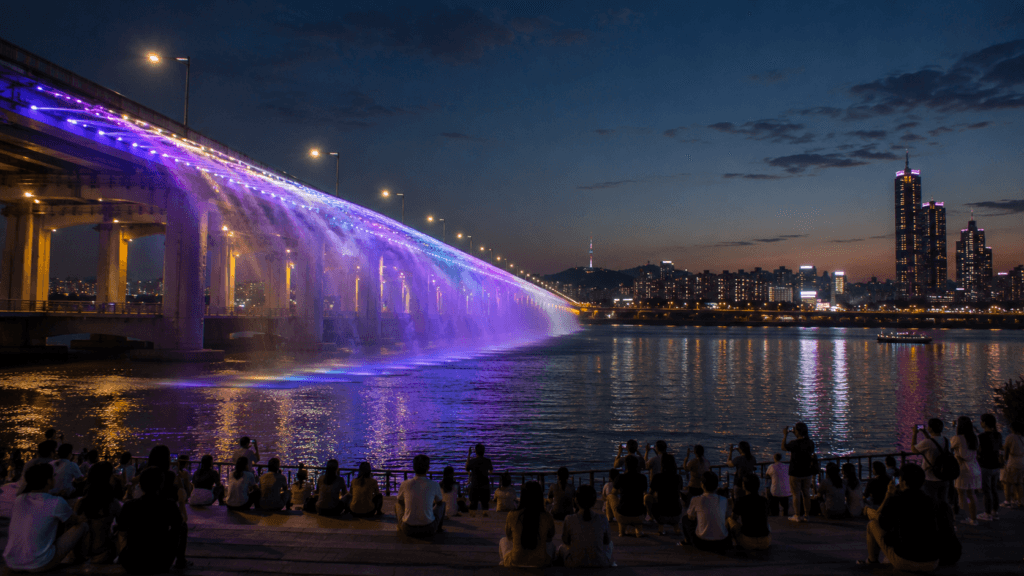
Spring brings back picnics and longer outdoor visits as temperatures become comfortable again. During hot summer months, evenings become more attractive than afternoons, and the riverside can remain lively well after sunset.
Autumn is particularly suited to cycling, walking, and spending long periods outdoors.
Winter changes the atmosphere considerably. Picnic mats become less common, but runners, cyclists, walkers, and people using the paths do not simply disappear.
The river’s role changes rather than ending.
That seasonal variation helps keep the Han River from becoming a single-purpose attraction.
The same person who meets friends there on a warm summer evening may use the riverside for a brisk walk months later.
The landscape is familiar.
The reason for being there changes.
The Han River Is Both Built and Natural
There is an interesting contradiction in the Han River that is easy to miss.
It feels like an escape into nature, yet much of the experience Seoul residents enjoy today is the result of deliberate urban planning and environmental management.
The parks were developed.
The cycling and walking paths were built.
Water quality is monitored.
Sections of artificial riverbank are being restored toward more natural forms, while ecological parks protect wetlands, vegetation, and wildlife alongside areas designed for heavy public use. Seoul currently identifies five ecological parks along the river.
In 2026, the city reported that more than 90% of the riverbank sections targeted for natural-style restoration had been converted, replacing concrete in many areas with more natural materials and vegetation.
That makes the Han River more interesting than a simple choice between “nature” and “city.”
It is both.
Apartment towers can be visible across the water while reeds grow near the riverbank. A cyclist can ride past an ecological area and reach a busy commercial district soon afterward.
The city has not disappeared.
It has made room for the river inside it.
Why Locals and Visitors See the Same River Differently
A visitor and a Seoul resident can stand in exactly the same park and pay attention to completely different things.
The visitor may notice the bridge, the width of the water, or the skyline.
The resident may be looking for an empty patch of grass.
They may be checking whether the cycling path is crowded, waiting for a friend to arrive, wondering whether to buy ramen, or deciding how long to walk before heading home.
Neither way of experiencing the Han River is more correct.
But the difference explains why photographs alone cannot show what the river means to Seoul.
The famous view is only the background.
The more important story is what people have learned to do with the space in front of it.
Decades of riverfront development made that space accessible. Environmental management helped make the river and its surroundings healthier. Seoul’s dense geography made open space particularly valuable, while convenience stores, delivery culture, cycling routes, public transportation, and changing leisure habits made staying there easy.
Those factors gradually turned a geographical feature into part of the city’s routine.
Conclusion
The Han River was always going to shape Seoul geographically. A river this large running east to west through the capital could hardly do otherwise.
But geography alone does not explain why friends meet there after work, why runners return to the same riverside paths every week, or why families can spend half a Saturday on the grass without needing a special event.
Today’s relationship between Seoul and the Han River was built over time.
Riverbanks once focused heavily on flood control were transformed into public parks. Water-quality management and sewage-treatment improvements helped address the environmental pressures created by rapid urbanization. More recently, ecological restoration has continued alongside the recreational spaces residents already use.
The result is something unusual.
One of the defining geographical features of a huge capital city has also become one of its most flexible everyday spaces.
You can exercise there without treating it as a sports facility, meet friends without needing a café, eat dinner without entering a restaurant, or spend an hour outdoors without planning an excursion beyond Seoul.
That is why asking what there is to “see” at the Han River only tells part of the story.
For a visitor, the river may begin with the view.
For Seoul residents, its real value is often found in something much more ordinary.
It is a place they can actually use.
FAQ
Why is the Han River so important to Seoul?
The Han River crosses Seoul from east to west and has played an important role in the city’s geography and development. Today, 11 Hangang Parks along the river provide public space for exercise, leisure, socializing, and everyday recreation.
Was the Han River always as clean as it is today?
No. Rapid urbanization and industrial development placed significant environmental pressure on the river. Seoul has invested in wastewater treatment, pollution control, water-quality monitoring, and ecological restoration, and recent official monitoring shows improvement in several major water-quality indicators.
How clean is the Han River today?
There is no single measurement that defines an entire urban river as simply “clean.” However, Seoul reported that major water-quality indicators improved for three consecutive years through 2024, including higher dissolved oxygen and lower total nitrogen and phosphorus.
Why do Seoul residents spend so much time at the Han River?
The river provides large open spaces within a dense city and can be used for many purposes without requiring admission or significant spending. Residents use it for walking, cycling, running, picnics, meeting friends, eating, and relaxing.
How many Han River parks are there in Seoul?
Seoul currently operates 11 Hangang Parks, including Yeouido, Banpo, Ttukseom, Mangwon, Jamsil, Ichon, Jamwon, Gwangnaru, Nanji, Gangseo, and Yanghwa.
Continue Exploring
If you enjoyed this article, you may also like:
Why Korean Weekends Feel Different
The Han River becomes especially lively when the working week ends, but it is only one part of how Koreans use cafés, neighborhoods, parks, and public spaces differently on weekends.
Why After-Work Evenings Feel Different in Korea
What happens between leaving the office and going home reveals another side of Korean daily life, from shared dinners to late cafés and outdoor spaces.
Why Korean Cafés Are More Than Coffee Shops
Cafés serve many of the social functions that the Han River performs outdoors, giving Koreans flexible places to meet, work, rest, and spend time without a rigid schedule.