It is 9 p.m. in a Korean drama, yet the teenagers on screen are still wearing their school uniforms.
One is eating at a convenience store. Another is walking home with a backpack, while someone else has only just left a private academy. Earlier in the episode, those same students spent most of the school day in one classroom with the same classmates, ate lunch together, and watched their homeroom teacher become involved in problems that seemed surprisingly personal.
For international viewers, these details can make a K-drama high school feel quite different from the schools they know.
Some of what appears on screen reflects recognizable features of Korean student life. Students commonly wear uniforms, the homeroom class plays an important role in school identity, and private education can extend studying well beyond the official school day.
Other elements are much more dramatic. School bullying, extreme academic rivalries, wealthy parents manipulating schools, and students living under relentless pressure make powerful television precisely because they take real concerns and push them toward conflict.
The interesting question, then, is not whether Korean schools really look exactly like K-dramas.
It is why so many of those familiar scenes keep appearing—and what they tell viewers about the world the characters live in.
Why Are Students Still Wearing Uniforms at Night?
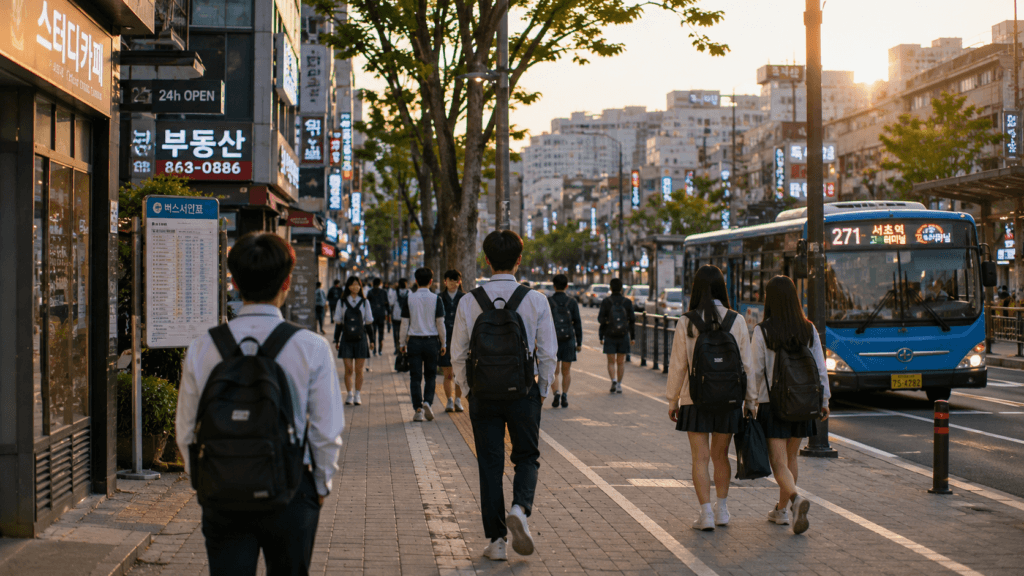
School uniforms are one of the easiest visual clues that a drama character is still living within the rhythm of student life.
Middle and high school uniforms are common in South Korea, although designs and rules vary by school. For drama writers, the uniform immediately communicates age and school identity without needing any explanation.
What may be more surprising to international viewers is how long the uniform can remain visible after the school day ends.
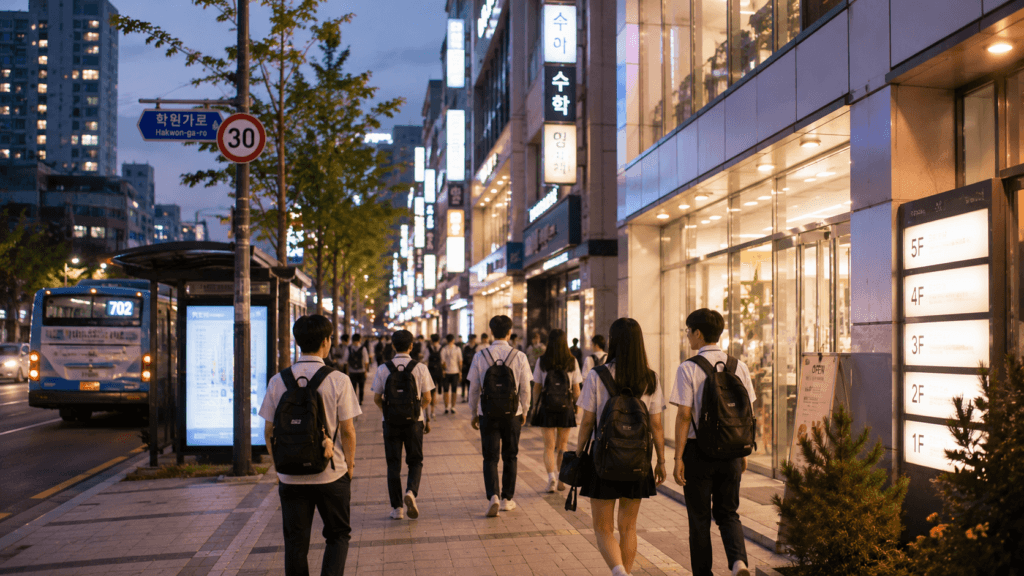
A student may leave school and go directly to a hagwon (학원), a private academy used for additional study. Others may stay at school longer, eat before heading to another class, or spend some time with friends before going home.
Changing clothes in between is not always practical.
As a result, seeing uniformed teenagers on public transportation, in restaurants, or around commercial neighborhoods during the evening does not necessarily mean school has just finished.
Their academic day may still be continuing somewhere else.
K-dramas use this naturally. A scene at a convenience store after dark can still feel connected to school because the characters have not fully left that part of their day behind.
The uniform becomes more than a costume. It visually follows the character from the classroom into the rest of their teenage life.
The Homeroom Class Creates a Different Kind of School Story
Another detail becomes obvious if you pay attention to where K-drama students spend their day.
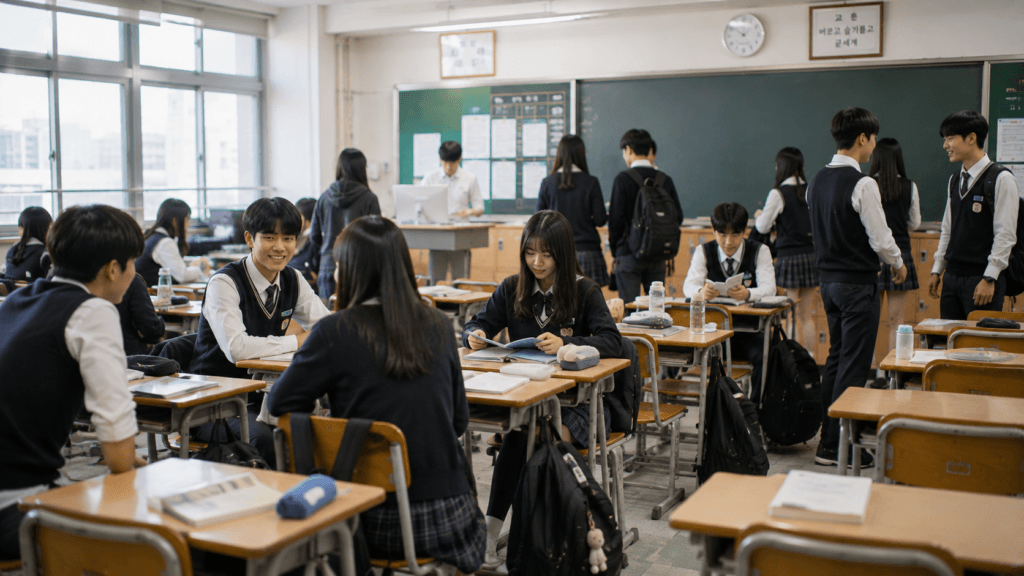
Many scenes return to the same classroom and the same group of classmates.
Korean schools organize students into homeroom classes, or ban (반), and students generally remain associated with that class while teachers may move between classrooms for different subjects. Exact routines vary by school and grade, but the homeroom structure gives students a clear class identity.
For television, this is extremely useful.
The drama can build a small social world around one classroom. The class president, the top student, the quiet student, close friends, rivals, and outsiders repeatedly encounter one another because they share the same space.
That helps explain why relationships within “Class 2” or “Class 3” can feel so important in Korean school dramas.
The homeroom teacher can also become more visible than international viewers expect. Rather than appearing only to teach one subject, the teacher may be involved with attendance, student guidance, school communication, or problems affecting the class.
Dramas naturally expand this role when the plot needs an adult to notice—or fail to notice—what is happening among the students.
This recurring classroom also gives school dramas something they need for storytelling: characters who cannot easily avoid one another. A friendship that breaks down on Monday still has to survive another day in the same room on Tuesday.
Why Exams Can Affect the Entire Family
Academic pressure is probably the most internationally familiar part of South Korean education, but K-dramas often present it at its most extreme.
The reality behind those stories is that university admission can carry considerable importance for Korean students and families. The Suneung (수능), South Korea’s College Scholastic Ability Test, is particularly prominent, although university admissions involve more than a single exam.
That pressure helps explain why education in dramas frequently becomes a family story rather than remaining inside the classroom.
Parents may worry about grades, private education, university choices, and what those decisions could mean for their child’s future. A teenager’s academic performance can therefore become a source of disagreement about money, expectations, comparison with other families, or the child’s own ambitions.
Drama writers can push these anxieties much further. They may create families obsessed with elite universities, students willing to sabotage one another, or parents whose entire identity appears to depend on a child’s academic success.
Those plots should not be read as the daily reality of every Korean household.
They work because the underlying stakes are recognizable, while the drama intensifies them enough to create conflict.
For K-drama fans, that distinction is useful. The pressure has a cultural context; the most shocking behavior usually has a storytelling purpose.
Hagwons Explain Why School Life Can Continue After School
If there is one word that helps explain many evening scenes in Korean youth dramas, it is hagwon.
Hagwons are private educational institutions, and they can cover academic subjects as well as languages, arts, music, and other areas. For many students, particularly in academically competitive environments, attending a hagwon can become part of the weekday routine.
This changes the shape of the day.
The final school bell does not necessarily mean a student is free for the evening. There may be another class ahead, homework afterward, and a commute between all of them.
That is why a late-night scene involving students can make more sense once you understand what happened before it.
The convenience-store stop may be a quick break between studying and going home. The walk through the neighborhood may happen after a hagwon rather than immediately after school. Friends may spend time together precisely because they share the same busy schedule rather than because they have an entire evening free.
K-dramas often turn these in-between moments into important scenes because students finally have space to talk away from teachers and parents.
A short walk home can become the place where friendships, crushes, and worries actually surface.
Why Age and Seniority Appear at School Too
The different ways Korean drama characters speak do not suddenly begin when they enter the workplace.
School stories introduce viewers to some of the same social ideas earlier.
Students in the same grade can usually interact comfortably once they become friends, while older and younger students may have a seonbae (선배) and hubae (후배) relationship—senior and junior.
This is especially visible in clubs, sports teams, universities, and stories where characters from different school years interact.
Age can also influence forms of address and speech. That is why a character discovering that someone is older or younger can occasionally change the tone of an interaction in ways that seem surprisingly important from the subtitles alone.
This connects naturally with Why Korean Drama Characters Use Different Ways of Speaking. School dramas are often where viewers can see those language choices operating among characters who may be close in age but do not necessarily occupy the same social position.
Again, dramas can exaggerate seniority into intimidation or conflict. The existence of a senior-junior relationship does not mean every older student controls younger students.
The structure simply gives writers another relationship they can develop—or deliberately turn into a problem.
The Most Dramatic School Scenes Are Usually the Least Ordinary
School bullying is a good example of why K-dramas need to be watched as dramas rather than documentaries.
Bullying is a real social issue in South Korea, as it is in many countries. Korean dramas have also made it a major subject in stories about revenge, inequality, trauma, and institutional failure.
But the most extreme scenes are designed to disturb viewers.
Likewise, not every Korean student is studying until exhaustion, fighting for the top ranking, hiding a terrible secret from their homeroom teacher, or dealing with wealthy classmates whose parents control the school.
Most school life is much less cinematic.
Students complain about homework, eat lunch, make friends, worry about exams, participate in school events, become bored during class, and wait for the day to end.
Interestingly, those ordinary details are often what make dramatic school stories convincing. The familiar classroom, uniform, lunch period, hagwon schedule, or walk home gives the fictional conflict a recognizable world in which to happen.
What K-Drama Fans Should Notice
The next time you watch a Korean school drama, look beyond the obvious conflicts.
Notice how often the same classroom appears and how relationships form around the homeroom group. Watch where students go after school and whether the uniform remains on well into the evening. Pay attention to when hagwon, exam results, or university plans begin influencing conversations at home.
Those details can explain much of the world surrounding the characters without requiring the drama to stop and teach viewers about Korean education.
At the same time, keep the distinction between context and exaggeration.
K-dramas borrow recognizable pieces of Korean school life because viewers understand them quickly, then reshape those pieces according to the genre. A light romance may use the classroom to keep two characters together. A family drama may focus on university pressure, while a thriller can turn school hierarchy or bullying into something far darker.
The school setting may be familiar.
What the drama chooses to do with it is another matter.
Conclusion
School life looks different in Korean dramas partly because several features of Korean education are highly visible on screen: uniforms remain part of the day after classes finish, homerooms create close classroom groups, hagwons can extend academic routines into the evening, and age or seniority can influence student relationships.
K-dramas then select the parts that create the strongest stories.
Academic competition becomes family conflict. A classroom becomes a social world characters cannot escape. A late-night walk home after studying becomes the rare moment when two students can finally speak privately.
That is why the most useful question is not, “Are Korean schools really like this?”
Instead, ask which details come from recognizable Korean school life—and which ones the drama has deliberately pushed further.
Once you can tell the difference, those familiar classroom scenes start revealing much more than what is written on the blackboard.
FAQ
Do Korean students really wear uniforms?
Uniforms are common in Korean middle and high schools, although rules and designs vary by school. Students may still be wearing them in the evening if they go directly from school to other activities.
What is a hagwon?
A hagwon (학원) is a private educational institution. Students may attend hagwons for academic subjects, languages, arts, and other forms of supplementary education.
Are Korean schools as competitive as K-dramas show?
Academic competition and university admissions can be significant concerns, but dramas frequently heighten those pressures to create stronger conflicts. Experiences differ greatly among students, schools, and families.
Continue Exploring
If you enjoyed this article, you may also like:
What Makes Korean Dramas Different from Western TV?
School dramas are just one example of how familiar stories can feel surprisingly different in Korea. See what else changes when culture begins shaping the characters, relationships, and storytelling.
Why Korean Drama Characters Use Different Ways of Speaking
Ever wondered why a character suddenly changes their tone after learning someone’s age? Some of the most important relationship clues in K-dramas never fully appear in the subtitles.
Why Korean Dramas Feel More Emotional Than Hollywood Shows
A classroom argument, a friendship breaking apart, or the pressure of an exam can become surprisingly intense. There are reasons K-dramas often let these emotional moments linger.
Korean Drama Genres Explained: Romance, Thriller, Historical & More
School stories can become romances, revenge thrillers, mysteries, or coming-of-age dramas. Explore how Korean dramas use familiar genres—and why they often blend them together.