For many first-time visitors, a Korean apartment can feel surprisingly high-tech.
The building entrance opens with a smartphone.
A delivery notification appears before the package reaches the door.
Visitors can be verified through a video intercom without anyone leaving the living room.
Lights, heating, and security are often controlled from a single mobile app.
At first glance, these features seem futuristic.
Many people assume Korea simply enjoys adopting new technology faster than other countries.
While there is some truth to that idea, it doesn’t fully explain why smart homes have become so common.
The real reason is much simpler.
Technology in Korean apartments wasn’t introduced to impress residents.
It was introduced to solve small everyday problems.
Instead of asking people to change the way they live, smart home systems quietly support routines that already exist.
They reduce waiting.
They simplify communication.
They improve security.
They remove countless small inconveniences that would otherwise interrupt the day.
That is why smart homes have become a standard feature rather than a luxury in many Korean apartment buildings.
They’re not viewed as futuristic gadgets.
They’re simply another part of everyday life.
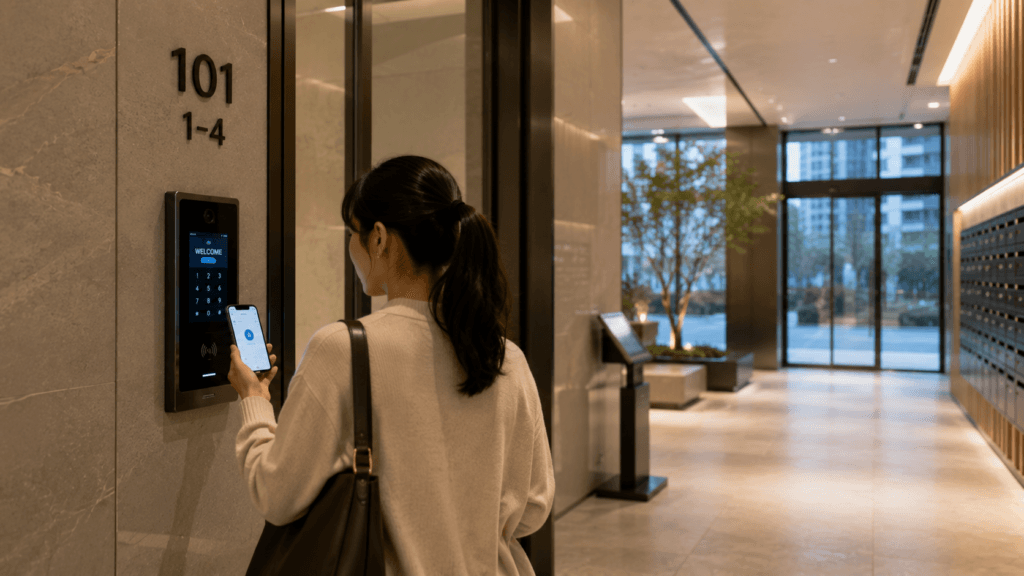
Smart Homes Are Becoming an Everyday Expectation
Not long ago, smart home technology was marketed as something only premium homes could offer.
Advertisements focused on futuristic lifestyles filled with voice assistants, automated lighting, and advanced home controls.
Today, the situation in Korea is very different.
Many residents hardly think about these technologies at all.
They simply expect them to work.
Someone leaving for work may lock the apartment with a digital door lock, receive a parcel notification during the day, approve a visitor remotely, and return home to an apartment where the heating has already been adjusted.
None of these actions feel particularly remarkable.
They have quietly become part of an ordinary day.
This shift happened because apartment living created the perfect environment for new technology.
When hundreds of households share the same building, small improvements quickly benefit a large number of people.
A digital entry system reduces the need for physical keys.
Centralized building management makes maintenance easier.
Mobile notifications simplify communication between residents and management offices.
Parcel systems reduce missed deliveries.
Each innovation may appear modest on its own.
Together, however, they create a smoother experience for everyone living in the building.
Rather than replacing daily routines, smart home technology fits naturally into them.
That approach explains why adoption has been so widespread.
The technology works quietly enough that residents often stop noticing it.
Once a system consistently saves time without demanding extra attention, it quickly becomes something people simply expect.
Technology That Works Quietly in the Background
The most successful technology is often the technology people rarely think about.
That idea describes Korean smart homes remarkably well.
Instead of filling homes with flashy devices, most apartment systems focus on removing small frustrations that occur every day.
Digital door locks are a good example.
Residents no longer need to carry traditional keys, worry about losing them, or replace locks after moving.
Entering the building becomes a quick, familiar action that takes only a few seconds.
Visitor management follows the same philosophy.
Rather than walking downstairs to open the entrance, residents can often verify guests through a video intercom or apartment application before allowing access.
Security improves without making the process more complicated.
Package delivery has also benefited enormously from smart technology.
Apartment applications frequently notify residents when parcels arrive, while secure delivery areas help organize the growing number of online purchases entering the building each day.
As discussed in Why Package Delivery Works So Well in Korean Apartment Buildings, efficient building design and digital systems now work together to make deliveries faster and more reliable.
Energy management is another example of technology quietly supporting daily life.
Residents can often monitor heating, electricity, or gas usage more easily than before.
Some apartments allow heating schedules to be adjusted remotely before family members return home.
Others provide notifications if unusual energy consumption is detected.
These features aren’t designed to showcase innovation.
They’re designed to make ordinary routines slightly easier.
The same philosophy extends to apartment management itself.
Residents may reserve shared facilities, receive maintenance notices, report issues, or communicate with building staff through a single application instead of making phone calls or visiting an office.
None of these improvements dramatically changes life on its own.
Their value comes from quietly removing dozens of tiny inconveniences over time.
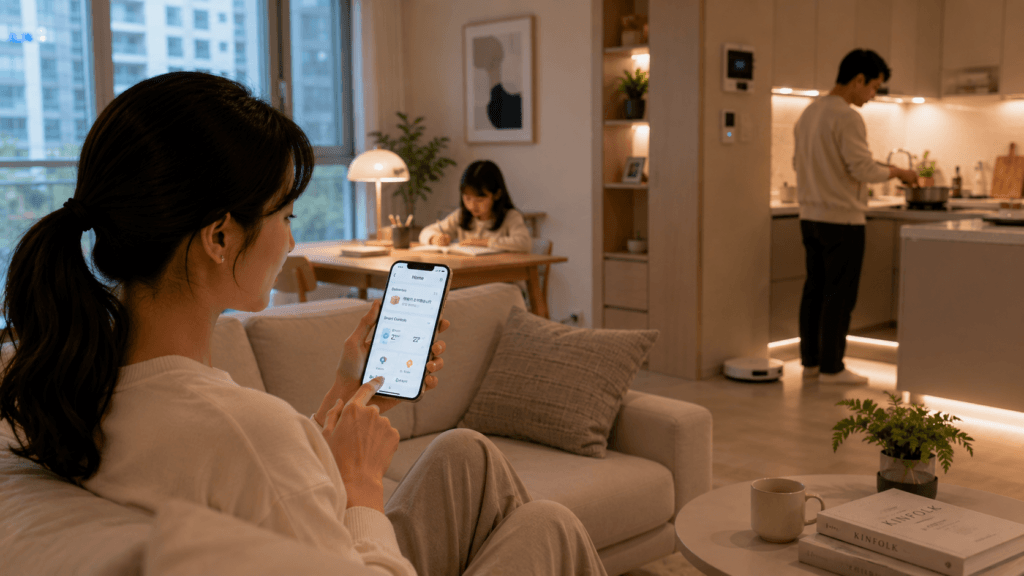
Why Apartment Living Accelerated Smart Home Adoption
One reason Korea adopted smart apartment technology so quickly is that apartment living already encouraged shared infrastructure.
Unlike detached houses scattered across large suburban neighborhoods, apartment complexes concentrate hundreds—or sometimes thousands—of households in one carefully managed environment.
This makes new technology easier to install, maintain, and update.
Building-wide systems can support every resident simultaneously.
Security networks protect multiple entrances.
Digital parking systems organize vehicle access.
Management offices oversee maintenance for an entire community rather than for individual homes.
The benefits therefore extend far beyond a single apartment.
This connected environment also complements other aspects of modern Korean living.
For example, online shopping and food delivery have become deeply integrated into apartment life because secure entrances, parcel systems, and centralized management make high-volume deliveries practical.
Similarly, neighborhood services function efficiently because apartment complexes naturally bring together large numbers of residents within walking distance.
As explored in Korean Apartment Culture: Why Apartments Shape Everyday Life in Korea, the apartment itself acts as part of a much larger system supporting everyday urban life.
Smart technology simply strengthens that system.
Rather than changing how apartments function, it helps them function even more smoothly.
Smart Homes Feel Normal to Korean Residents
Ask someone visiting Korea for the first time what impressed them most about apartment living, and smart technology often appears near the top of the list.
The apartment entrance opens without a physical key.
Packages arrive with automatic notifications.
Visitors can be verified remotely.
Building announcements appear instantly through an app.
To many visitors, these features feel surprisingly advanced.
Ask a Korean resident the same question, however, and the response is often quite different.
Most simply describe these systems as normal.
That difference in perspective is important.
Technology has become so deeply integrated into everyday apartment life that it rarely stands out anymore.
People don’t think about using a digital door lock any more than they think about turning on a light switch.
It has become part of the routine.
The same is true for apartment applications.
Residents often use them to check delivery notices, reserve community facilities, receive maintenance updates, or communicate with the management office.
These actions take only a few seconds and quickly become habits that require almost no conscious thought.
Perhaps the greatest success of Korean smart homes is that they don’t constantly remind people they are “smart.”
Instead, they quietly disappear into the background.
The apartment feels more convenient, but not because residents spend their day interacting with technology.
Rather, technology reduces the number of interruptions they experience.
Waiting becomes shorter.
Communication becomes simpler.
Security becomes easier to manage.
Daily routines continue almost unchanged—just with fewer obstacles along the way.
This philosophy reflects a broader pattern found throughout Korean apartment design.
As discussed in How Korean Apartments Make Small Spaces Feel Bigger, thoughtful design is often less about adding impressive features than removing unnecessary friction from everyday life.
Smart technology follows exactly the same principle.
It supports people without demanding their attention.
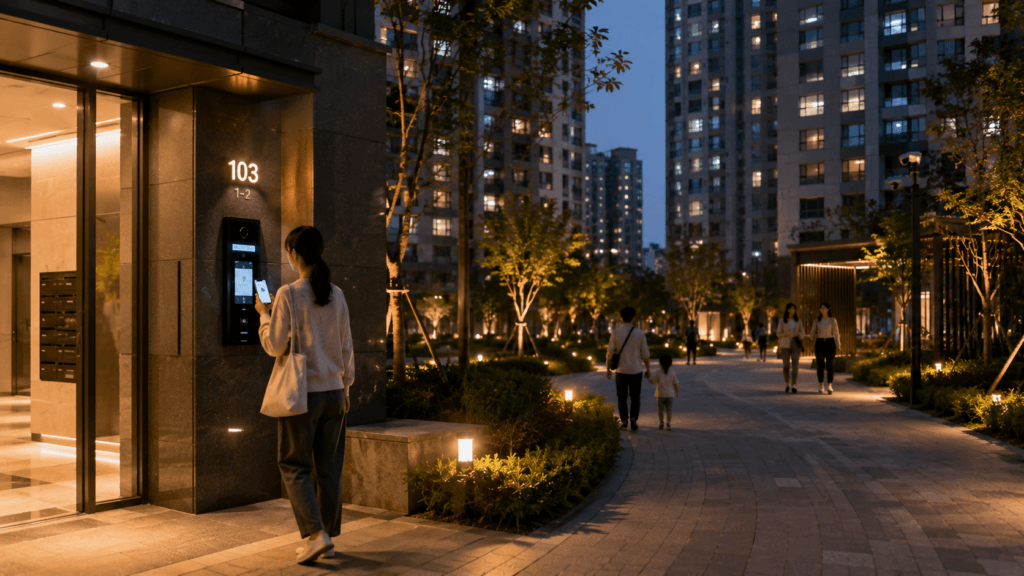
The Future of Korean Apartment Living
Smart homes in Korea continue to evolve, but the direction of that change remains surprisingly consistent.
The goal is rarely to fill homes with more technology.
Instead, new systems aim to make existing routines even more comfortable.
Artificial intelligence is beginning to help optimize heating and energy use.
Apartment applications are becoming more personalized.
Building management systems continue improving maintenance and security through better data and automation.
Some newer developments are experimenting with robot deliveries inside apartment complexes, while others focus on energy efficiency or features that make independent living easier for older residents.
As Korea’s population ages, smart home technology is expected to play an increasingly important role in supporting accessibility and everyday safety.
Yet despite these advances, the core philosophy has not changed.
Residents are not looking for technology simply because it is new.
They value technology because it quietly solves practical problems.
Whether that means unlocking a door without searching for keys, receiving a delivery notification at exactly the right moment, or adjusting the heating before arriving home, each innovation succeeds only if it makes everyday life feel simpler.
In that sense, the future of Korean smart homes may not look dramatically different from today.
The technology will likely become even less noticeable.
And that may be its greatest achievement.
Conclusion
When people imagine a smart home, they often picture futuristic devices and voice-controlled gadgets.
Korean apartments tell a different story.
Here, smart technology is less about showing what is possible and more about improving what already happens every day.
Digital access systems, parcel notifications, energy management, and apartment applications all exist for the same reason.
They remove small inconveniences before residents even think about them.
That is why smart homes have become standard across so many Korean apartment buildings.
They fit naturally into apartment living, support existing routines, and quietly improve daily life without demanding attention.
Understanding Korean smart homes therefore means understanding something larger than technology itself.
It reveals how Korean apartment culture continues to evolve—not by replacing familiar ways of living, but by making them a little easier, safer, and more comfortable every year.
Frequently Asked Questions
Are smart homes common in Korea?
Yes. Smart home features such as digital door locks, apartment apps, parcel notifications, and remote building access are common in many modern Korean apartment complexes.
What smart features do Korean apartments usually have?
Typical features include digital entry systems, video intercoms, mobile apartment apps, parcel notifications, energy management, visitor access controls, and smart parking systems.
Do older Korean apartments have smart technology?
Many older apartment buildings have gradually upgraded with digital door locks, security systems, and mobile management services, although newer developments generally offer more integrated smart home features.
Are Korean smart homes expensive?
Basic smart home features are now considered standard in many apartment developments rather than premium luxuries. More advanced systems may vary depending on the building and developer.
Why did Korea adopt smart apartments so quickly?
High apartment density, centralized building management, widespread internet infrastructure, and a strong focus on convenience made Korea an ideal environment for smart home technology to develop rapidly.
Continue Exploring
If you enjoyed this article, you may also like:
- Why Almost Everyone Lives in Apartments in Korea
- Why Package Delivery Works So Well in Korean Apartment Buildings
- How Delivery Culture Changed Life Inside Korean Homes
- Why Korean Apartment Complexes Feel Like Small Cities
- Why Korean Neighborhoods Are Designed for Everyday Convenience
- Inside a Typical Korean Apartment: What Every Room Reveals About Korean Life