How can a package ordered in the morning arrive safely before dinner—even when nobody is home to receive it?
For many visitors to Korea, that’s one of the country’s most surprising everyday experiences.
In many places around the world, package delivery comes with familiar frustrations.
Missed deliveries.
Porch theft.
Repeated delivery attempts.
Packages left in unsafe locations.
Yet in Korean apartment buildings, receiving a delivery often feels almost effortless.
The reason isn’t simply that delivery companies work faster.
It’s that the buildings themselves have quietly evolved to support modern delivery.
From secure entrances and centralized management to parcel lockers and carefully planned apartment layouts, Korean apartment communities make receiving packages feel like a natural part of daily life.
Once you understand how these buildings work, it’s easy to see why package delivery has become one of Korea’s most admired everyday conveniences.
Apartment Communities Were Designed to Handle Daily Logistics
Most Korean apartment buildings are not isolated structures.
They’re part of large residential communities that may include several buildings and hundreds—or even thousands—of households.
Managing daily life for so many residents requires systems that are both organized and efficient.
Visitors often notice security gates, management offices, clearly numbered buildings, and well-planned pedestrian pathways.
These features don’t exist only for safety.
They also help deliveries move smoothly throughout the complex.
Drivers can quickly identify the correct building.
Residents know exactly where deliveries should arrive.
Management staff can assist when needed.
Because the entire apartment complex follows a consistent layout, everyday logistics become far more predictable than they would in neighborhoods made up of individual houses.
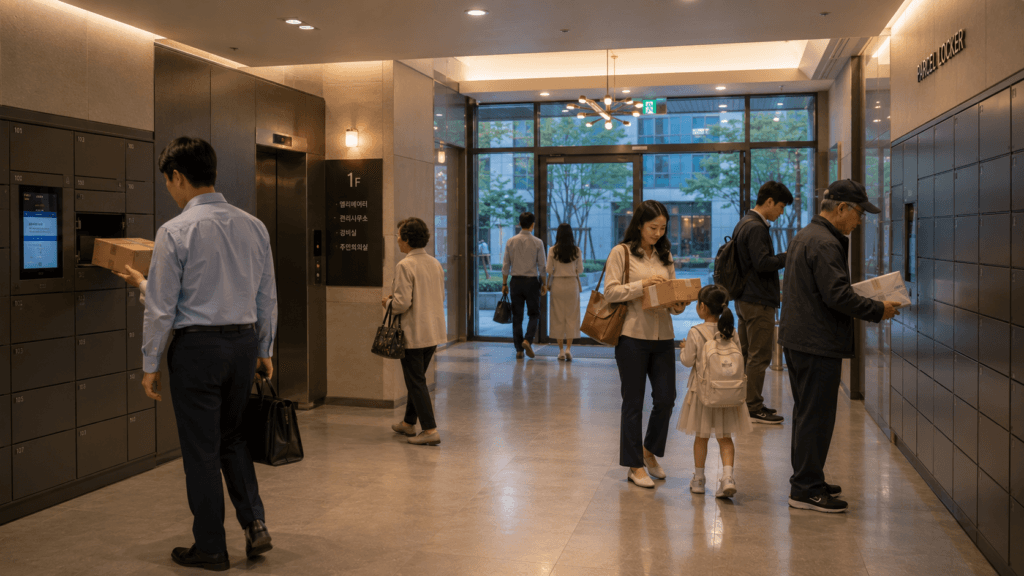
Secure Entrances Create Confidence
Another reason package delivery works so well is that most apartment buildings have controlled entrances.
Rather than leaving packages outside an unlocked front door, delivery drivers usually enter through secured access systems or designated entrances.
Many buildings also include CCTV cameras, intercom systems, and resident access controls.
These features help protect both residents and deliveries.
Instead of worrying about where to leave a package, delivery drivers can deliver it within a secure residential environment.
That added layer of security reduces the risk of lost or stolen deliveries while giving residents greater peace of mind.
As explored in Why Korean Apartments Feel Surprisingly Quiet, many apartment features are designed not only for comfort but also for creating a safer and more organized shared living environment.
Parcel Lockers Changed Everyday Convenience
Not every resident is home when a package arrives.
Instead of requiring another delivery attempt, many apartment complexes provide parcel lockers that allow packages to be collected later.
These secure storage areas have quietly transformed everyday life.
Residents can retrieve deliveries after work, during an evening walk, or whenever it’s most convenient.
Delivery drivers complete their routes more efficiently because they don’t need to coordinate individual delivery times.
Everyone benefits.
It’s such a common feature that many residents rarely think about it anymore.
For first-time visitors, however, it often feels like one of the smartest ideas in modern apartment living.
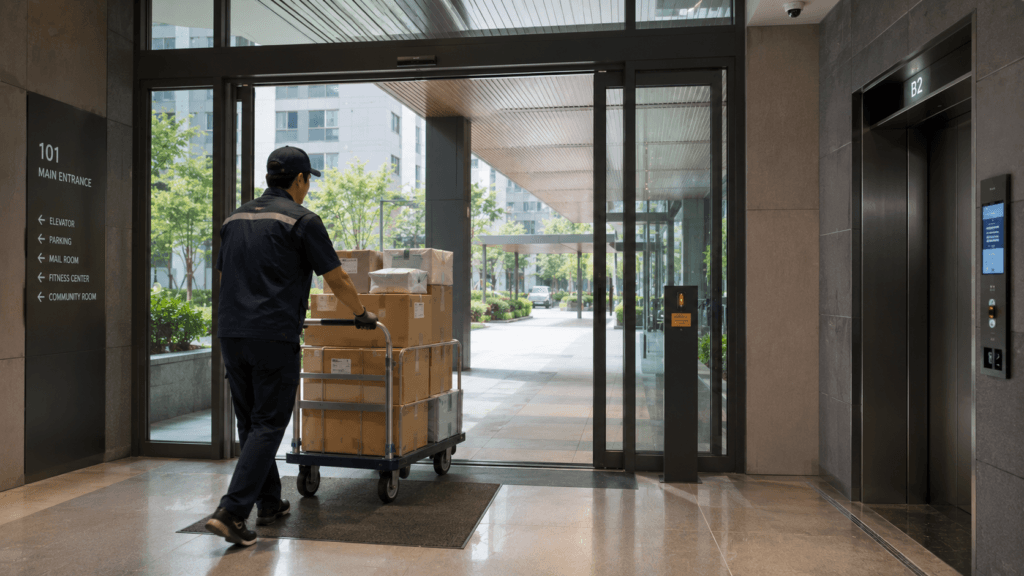
Delivery Drivers Already Know How the Buildings Work
One reason deliveries move so quickly is that Korean apartment buildings follow familiar patterns.
While every apartment complex is different, many share similar layouts, building numbering systems, and entrance designs.
Experienced delivery drivers quickly learn where each building is located, which entrance to use, and how residents typically receive packages.
Apartment buildings are clearly labeled with building and unit numbers, making addresses easy to locate.
Elevators are positioned for efficient movement through the building.
Management offices and information boards also help visitors find their destination when needed.
Because the environment is predictable, drivers spend less time searching and more time delivering.
The result isn’t simply faster service.
It’s a smoother experience for everyone involved.
Good Building Design Supports the Entire Delivery System
Fast delivery depends on more than hardworking drivers.
It also depends on apartment buildings that were designed with everyday convenience in mind.
Wide entrances make it easier to move carts and large packages.
Covered drop-off areas protect deliveries during rain or snow.
Dedicated parking spaces allow delivery vehicles to stop without blocking traffic inside the complex.
Well-maintained walkways and elevators reduce unnecessary delays.
None of these features seem particularly remarkable on their own.
Together, however, they create an environment where deliveries can happen quickly without disrupting residents’ daily lives.
It’s another example of how Korean apartment design quietly supports routines that many people take for granted.
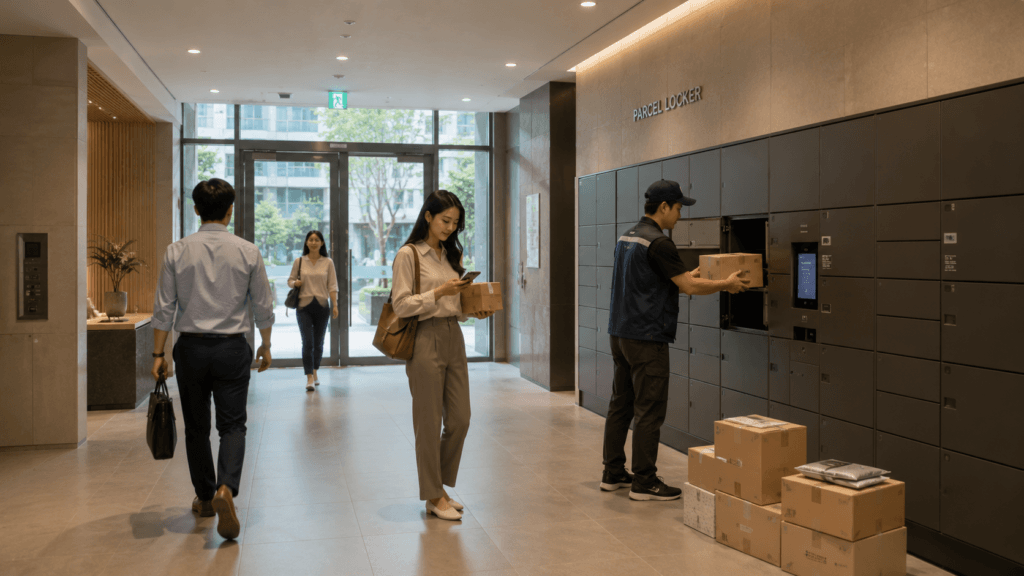
Convenience Is Built Into Everyday Life
Package delivery in Korea isn’t successful because of a single innovation.
It’s the result of many practical systems working together.
Apartment communities provide secure entrances.
Parcel lockers solve the problem of missed deliveries.
Building layouts help drivers navigate efficiently.
Management systems keep everything organized.
Each feature makes a small contribution.
Together, they create a delivery experience that feels remarkably simple.
For residents, receiving a package rarely becomes an inconvenience.
It’s simply another routine that fits naturally into everyday apartment life.
As explored in How Korean Apartments Make Small Spaces Feel Bigger, many Korean homes are designed around one central idea: everyday life should feel easier, not more complicated.
Conclusion
The efficiency of package delivery in Korean apartment buildings isn’t just about speed.
It’s about thoughtful design.
Secure entrances, parcel lockers, organized apartment communities, and predictable building layouts all work together to support modern living.
While visitors often notice how quickly packages arrive, the real story lies behind the scenes.
The apartment buildings themselves have quietly evolved to make everyday logistics simpler, safer, and more reliable.
It’s another example of how Korean apartment design focuses less on impressive features and more on helping daily life run smoothly.
Frequently Asked Questions
Why is package delivery so efficient in Korean apartment buildings?
Large apartment communities use secure entrances, organized building layouts, parcel lockers, and centralized management systems that help deliveries move quickly and safely.
What happens if no one is home to receive a package?
Many apartment complexes provide secure parcel lockers where packages can be stored until residents return home.
Are Korean apartment buildings secure for deliveries?
Yes. Most apartment buildings have controlled entrances, CCTV, intercom systems, and resident access controls that help protect deliveries.
Do delivery drivers enter Korean apartment buildings?
In many cases, yes. Depending on the building’s policies, drivers may enter through secure access systems or deliver packages to designated locker areas inside the complex.
Why do apartment buildings make delivery easier?
Because many Korean apartment complexes are designed with consistent layouts, clear building numbers, convenient entrances, and centralized facilities that simplify navigation for delivery drivers.
Continue Exploring
If you enjoyed this article, you may also like:
- How Delivery Culture Changed Life Inside Korean Homes
- Why Smart Homes Are Becoming Standard in Korean Apartments
- How Korean Apartments Make Small Spaces Feel Bigger
- Why Korean Apartment Complexes Feel Like Small Cities
- Inside a Typical Korean Apartment: What Every Room Reveals About Korean Life
- Why Almost Everyone Lives in Apartments in Korea