Look across almost any Korean city and one feature dominates the skyline.
Rows of apartment towers rise above schools, shopping streets, subway stations, parks, and busy intersections.
To an outsider, they may seem like a practical response to limited urban space.
Build upward, house more people, and place homes close to public transportation.
That explanation is partly correct.
But it does not fully explain Korean apartment culture.
In Korea, an apartment is rarely just a private unit behind a front door. It is connected to a larger system that quietly organizes everyday life.
The entrance changes how people move between the outside world and the home. The heated floor affects where families sit and how rooms are furnished. Delivery drivers move through shared entrances with remarkable efficiency. Children play below the same towers where their grandparents may take an evening walk. Groceries, schools, clinics, cafés, and subway stations are often woven into the surrounding neighborhood.
Over time, apartment living has influenced far more than housing.
It has shaped family routines, consumer habits, neighborhood design, technology, privacy, convenience, and even the way people understand what a modern home should provide.
To understand why Korean apartments look and function the way they do is to understand something much larger about contemporary Korea.
Korean Apartments Are More Than Places to Live
In many countries, an apartment building is simply a collection of individual homes.
Residents may share an entrance, elevator, or parking garage, but most of daily life happens elsewhere.
Korean apartment complexes often work differently.
The apartment is not separated from the neighborhood as clearly as it may first appear. Instead, the complex becomes one of the main structures around which the neighborhood is organized.
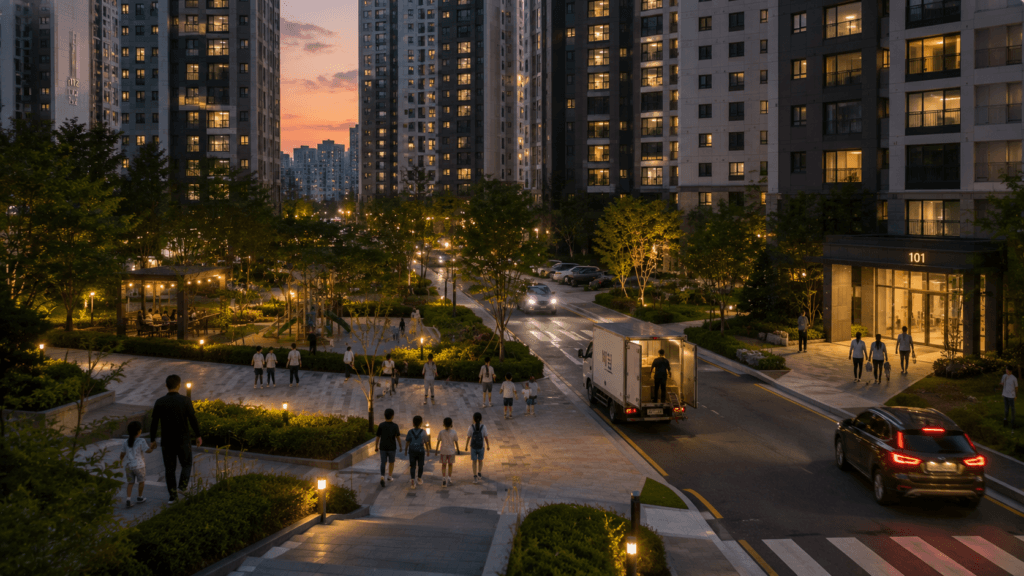
A resident may leave the building in the morning, pass a playground and a senior exercise area, stop at a convenience store near the entrance, walk a child to a nearby school, and reach public transportation without ever feeling far from home.
This does not happen by accident.
Large apartment developments are often planned together with roads, commercial spaces, schools, walking paths, security systems, and public facilities. The result is a form of urban life in which the home extends beyond the walls of the unit.
That helps explain Why Korean Apartment Complexes Feel Like Small Cities.
They are not cities in the literal sense. Yet they often contain enough shared infrastructure to support a large part of everyday life.
This arrangement became especially important as Korea urbanized rapidly.
Millions of people moved toward major cities, and housing had to expand quickly without allowing daily life to collapse under the pressure of population density.
Apartments offered a repeatable answer.
They could house many families on limited land while connecting them to transportation, education, shops, and services. Standardized construction also made it possible to reproduce familiar layouts and living systems across different cities.
For many Korean families, this familiarity became part of the appeal.
Moving to a new apartment did not necessarily mean learning an entirely new way of living. The neighborhood changed, the building changed, and the view changed, but many of the underlying routines remained recognizable.
The entrance still marked a clear boundary between outdoors and indoors.
The floor still played an important role in family life.
Storage was carefully built into the home.
Utility work was pushed into practical spaces.
Shared services operated around the building.
An apartment therefore offered more than shelter.
It offered a predictable framework for everyday life.
That predictability is one reason Why Almost Everyone Lives in Apartments in Korea cannot be answered only by pointing to population density.
Apartments became popular because they fit the way modern Korean cities were developing. Over time, people also adjusted their expectations, routines, and preferences around apartment living.
What began as a housing solution eventually became a cultural norm.
Every Part of the Apartment Has a Purpose
Step inside a typical Korean apartment and many details may appear ordinary.
There is an entrance, a living room, a kitchen, bedrooms, bathrooms, and some form of storage.
But the way these spaces are arranged reveals a particular approach to daily life.
Very little is designed without a practical reason.
The entrance is one of the clearest examples.
Shoes are removed before entering the main living space, creating a strong physical and cultural boundary between the outside world and the home. The built-in shoe cabinet keeps that transition organized while preventing the entrance from becoming crowded.
This is not simply a decorative preference.
As explored in Why Koreans Always Take Off Their Shoes Indoors, the custom reflects ideas about cleanliness, comfort, and the meaning of indoor space.
The home begins where outdoor shoes end.
That distinction matters because Korean homes have traditionally been used much closer to floor level than many Western homes.
People sit, rest, play, and sometimes sleep on the floor. Children spread out toys there. Families may gather around a low table. Even in modern apartments filled with sofas and dining furniture, the floor remains an active part of the living environment.
Ondol heating helped create that relationship.
Instead of warming the room mainly through radiators or forced air, traditional Korean heating warmed the floor itself. Modern systems are more advanced, but the basic experience remains familiar: heat rises gently from beneath the room.
As explained in How Ondol Heating Shaped Korean Home Culture, this changed more than winter comfort.
It influenced posture, furniture, room use, family gathering, and the emotional idea of home as a warm interior space.
Once the floor became central to daily life, other design choices followed naturally.
Heavy carpeting became less necessary. Clean surfaces became easier to maintain. Furniture often stayed relatively low. Open floor areas remained useful rather than feeling unfinished.
That is why Why Korean Homes Rarely Use Carpets is not really a story about flooring alone.
It is part of a larger design logic.
Small choices begin to reveal a much bigger philosophy.
Taking off shoes, warming the floor, using built-in storage, and keeping utility work away from the main living area may appear unrelated.
In reality, they all support the same goal.
They make everyday family life more comfortable, orderly, and efficient.
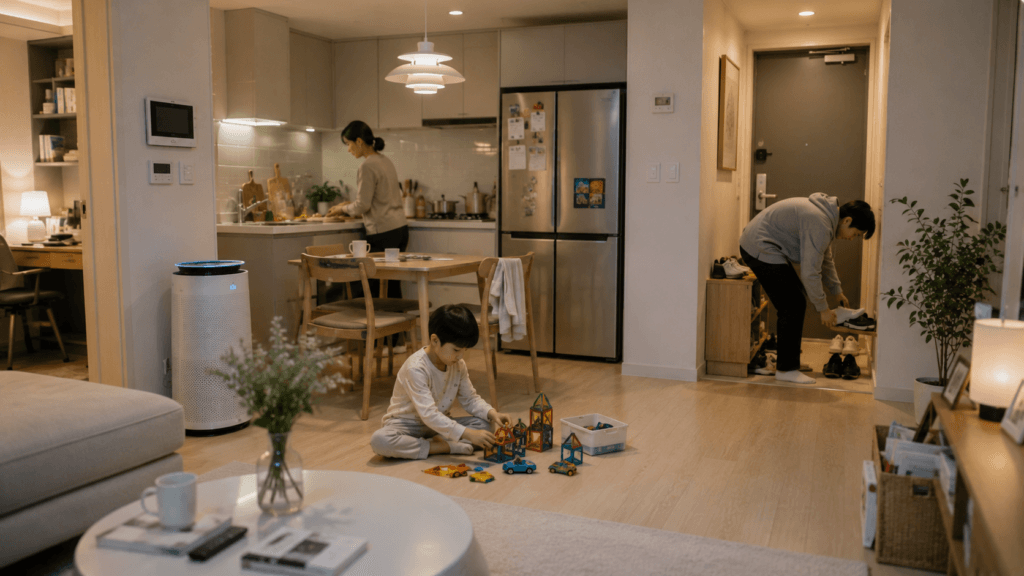
The kitchen follows this same practical logic.
It may not always be large, but it is designed around repeated daily use. Storage is concentrated, appliances are carefully placed, and movement between cooking, washing, and food preparation is kept efficient.
This helps explain Why Korean Kitchens Are Smaller Than You Expect.
The size of the kitchen cannot be judged separately from the rest of the home.
Korean households often rely on dense storage, specialized appliances, frequent grocery access, food delivery, and nearby commercial services. A smaller kitchen may still work effectively because the entire living environment supports it.
Even the kimchi refrigerator belongs to this wider system.
To someone unfamiliar with Korean households, a second refrigerator devoted largely to fermented food may seem excessive.
Inside the home, however, it solves several practical problems at once.
It manages temperature, separates strong aromas, stores different batches, and supports a food tradition that changes over time rather than remaining chemically still.
That is why Why Korean Families Still Use Kimchi Refrigerators is ultimately not about owning an unusual appliance.
It is about adapting modern technology to the rhythms of everyday Korean food culture.
The same pattern appears in spaces that visitors may barely notice.
A small utility area behind the kitchen may hold laundry machines, cleaning supplies, drying racks, recycling, or additional storage. These activities are necessary, but they do not need to dominate the visible living space.
As explored in Why Korean Apartments Have Hidden Utility Spaces Behind the Kitchen, practical household work is often moved to the edge of the home so the main rooms can remain calm and uncluttered.
This ability to separate visible living from invisible maintenance is one of the defining strengths of Korean apartment design.
The apartment does not eliminate the work of daily life.
It gives that work a place to happen.
Apartment Living Changed Everyday Life
The influence of Korean apartments doesn’t end at the front door.
Over time, apartment living has changed the way people shop, receive deliveries, organize their homes, and even interact with their neighbors.
Many of these habits feel perfectly ordinary to Korean residents.
Visitors, however, often notice that daily life seems unusually smooth.
Packages arrive quickly.
Food delivery reaches almost every neighborhood.
Apartment entrances remain organized despite hundreds of households sharing the same building.
Technology quietly handles tasks that once required far more effort.
None of this developed overnight.
As apartment living became the norm, services gradually adapted to support it.
The result is a lifestyle in which the apartment functions as the center of a highly connected everyday system.
Food delivery is one of the clearest examples.
Ordering dinner with a smartphone may be common in many countries today, but Korea’s apartment-centered cities allow delivery services to operate with remarkable speed.
Drivers can serve dozens of households within a relatively small area because apartment complexes place large numbers of customers close together.
This is one reason How Delivery Culture Changed Everyday Life in Korean Homes goes beyond restaurant apps.
The apartment itself made this level of convenience possible.
The same is true for package deliveries.
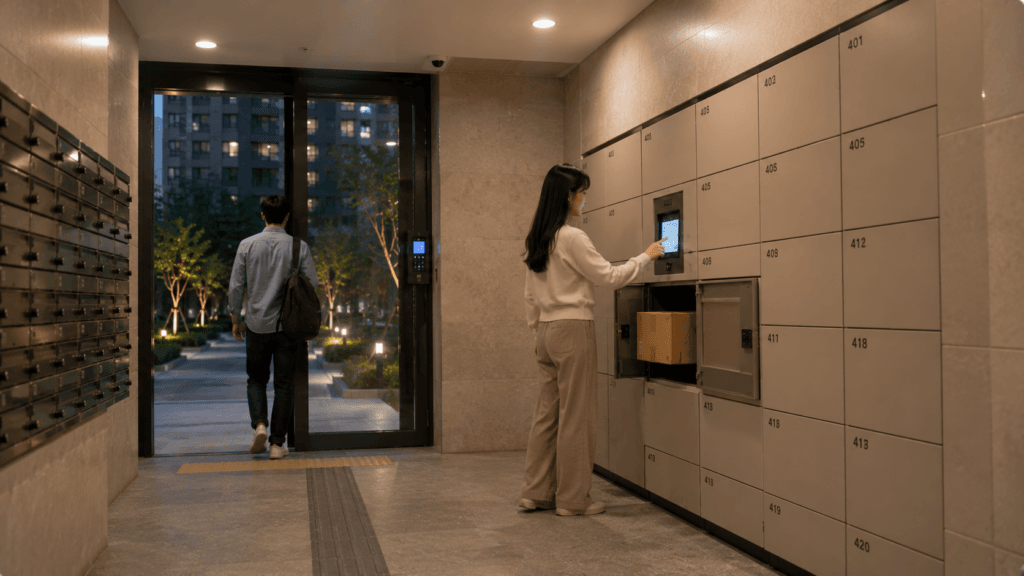
Online shopping has become part of daily life almost everywhere, but Korean apartment buildings are often designed with secure entrances, parcel lockers, management offices, and delivery procedures that help thousands of packages reach residents every day.
As explained in Why Package Delivery Works So Well in Korean Apartment Buildings, the efficiency comes from both technology and thoughtful building design.
Living in a smaller apartment has also encouraged people to become surprisingly creative with space.
Instead of treating limited square footage as a disadvantage, many households rely on built-in storage, multifunctional furniture, and careful organization to make compact homes feel far larger than their actual size.
This is why How Korean Apartments Make Small Spaces Feel Bigger is less about interior decoration and more about everyday problem-solving.
The goal isn’t simply to fit more furniture inside.
It’s to make the space feel comfortable without creating visual clutter.
Technology has gradually become another invisible layer of apartment living.
Modern apartment buildings often include digital entry systems, smart parking, energy monitoring, parcel notifications, and mobile applications that allow residents to control different parts of their homes remotely.
As explored in Why Smart Homes Are Becoming Standard in Korean Apartments, these features rarely feel futuristic to residents anymore.
They simply reduce small inconveniences that occur every day.
Whether unlocking the building entrance, checking visitor access, or managing household systems from a phone, technology increasingly works quietly in the background rather than demanding attention.
Why Apartments Changed Korean Society
Eventually, apartments stopped being only a housing solution.
They began influencing the rhythm of Korean society itself.
Children often grow up playing with friends who live only a few floors away.
Parents meet while walking through shared courtyards or waiting near schools.
Older residents exercise in neighborhood parks built inside apartment complexes before meeting friends at nearby cafés.
Even people who rarely know every neighbor by name still share many parts of everyday life through common spaces.
The apartment creates a quiet sense of community without requiring constant interaction.
It also shapes the daily schedule.
Commutes become shorter because transportation is nearby.
Shopping becomes easier because supermarkets and convenience stores are integrated into surrounding neighborhoods.
Exercise often happens inside or around the complex rather than requiring a separate trip across the city.
This helps explain why Why Korean Neighborhoods Are Designed for Everyday Convenience is closely connected to apartment living itself.
The neighborhood and the apartment are designed to support one another.
Apartment culture has also influenced expectations about modern housing.
Many buyers now compare schools, transportation, landscaping, security systems, fitness facilities, playgrounds, and community amenities as naturally as they compare the size of the apartment itself.
The value of a home increasingly reflects the quality of the surrounding environment, not simply the walls inside the unit.
In that sense, Korean apartments have become small ecosystems.
People don’t choose only where they will sleep.
They choose how they want to live.
Why Understanding Korean Apartments Helps You Understand Korea
Many visitors first notice Korean apartments because of their appearance.
The towers seem similar.
The neighborhoods feel carefully organized.
The buildings stretch across nearly every major city.
Yet after spending time inside them, a different picture begins to emerge.
Every feature exists for a reason.
The heated floor encourages families to use living spaces differently.
Removing shoes protects a home designed around floor-level living.
Compact kitchens reflect efficient daily routines rather than limited ambition.
Utility balconies quietly separate household work from family life.
Smart technology simplifies ordinary tasks instead of drawing attention to itself.
Even delivery systems, neighborhood design, and community spaces become easier to understand once viewed through the lens of apartment living.
This is why Korean apartment culture is ultimately about much more than architecture.
It reflects how modern Korea balances density with comfort, efficiency with community, and tradition with innovation.
Once you begin noticing how apartments shape everyday routines, many other parts of Korean life start making sense as well.
The buildings may all look similar from a distance.
But together, they tell the story of how millions of people experience home in contemporary Korea.
Frequently Asked Questions
Why do so many people live in apartments in Korea?
Rapid urbanization, limited land in major cities, and well-planned residential developments made apartments the most practical and convenient housing option for millions of Korean families.
Are Korean apartments all the same?
No. While many share similar layouts, apartment sizes, amenities, technology, and neighborhood designs vary widely depending on the city, developer, and price range.
Why do Korean apartments seem so convenient?
Most apartment complexes are planned together with transportation, schools, parks, shopping areas, and community facilities, allowing many daily activities to happen close to home.
What makes Korean apartment culture different?
Rather than viewing an apartment as just a private residence, Korean apartment culture combines home design, neighborhood planning, technology, and shared infrastructure into one connected lifestyle.
Can foreigners experience Korean apartment culture?
Yes. Many foreign residents live in Korean apartments and quickly become familiar with everyday routines such as removing shoes indoors, using delivery services, and enjoying neighborhood-centered living.
Continue Exploring
If you enjoyed this article, you may also like:
- Why Almost Everyone Lives in Apartments in Korea
- Inside a Typical Korean Apartment: What Every Room Reveals About Korean Life
- What Is an Officetel? Korea’s Unique Apartment Alternative
- Can Foreigners Rent an Apartment in Korea? What to Expect Before You Move
- Jeonse vs Monthly Rent: Why Korea Created a Different Housing System
- Why Korean Apartment Complexes Feel Like Small Cities